Newer version: For the updated release, see our Qwen3.8-27B analysis.
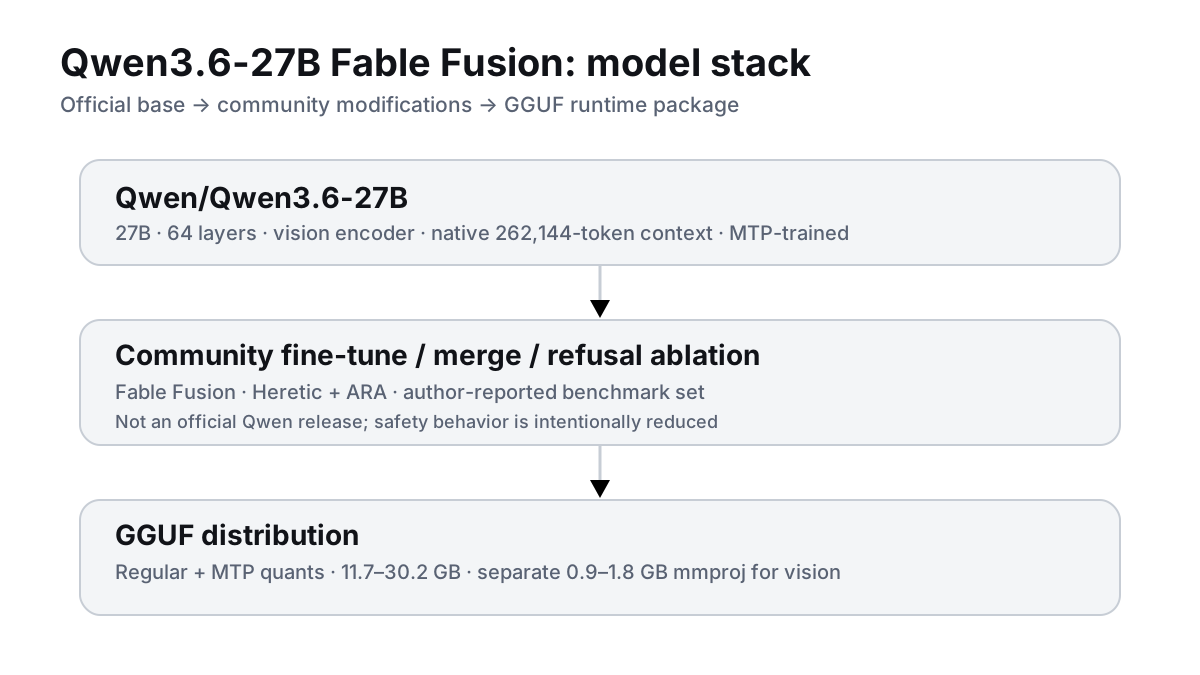
Fable Fusion 711 is a community GGUF based on Qwen3.6-27B, with image input, reduced refusals, several quantization levels and optional multi-token-prediction files.12
The repository offers regular, MTP, LOW-MTP and AMD-labelled files plus separate projectors, so the file list matters more than the long marketing name when choosing a Mac download.3
For a Mac with 32 GB of unified memory, download the regular Q4_K_M GGUF first.345
Its 18.0 GB file leaves meaningfully more room than Q5, Q6 or Q8 variants for macOS, runtime buffers, KV cache and ordinary applications. A 24 GB Mac can run the model with stronger compression, while 48 GB and 64 GB systems can trade spare memory for higher precision, longer context or vision.345
The optional MTP files are not an automatic upgrade on Apple Silicon. Treat them as an experiment and keep them only when a controlled comparison shows better practical throughput.1
The answer in 30 seconds
| Your Mac | Best starting file | What to expect |
|---|---|---|
| 16 GB | Choose a smaller model | Possible only with severe compromises; not a sensible everyday fit |
| 24 GB | Regular IQ3_M | Usable with a modest context and low background memory pressure |
| 32 GB | Regular Q4_K_M | Best overall balance and recommended starting point |
| 48 GB | Q5_K_M or Q6_K | More quality and enough room for useful context or vision |
| 64 GB+ | Q6_K or Q8_0 | Maximum precision is possible, but Q6_K may remain the smarter trade |
For image input, load the matching mmproj file from the same repository. For MTP, compare the regular and MTP versions under identical conditions before deciding.34
Why this model is worth a closer look
The official Qwen3.6-27B base is a dense 27-billion-parameter vision-language model. Qwen documents 262,144 context tokens plus text and image support; the Fable model card describes its release as a community version of that checkpoint.671
That combination gives the model an appealing local profile:
- enough parameters for more demanding writing, reasoning and document tasks;
- vision support through a separate multimodal projector;45
- quantizations ranging from roughly 11.7 GB to 30.2 GB;3
- regular and MTP-capable GGUF variants;3
- compatibility with llama.cpp and applications built around it;14
- an Apache 2.0 repository license.289
It is important to keep the label accurate: Fable Fusion 711 is not an official Qwen release. It is a community model hosted by DavidAU and based on the official Qwen3.6-27B checkpoint. The HF metadata lists the repository as Apache 2.0; that does not settle rights to training data or every possible use.289 For memory planning, see the Mac unified-memory guide.
What the unusually long name means
The repository name combines several independent properties:
Qwen3.6-27B: the official base checkpoint;Fable Fusion: the community tuning and merge label;711: the uploader-reported ARC Challenge result of 0.711;1UncensoredandHeretic: reduced-refusal tuning and ablation methods (the Heretic tool documents the ablation approach in its own repository; the underlying methods are described, among others, by Arditi et al. and Carleo et al.);101112MTP: optional multi-token-prediction weights;GGUF: the local model format used by llama.cpp and many desktop applications.
The number 711 is therefore not a version number, parameter count or independent quality rating. It is one reported evaluation result whose full reproduction configuration is not published on the model card.1
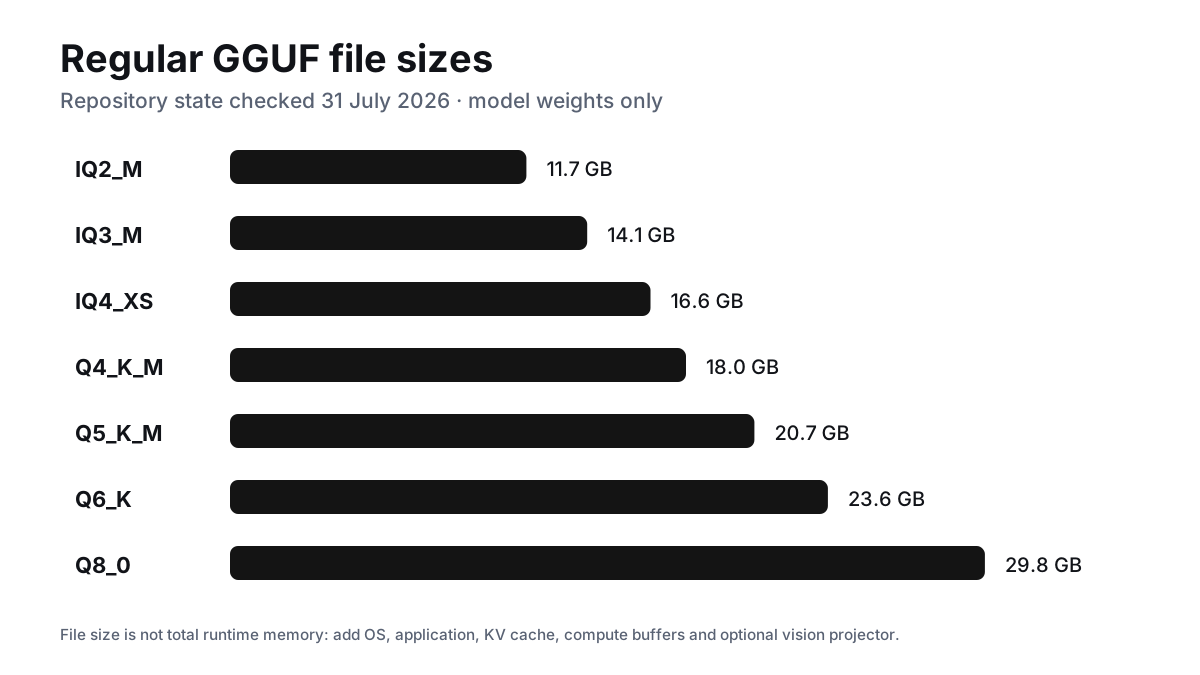
Every relevant GGUF size
| Quantization | Regular | MTP | MTP overhead |
|---|---|---|---|
| IQ2_M | 11.7 GB | 12.1 GB | +0.4 GB |
| IQ3_M | 14.1 GB | 14.5 GB | +0.4 GB |
| IQ4_XS | 16.6 GB | 17.0 GB | +0.4 GB |
| Q4_K_S | 17.1 GB | 17.5 GB | +0.4 GB |
| IQ4_NL | 17.3 GB | 17.8 GB | +0.5 GB |
| Q4_K_M | 18.0 GB | 18.5 GB | +0.5 GB |
| Q5_K_S | 20.2 GB | 20.6 GB | +0.4 GB |
| Q5_K_M | 20.7 GB | 21.2 GB | +0.5 GB |
| Q6_K | 23.6 GB | 24.0 GB | +0.4 GB |
| Q8_0 | 29.8 GB | 30.2 GB | +0.4 GB |
The repository also includes AMD-labelled MTP variants, LOW-MTP files and separate vision projectors.3 The main lesson is more important than any individual number: file size is not total memory use.
The loaded model also needs room for macOS, the inference runtime, compute buffers, KV cache, temporary allocations, image embeddings, a multimodal projector and any other applications you keep open.45
Which quantization fits your Mac?
16 GB: technically possible, practically wrong
Even IQ2_M consumes 11.7 GB for the weights alone. Once the operating system, runtime and KV cache are included, there is little reserve left. The model may start under aggressive settings, but quality and stability compromises make a smaller model the better everyday choice.345
24 GB: the realistic entry point
Start with IQ3_M at 14.1 GB. It preserves more working memory than the 4-bit files and gives the runtime a better chance of staying responsive.345
Use a modest context, close memory-heavy applications and test text-only inference before adding vision or MTP. IQ4_XS may fit, but it leaves less room for growing conversations and image workloads.
32 GB: the strong default
The regular Q4_K_M at 18.0 GB is the strongest default. It offers a useful quality level without consuming so much memory that ordinary Mac usage, moderate context and runtime buffers become uncomfortable.345
Q5_K_M can fit, but the extra precision reduces the memory available for the parts of the workload users actually feel: longer prompts, larger documents, vision and system responsiveness.
A sensible first configuration is:
- regular Q4_K_M;
- 8K or 16K context;
- text-only inference first;
- one active generation;
- MTP and vision tested separately.
48 GB: quality without constant compromise
Q5_K_M and Q6_K become practical. At this point, the question is no longer simply whether the model fits. You can decide whether the spare memory should fund higher weight precision, a larger KV cache, image input or parallel work.
For many users, Q5_K_M with generous headroom will feel better than a larger file running close to the limit.
64 GB and above: Q8_0 fits, but Q6_K may still win
Q8_0 at 29.8 GB is realistic on a 64 GB Mac. That does not make it automatically superior. The visible quality difference between Q6_K and Q8_0 may be small for many prompts, while Q6_K leaves more memory for context, vision and other applications.345
Run your real tasks through both before keeping the larger download.
The estimates above are conservative compatibility estimates based on the published file sizes and the additional memory required by local inference. They are not original speed benchmarks. Runtime version, context length, KV-cache type, batch size, vision and parallelism can change the result.345 The Mac unified-memory guide explains the memory model in more detail.
Regular GGUF or MTP?
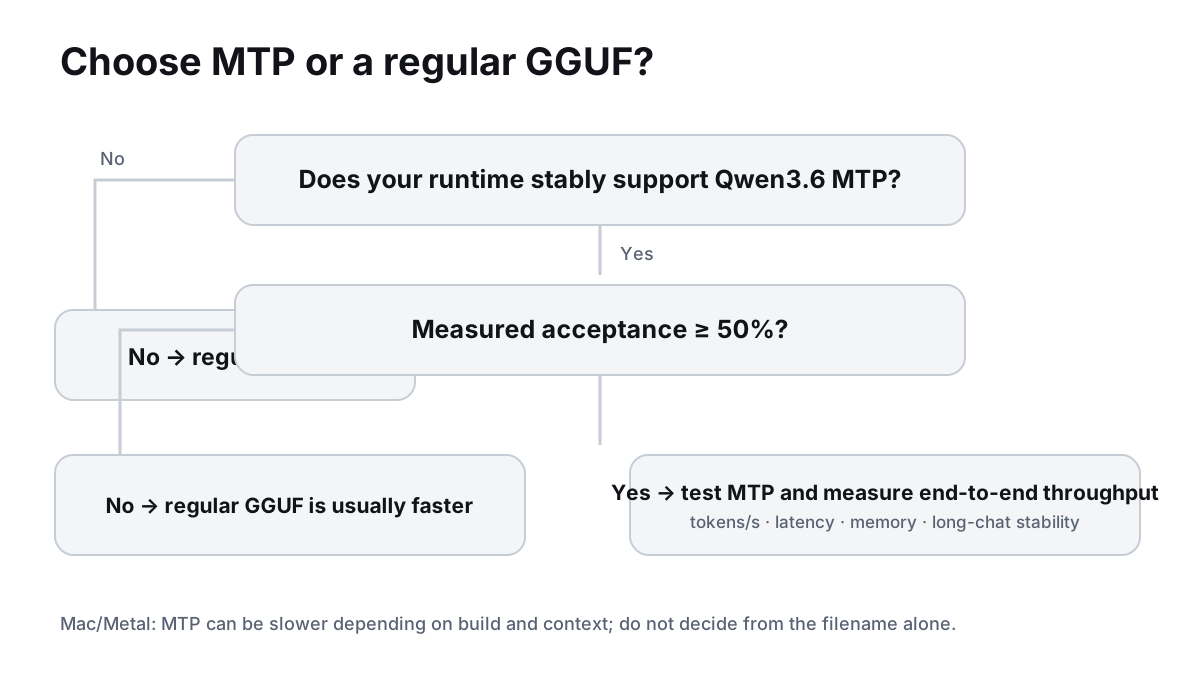
MTP stands for multi-token prediction. The Fable model card describes separate MTP GGUFs with additional MTP tensors; a compatible runtime can use those predictions as a speculative draft.1
The caveat matters: on Apple Silicon, MTP can add memory use, create a second draft context and lose its advantage when acceptance falls or the workload becomes more complex. One closed llama.cpp issue documents an MTP+vision OOM/slot error in a specific branch and environment using Qwen3.6-35B-A3B; that is not evidence about every current Mac build.13 Issue threads 23371, 23752, 23577 and 23302 plus discussion 23738 document further community-reported MTP, slot and server failure cases.1415161718
The uploader recommends switching back to regular GGUFs when acceptance for two proposed tokens falls below 50 percent. Treat that as an uploader heuristic, not an Apple-Silicon measurement or a guarantee.1
A useful MTP test
Compare the regular and MTP versions with:
- the same quantization;
- the same context length;
- the same sampling settings;
- the same short, long and multi-step prompts;
- a fresh session for each run.
Record time to first token, generation speed, acceptance rate, peak memory, output quality and any repetitions or errors. Keep MTP only when the complete experience is better—not merely one displayed tokens-per-second number.
Vision: why you need a second file
The Qwen3.6 base is multimodal. In the GGUF ecosystem, the language model and multimodal projector are distributed separately. Text-only use requires the main GGUF; image input also requires a matching mmproj file from the same repository.645
llama-server \
  -m Qwen3.6-27B-Fable-Fusion-711-Q4_K_M.gguf \
  --mmproj mmproj-F16.gguf \
  -c 8192
Do not mix a projector from another base model. Vision consumes additional memory, so 24 GB users should treat it cautiously. On a 32 GB Mac, establish a stable Q4_K_M text setup before combining vision with MTP.45
What do the reported benchmarks prove?
The model card labels the seven values “BENCHMARKS by Nightmedia”: Fable Fusion is above the compared Qwen3.6-27B base on six tasks, with an equal BoolQ result.1


| Task | Fable Fusion 711 | Qwen3.6-27B base | Reported difference |
|---|---|---|---|
| ARC Challenge | 0.711 | 0.647 | +6.4 pp |
| ARC Easy | 0.879 | 0.803 | +7.6 pp |
| BoolQ | 0.910 | 0.910 | 0.0 pp |
| HellaSwag | 0.790 | 0.773 | +1.7 pp |
| OpenBookQA | 0.514 | 0.450 | +6.4 pp |
| PIQA | 0.823 | 0.806 | +1.7 pp |
| WinoGrande | 0.763 | 0.742 | +2.1 pp |
| Unweighted mean | 0.770 | 0.733 | +3.7 pp |
The mean is calculated from the published values; it is not a standardized aggregate score. The available results also do not fully disclose the evaluation-harness revision (typically lm-evaluation-harness), task configuration, chat template, seeds, quantization or raw outputs.119
These tasks mainly cover knowledge and multiple-choice reasoning. They do not establish superior coding, creative writing, vision, long-context or agent performance.
The defensible conclusion is:
The model card reports encouraging gains, but a broad quality advantage has not yet been independently demonstrated under a fully reproducible configuration.
October 8 decision: use the older Fable tune deliberately
This is DavidAU’s community merge, not an official Qwen3.8 checkpoint and not the base Qwen3.6 instruction model. It remains interesting for evaluating refusal behavior or a specific creative-writing workload; for a new, general-purpose model install, compare the current Qwen3.8-27B checkpoint before spending storage and RAM on a 2026 Qwen3.6 derivative. Do not interpret the community card’s seven Nightmedia-reported multiple-choice scores as verified agent reliability, tool-call correctness, coding quality or image understanding.
Download, model runtime and context must be recorded together. The repository’s current Hugging Face page documents a llama serve -hf ...:Q4_K_M launcher; depending on how llama.cpp is installed, the executables may instead be named llama-server and llama-cli. Check --help against your installed version rather than blindly copying the command prefix. On a Mac, benchmark a regular (non-MTP), text-only Q4_K_M at a modest 4K context first, then add the matching vision projector and MTP experiments separately.
A minimal local benchmark should record: repository commit/file hash, exact GGUF quantization, llama.cpp revision, macOS/Apple chip/unified memory, requested and actual context, prompt processing and decoding times, swap/memory pressure, and whether the output respected your tool schema. Nothing on the community model card supplies a measured M-series speed guarantee. Even the advertised 262K model ceiling does not mean 262K is usable with the 18GB Q4 package on a 32GB Mac.
Install with llama.cpp
For the regular Q4_K_M version:
llama-cli -hf DavidAU/Qwen3.6-27B-Fable-Fusion-711-Uncensored-Heretic-NM-DAU-NEO-MAX-MTP-GGUF:Q4_K_MTo start a local server:
llama-server -hf DavidAU/Qwen3.6-27B-Fable-Fusion-711-Uncensored-Heretic-NM-DAU-NEO-MAX-MTP-GGUF:Q4_K_MRecord the exact llama.cpp build when comparing results. If MTP or vision behaves incorrectly, return to the regular text-only configuration first. The server options are documented in the llama.cpp server README.20
Install with LM Studio
- Open LM Studio and search for the full Hugging Face repository.
- Download the regular Q4_K_M file first.
- Start with an 8K context.
- Verify that the prompt template is detected correctly.
- Test several text prompts.
- Add the matching vision projector only after text inference is stable.
- Compare the MTP version in a separate session.
Do not begin with the model’s theoretical maximum context. Architectural context support does not mean that a 24 GB or 32 GB Mac can use the maximum comfortably.
Sampling settings worth testing
The model card suggests temperature 1.0, top-p 0.95 and top-k 20 for thinking-oriented tasks, and a lower temperature around 0.6 for more precise coding work. Use these as test presets rather than universal defaults.1
Check the model for factual hallucinations, repetition, JSON stability, code that passes actual tests and differences between thinking and non-thinking behaviour. A model that refuses less is not automatically a model that answers more accurately.
Who should download it?
Fable Fusion 711 is best suited to users who:
- own a Mac with at least 32 GB of unified memory;
- want a capable general-purpose local model;
- value reduced refusals for legitimate creative or research workflows;
- want optional image input;
- are willing to compare community fine-tunes carefully;
- understand that model-card benchmarks are an invitation to test, not a final verdict.
Who should skip it?
Choose another model when your Mac has only 16 GB, when speed matters more than maximum local capability, when you require independently reproduced benchmarks or when you do not want to manage quantizations, projectors and runtime versions.
A smaller model at a healthy quantization often delivers a better daily experience than a larger model running at the edge of available memory.
“Uncensored” still requires guardrails
Reduced refusal behaviour can be useful for fiction, roleplay and legitimate security research. It also removes a protection layer. Do not connect the model directly to unrestricted shell commands, browser automation, file deletion, confidential repositories or a publicly reachable API.
Bind local services to 127.0.0.1, restrict tools with allowlists and validate outputs before executing them. Local does not automatically mean safe.
Community package with a clear niche use case
Fable Fusion 711 is a community package around a 27B Qwen base with image input, reduced refusals and optional MTP files.613
Its clearest use case is a 32 GB Apple Silicon Mac running the regular Q4_K_M GGUF. That combination preserves the model’s appeal without spending nearly all unified memory on weight precision. On 24 GB, IQ3_M is the sensible experiment. On 48 GB and 64 GB, Q5_K_M or Q6_K often provides a better overall system balance than blindly selecting Q8_0.
The reported benchmarks are third-party evidence, not an independent Mac benchmark.1 The real decision should come from your own prompts under identical runtime, context and quantization settings. For most Mac users, the winning configuration will not be the largest or most exotic file. It will be the one that leaves enough memory for the work around the model.345
Sources
Footnotes
-
https://huggingface.co/DavidAU/Qwen3.6-27B-Fable-Fusion-711-Uncensored-Heretic-NM-DAU-NEO-MAX-MTP-GGUF ↩ ↩2 ↩3 ↩4 ↩5 ↩6 ↩7 ↩8 ↩9 ↩10 ↩11 ↩12 ↩13
-
https://huggingface.co/api/models/DavidAU/Qwen3.6-27B-Fable-Fusion-711-Uncensored-Heretic-NM-DAU-NEO-MAX-MTP-GGUF ↩ ↩2 ↩3
-
https://huggingface.co/api/models/DavidAU/Qwen3.6-27B-Fable-Fusion-711-Uncensored-Heretic-NM-DAU-NEO-MAX-MTP-GGUF/tree/main?recursive=true ↩ ↩2 ↩3 ↩4 ↩5 ↩6 ↩7 ↩8 ↩9 ↩10 ↩11 ↩12 ↩13 ↩14
-
https://github.com/ggml-org/llama.cpp/blob/master/docs/multimodal.md ↩ ↩2 ↩3 ↩4 ↩5 ↩6 ↩7 ↩8 ↩9 ↩10 ↩11 ↩12 ↩13 ↩14
-
https://github.com/ggml-org/llama.cpp/blob/master/tools/quantize/README.md ↩ ↩2 ↩3 ↩4 ↩5 ↩6 ↩7 ↩8 ↩9 ↩10 ↩11 ↩12
-
https://github.com/ggml-org/llama.cpp/blob/master/tools/server/README.md ↩
Frequently Asked Questions
Is Qwen3.6 Fable Fusion 711 an official Qwen model?
No. It is a community fine-tune and merge by DavidAU based on Qwen/Qwen3.6-27B.
Which GGUF should I use on a 32 GB Mac?
Start with the regular 18.0 GB Q4_K_M file. It offers the most practical balance of model quality, context capacity and system headroom.
Can Fable Fusion 711 run on a 24 GB Mac?
Yes, but IQ3_M is the safer starting point. Keep the context modest and test text-only inference before enabling vision or MTP.
Is the MTP version faster on Apple Silicon?
Not necessarily. Compare it directly with the regular file using identical prompts and settings, and keep MTP only when overall throughput improves.
What does 711 mean?
It refers to the uploader-reported ARC Challenge score of 0.711, not a model version or parameter count.