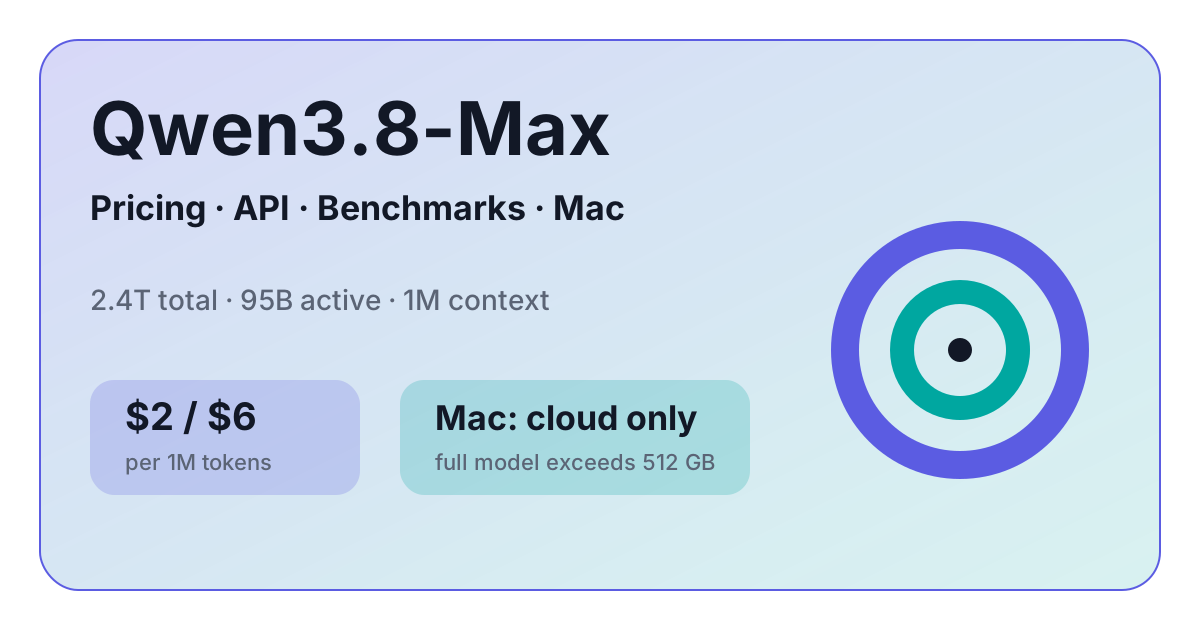
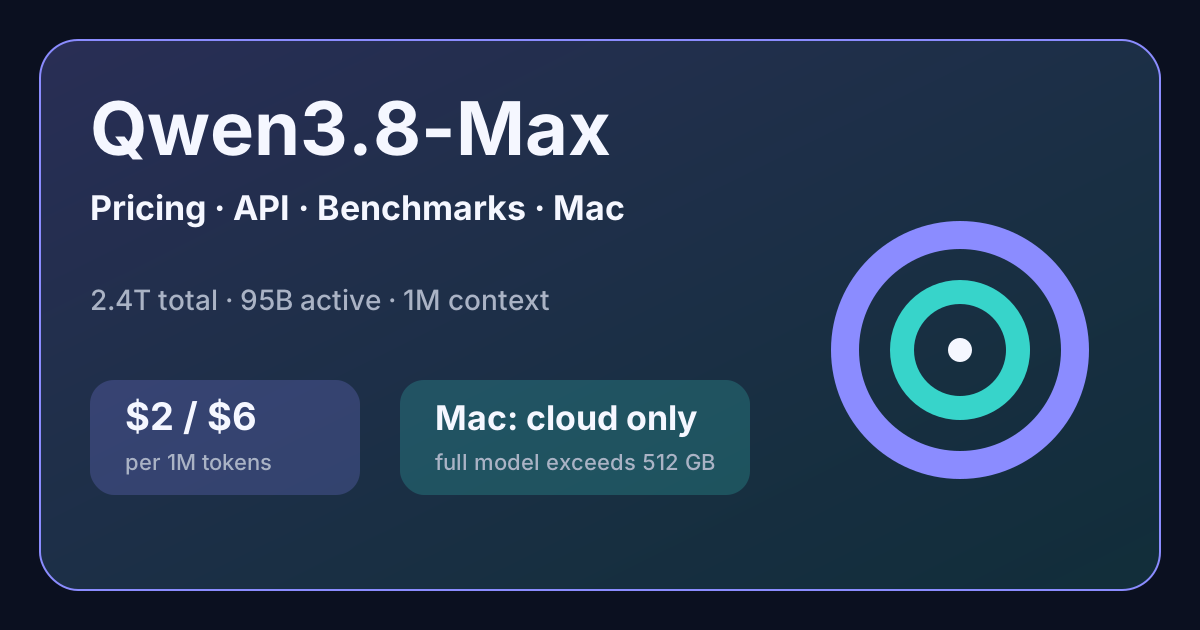
Historical snapshot: August 3, 2026. Qwen3.8-Max is Alibaba’s new flagship Mixture-of-Experts model with 2.4 trillion total parameters and 95 billion active parameters per token. QwenCloud lists a 1-million-token context window, $2 per million input tokens, and $6 per million output tokens. The weights were promised for the following week but were not yet available at that snapshot. A full 2.4T checkpoint would not fit in the 512 GB unified-memory ceiling of today’s largest Mac, even at a theoretical 2-bit raw weight size.
Update: August 25, 2026. The official Qwen organization now lists the Qwen3.8-27B checkpoint, the full Qwen3.8-2.4T-A95B checkpoint, and an official FP8 variant. The Max-class open weights are therefore public. The open 2.4T checkpoint is text-only, requires thinking, and does not support multimodal input; the hosted Qwen3.8-Max version adds vision, non-thinking, and built-in tools. Its custom license has additional conditions. The cloud figures below remain the historical August 3 snapshot; current regional Model Studio prices are added immediately before the pricing table.
Verified snapshot
| Item | Status on August 3, 2026 |
|---|---|
| Official product name | Qwen3.8-Max |
| Official Alibaba model ID | qwen3.8-max |
| Architecture | Mixture of Experts |
| Parameters | 2.4T total, 95B active per token |
| Inputs / output | text, image, video / text |
| Context | 1M; 991K max standard input; 131K max output |
| Hosted price | $2 input / $6 output per 1M tokens |
| Open weights | released: 2.4T-A95B and FP8; custom Qwen3.8-Max license |
| Single-Mac deployment | not practical for the full checkpoint |
Why the “95B active” number needs context
Qwen3.8-Max routes each token through only part of its 2.4-trillion-parameter expert pool. Alibaba says 95 billion parameters are active for a token. That can reduce inference compute compared with a dense 2.4T model, but it does not turn the checkpoint into a 95B download. Unless a future runtime streams experts from storage or distributes them across machines, the complete expert set still has to be available.
This distinction matters for every local-hardware estimate. Treating Qwen3.8-Max as a normal 95B model would understate raw weight storage by roughly 25 times.


Preview versus production release
The qwen3.8-max-preview endpoint appeared on July 19 through Alibaba’s token plans and Qoder.1 Alibaba’s documentation warned that the preview could be updated, removed, or replaced. The production qwen3.8-max launch followed on August 3, 2026 (general availability; announced August 2).12
At the August 3 snapshot, there was no final weight repository, download manifest, model card, or license to verify. “Open weights announced” was therefore accurate for that historical date; the official 2.4T3 and FP84 repositories are public now under the custom Qwen3.8-Max license.5
Context, modalities, and API features
QwenCloud lists text, image, and video input with text output.6 Its headline context window is 1 million tokens, with more specific limits of 991K standard input, 983K thinking-mode input, 131K output, and up to 262K reasoning tokens.7 These caps apply separately, not additively.
The hosted service advertises function calling, structured outputs, context caching, and web search,89 Built-in Responses API tools include a code interpreter, web extractor, web search, and image-search tools. Published service limits are 2 million tokens per minute and 15,000 requests per minute.6
Alibaba documents OpenAI-compatible, Anthropic-compatible, and DashScope access across multiple regions, including Beijing, Singapore, Tokyo, Frankfurt, and Virginia.10 Enterprises should still validate the exact regional endpoint, retention terms, data residency, and contractual controls before sending sensitive data.
Qwen3.8-Max API pricing
Current region-specific rates, checked October 11, 2026: Alibaba Model Studio lists $1.65 input / $4.951 output per million tokens for US Virginia (Global), versus $2.00 input / $6.00 output for Singapore (International). These are different deployment scopes, not currency conversion. Alibaba pricing.
| Qwen3.8-Max deployment | Standard input / 1M | Standard output / 1M |
|---|---|---|
| US Virginia Global | $1.65 | $4.951 |
| Singapore International | $2.00 | $6.00 |
Worked example, excluding cache/tools: 1M input + 200,000 output cost $2.6402 in Virginia (1.65 + 0.2 × 4.951), versus $3.20 in Singapore (2 + 0.2 × 6), a difference of $0.5598. At 20M input + 5M output, costs are $57.755 vs $70.00. The $2/$6 calculator and existing pricing diagram below apply specifically to the QwenCloud/Singapore tier.


Before sending requests: The sample hostname dashscope-intl.aliyuncs.com does not establish that processing happens in Virginia. Verify region, workspace, deployment scope, cache tiers and provider data handling independently.
Current regional note (August 25, 2026): The [current Alibaba Model Studio page]11 lists $1.65 input / $4.951 output per 1M tokens for Frankfurt (Germany), the US, Tokyo (Japan), Hong Kong, and Beijing; the Singapore endpoint and the current [QwenCloud model page]6 still show $2/$6. The table below therefore remains explicitly a QwenCloud/international snapshot from August 3. Check region, cache tier, taxes, and contract terms before production use.
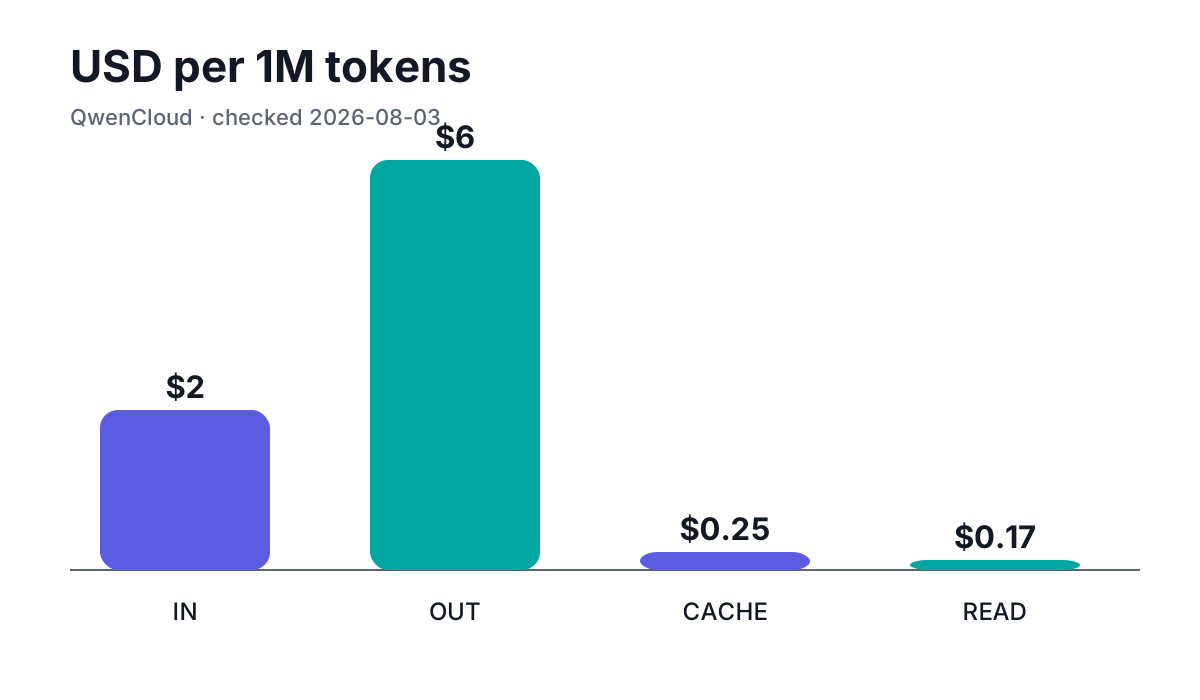
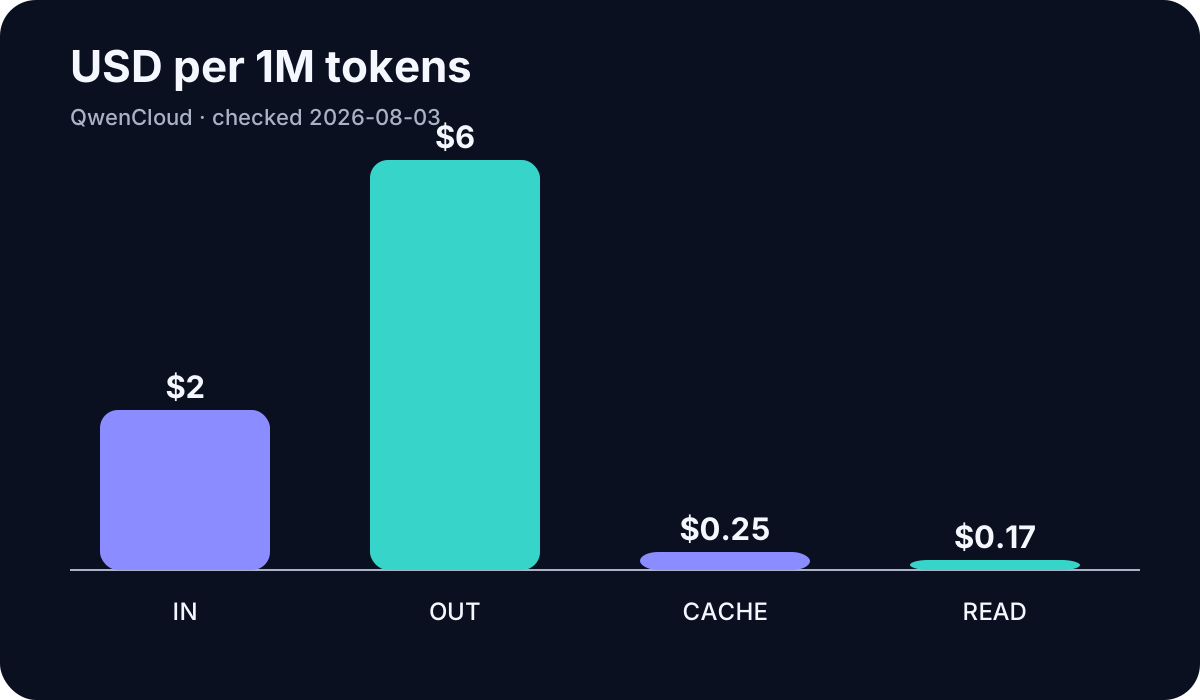
QwenCloud’s list prices on August 3 are:6
| Billing unit | USD per 1M tokens |
|---|---|
| Standard input | $2.00 |
| Output | $6.00 |
| Implicit cached input | $0.25 |
| Explicit cache creation | $2.50 |
| Explicit cache read | $0.17 |
Source: QwenCloud. Taxes and third-party provider markups are not included.
New pricing tier (October 3, 2026): OpenRouter now also lists Qwen3.8-Max as qwen/qwen3.8-max-prime (created September 23, 2026) with 1,000,000 tokens of context and $4.00 input / $12.00 output per 1M tokens. The dated qwen/qwen3.8-max-0902 entry stays at $2/$6. According to provider analysis, Max Prime uses the same weights as Qwen3.8-Max and differs in speed and price, not as a new model. (OpenRouter)
The calculation is:
cost = input_M×2 + output_M×6 + implicit_cache_M×0.25 + cache_create_M×2.50 + cache_read_M×0.17
Example workloads
| Workload | Assumption | Calculated cost |
|---|---|---|
| small | 1M input + 0.2M output | $3.20 |
| medium | 20M input + 5M output | $70 |
| heavy | 200M input + 50M output | $700 |
A repeated 100M-token prefix billed entirely as implicit cache hits would cost $25 instead of $200 in standard input charges, a theoretical $175 difference. Real savings depend on cache eligibility and prefix matching.
Can the full model run locally on a Mac?
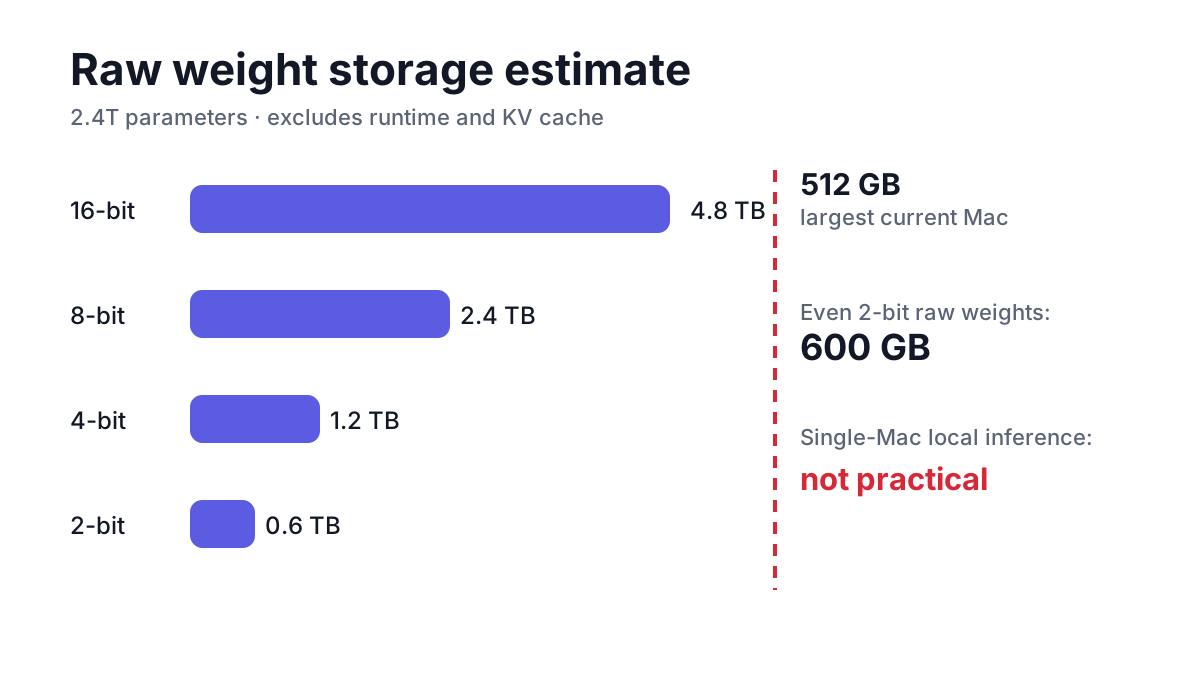
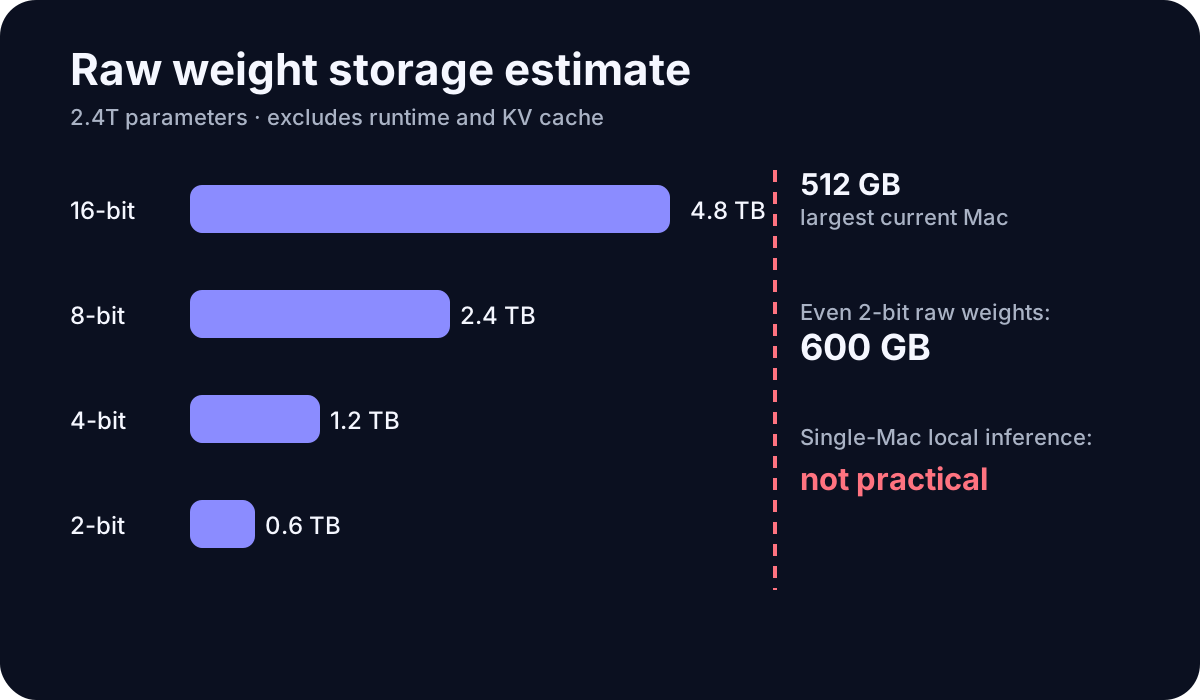
Raw weight storage is parameter count multiplied by bits per parameter, divided by eight:
| Weight format | Raw size for 2.4T parameters | Fits in 512 GB? |
|---|---|---|
| 16-bit | 4.8 TB | no |
| 8-bit | 2.4 TB | no |
| 4-bit | 1.2 TB | no |
| 2-bit | 600 GB | no |
These figures exclude quantization metadata, runtime buffers, routing structures, and KV cache. Apple’s M3 Ultra Mac Studio tops out at 512 GB of unified memory.1213 The full Qwen3.8-Max checkpoint therefore does not fit on a single current Mac even under the unrealistic assumption of clean 2-bit weights with zero overhead.
The model could eventually be experimented with through multi-node sharding, SSD offload, or expert streaming. Those are specialized distributed systems, not the responsive local-LLM workflow most Mac users expect. Qwen3.8-27B remains the relevant local target for Mac testing, and Qwen3.8-Flash is the cheaper API variant of the same generation.14 The full 2.4T checkpoint is now public, but it is still too large for a single Mac even under the theoretical 2-bit calculation; repository availability is not a local feasibility guarantee. First conversions of the 27B model exist as FP8,15 MLX 4-bit16 and an Unsloth GGUF;17 actual runtime behavior on a specific Mac still needs measurement.
What early benchmarks do—and do not—show
On Arena’s Software & IT Services text leaderboard dated August 1, Qwen3.8-Max was provisionally ranked ninth with a 1520±16 score from 1,405 votes.18 Its listed rank spread was 1–43. That is a promising early signal, but the uncertainty is large and the vote count is much smaller than for established models.
Alibaba also reports strong coding, multimodal, document, and long-horizon agent results. Those should remain labeled as vendor benchmarks until prompt sets, harnesses, model settings, and independent replications are available. An internal benchmark such as RecreationBench is not directly comparable with a widely reproduced public suite.
A separate Trilogy AI test ran the preview model and Kimi K3 against a matched 269-file software-architecture task.19 The models converged on the same core integration design and finished three blind-review points apart. Qwen was judged stronger on system boundaries; Kimi’s route was faster and more token-efficient. This is useful practitioner evidence, but it is one task against a mutable preview endpoint—not a general ranking.
Choose the exact Qwen3.8-Max provider and snapshot
Alibaba’s compatible API uses qwen3.8-max; OpenRouter IDs are different. Two important current variants have separate documented prices and execution characteristics:
| OpenRouter model ID | Input per 1M | Output per 1M | Meaning |
|---|---|---|---|
qwen/qwen3.8-max-0902 | $2 | $6 | Dated September 2 snapshot, released September 3; 1M context and 131,072 output tokens |
qwen/qwen3.8-max-prime | $4 | $12 | Faster premium serving tier, not the default snapshot |
The historical qwen/qwen3.8-max entry is not a reason to assume which dated snapshot a request selects. Check the live catalog ID and provider before benchmarking. For 1M uncached input plus 200K output tokens, the above list rates imply $3.20 on 0902 and $6.40 on Prime, excluding caching and tools. These are hypothetical billing calculations, not measured throughput or quality.
Cache billing is distinct from fresh input. The 0902 router page advertises $0.25/M implicit cache reads, $2.50/M five-minute cache creation and $0.17/M five-minute reads. Those provider rates should not be silently copied into Alibaba’s regional bill.
OpenAI-compatible Python example
import os
from openai import OpenAI

key = os.getenv("DASHSCOPE_API_KEY")
if not key:
    raise RuntimeError("DASHSCOPE_API_KEY is not set")

client = OpenAI(
    api_key=key,
    base_url="https://dashscope-intl.aliyuncs.com/compatible-mode/v1",
)

result = client.chat.completions.create(
    model="qwen3.8-max",
    messages=[
        {"role": "user", "content": "Audit this design and identify the three highest-risk assumptions."}
    ],
)

print(result.choices[0].message.content)
Confirm the endpoint for the intended Alibaba region and API product before production use.
Practical status for Mac users
Qwen3.8-Max is now relevant both as a hosted model and as a public 2.4T checkpoint repository. The hosted version combines sparse 95B-per-token activation, multimodal input, a 1M context window, and the documented pricing; the open checkpoint is text-only, thinking-only, and still too large for a single Mac. For local evaluation, Qwen3.8-27B remains the relevant model.
For Mac users, the practical path is cloud access for Max and local evaluation of Qwen3.8-27B, whose official checkpoint and first conversions are now available. A reliable local assessment still requires independent long-context and agent benchmarks.
Sources
Footnotes
Frequently Asked Questions
Is Qwen3.8-Max open source?
The weights are now public: Qwen lists the full [Qwen3.8-2.4T-A95B checkpoint](https://huggingface.co/Qwen/Qwen3.8-2.4T-A95B) and an [official FP8 variant](https://huggingface.co/Qwen/Qwen3.8-2.4T-A95B-FP8). The repository uses its own [Qwen3.8-Max License](https://huggingface.co/Qwen/Qwen3.8-2.4T-A95B/raw/main/LICENSE), not simply MIT or Apache. It allows broad use, but commercial products above 100 million monthly active users or $20 million monthly revenue must prominently display the model name; a Model as a Service or AI Work Assistant business above $50 million revenue over twelve months needs a separate license. The precise description is therefore public open weights under a custom license, not an unqualified Open Source label.
Can Qwen3.8-Max run on a Mac?
The full 2.4T model is not practical on a single current Mac. Even a theoretical 2-bit quantization would need about 600 GB, and the largest Mac Studio offers 512 GB of unified memory.
How much does the Qwen3.8-Max API cost?
QwenCloud still lists $2 per million input tokens and $6 per million output tokens. Alibaba Model Studio currently lists $1.65 input and $4.951 output per 1M tokens for Germany, the US, Japan, Hong Kong, and Beijing. Implicit cached input costs $0.25, explicit cache creation $2.50, and explicit cache read $0.17 per 1M tokens. OpenRouter has also listed a faster tier, qwen/qwen3.8-max-prime, at $4 input / $12 output per 1M tokens since September 23, 2026; verify the region, tier, and cache rate before use.
How large is the Qwen3.8-Max download?
The full checkpoint has 2.4 trillion parameters. Raw sizes: 4.8 TB at 16-bit, 2.4 TB at 8-bit, 1.2 TB at 4-bit, and 600 GB at 2-bit, each excluding runtime buffers and KV cache.
What does 95B active mean?
95 billion is the number of parameters actually computed per token. That lowers compute cost, but does not turn the checkpoint into a 95B download. All 2.4T parameters must be stored.
Is `qwen/qwen3.8-max` available at OpenRouter?
The official Alibaba model name is `qwen3.8-max`. The string `qwen/qwen3.8-max` was not yet present in OpenRouter's public catalog on August 3, 2026; it has been listed there since August 4.