Checked October 9, 2026; originally released August 14. The downloadable Qwen/Qwen3.8-27B repository identifies Qwen as the author, reports 27,781.4 million parameters, uses the qwen3_5 architecture tag, is exposed as image-text-to-text, and carries an Apache-2.0 license. An official FP8 build and community MLX/GGUF conversions appeared on the same day. 123456
The availability of official weights and MLX conversions makes this model relevant to Apple Silicon. The current official model card now includes a Qwen3.8-27B benchmark table and specifies 262,144 native context tokens, with an extension to 1,000,000 tokens described through RoPE/YaRN configuration. Those values belong to the downloadable checkpoint; the hosted Qwen3.8 service is a different deployment surface. Independent Qwen3.8-27B Mac benchmarks and reproducible runtime comparisons are still missing.
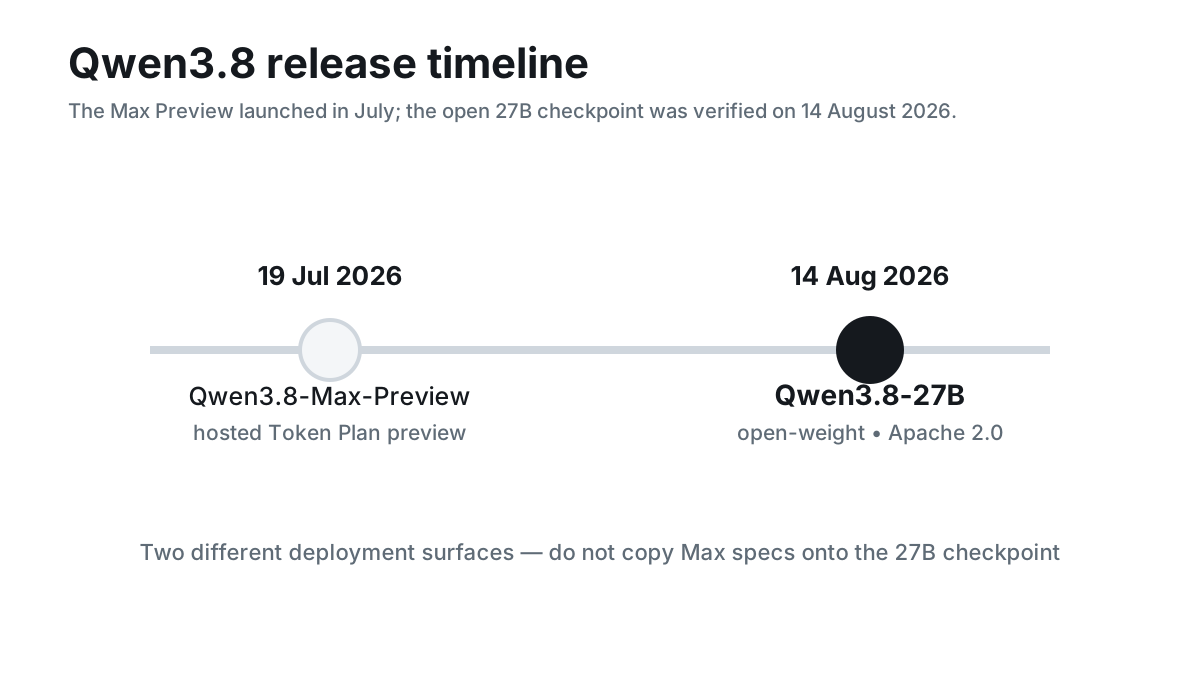
Verified model details
The published model details, with sources for each key claim:
| Item | Verified status |
|---|---|
| Official Qwen checkpoint | Yes: Qwen/Qwen3.8-27B. 1 |
| Parameter metadata | 27,781.4M. 1 |
| License | Apache 2.0. 12 |
| Multimodal task tag | image-text-to-text. 1 |
| Official FP8 | Yes. 2 |
| MLX | 4-bit, 8-bit and BF16 conversions already exist. 345 |
| GGUF | Unsloth package available. 6 |
| Official model-card benchmark table | Available; independent reproduction still open. |
| Native context | 262,144; extendable to 1,000,000 with documented configuration. |
| oMLX support | Strong compatibility signals, but needs a direct Qwen3.8-specific test. |
Do not confuse the 27B checkpoint with Qwen3.8-Max-Preview
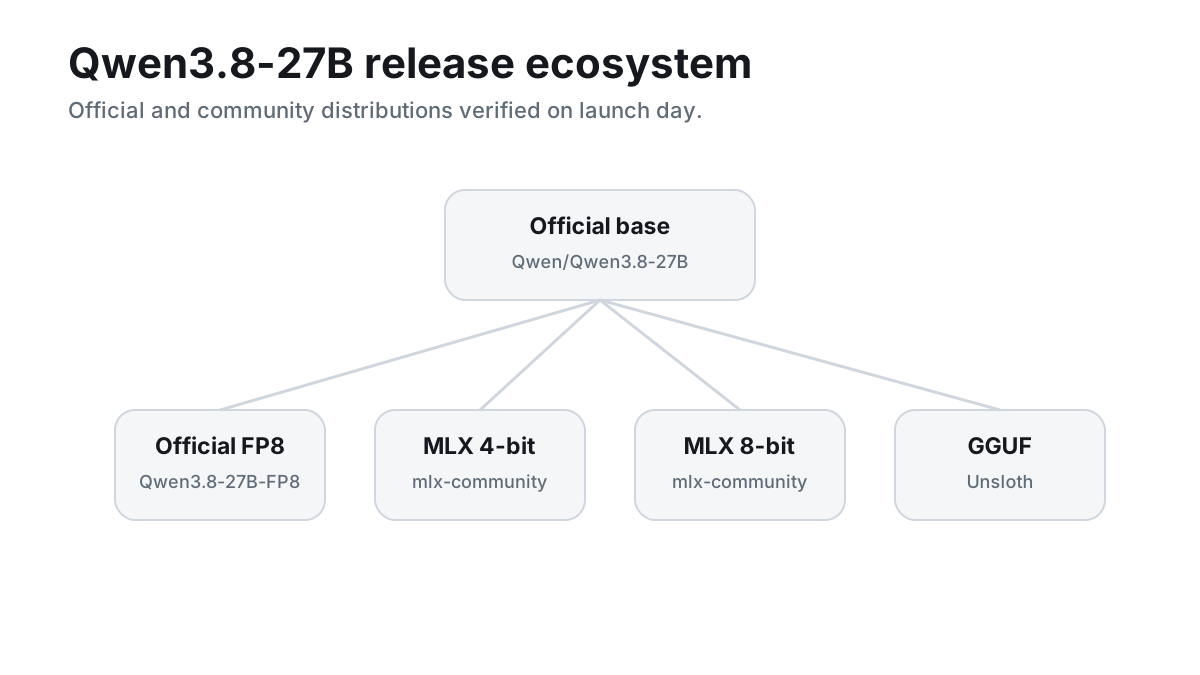
Alibaba launched qwen3.8-max-preview through its Token Plan on July 19, 2026. QwenCloud lists that hosted model with a one-million-token context window. 789
Qwen3.8-27B is a different product surface: downloadable weights, a 27B parameter class and Apache 2.0. The Max Preview service’s context window, pricing, infrastructure and vendor positioning should not be pasted onto the local 27B checkpoint.
This distinction matters for Mac users. One is a hosted service; the other can be quantized and served on your own machine. 123456
How much unified memory does a 27.78B model need?
A useful first-pass calculation is the theoretical raw weight storage:
storage ≈ parameter count × bits per weight ÷ 8
Using the repository’s 27.7814B parameter metadata:
| Precision | Theoretical raw weights |
|---|---|
| BF16 / 16-bit | ~55.6 GB |
| FP8 / 8-bit | ~27.8 GB |
| 8-bit quant | ~27.8 GB |
| 4-bit quant | ~13.9 GB |
Compare this with a real download: The MLX Community 4-bit file listing currently shows about 16.1 GB of model and supporting files. That exceeds the 13.9 GB theoretical weight-only floor, but it is still not an in-memory allocation measurement. Measure resident weights, context-dependent KV cache and vision processing separately on your Mac.
These are calculated estimates, not measured runtime memory. Real usage is higher because a running model also needs quantization metadata, runtime structures, KV cache, activations, allocator headroom and memory for macOS and the surrounding agent stack.


Practical Mac tiers
16 GB: A 4-bit model is already too close to the raw-weight floor for comfortable agent use.
24 GB: 4-bit is plausible, but long contexts and parallel tasks can consume the remaining headroom quickly.
32 GB: The natural starting point for 4-bit. Eight-bit weights alone are too close to total memory for comfort.
48 GB: Plenty of space for 4-bit and a more plausible target for 8-bit.
64 GB: Eight-bit becomes much easier to accommodate. BF16 still puts roughly 55.6 GB into weights before runtime overhead.
96 GB+: BF16 becomes technically reasonable, although it is unlikely to be the best value for most local-agent workloads.
Which MLX build should you start with?
For a practical Mac starting point, try 4-bit MLX and measure real unified-memory headroom. mlx-community/Qwen3.8-27B-4bit already exists, and its theoretical weight floor is roughly 13.9 GB. 3
That leaves much more unified memory for a real agent workload than an 8-bit build. Eight-bit becomes interesting when you have the memory and want to measure whether the extra precision improves your actual tasks. Without a Qwen3.8-specific quantization study, claiming a fixed quality gain would be speculation.
What about oMLX?
oMLX already has extensive support history for Qwen3.5/Qwen3.6-family models, including continuous batching, SSD caching and Qwen-specific fixes. 101112131415161718 Qwen3.8-27B retains the qwen3_5 architecture tag and has immediate MLX conversions, so there is a credible compatibility path.
But launch-day compatibility should still be treated as a testable hypothesis rather than a finished fact. The predecessor family exposed runtime-specific edge cases around vision fallback, thinking controls, MTP, quantization and long-context throughput. 1415161718
A useful smoke test for Qwen3.8-27B in oMLX should separately validate:
- basic OpenAI-compatible text generation,
- repeated tool calls,
- image input if you need vision,
- memory growth at longer contexts,
- MTP or DFlash only after Qwen3.8-specific support is confirmed.
The last point is important. oMLX’s DFlash documentation maps target models to specific draft checkpoints. The Qwen3.6 draft model should not be assumed to work with Qwen3.8. 12


Is Qwen3.8-27B actually better than Qwen3.6-27B?
The official model-card table provides an initial vendor-reported comparison, but it is not enough to answer the local-agent question independently.
The new checkpoint is official, its model-card evaluation is now accessible, and the local ecosystem is real. 123456 The remaining quality question is whether independent third-party and local Mac tests reproduce those results.
The official Qwen3.8 table is a useful starting point, but it is vendor-reported rather than an independent Mac evaluation. The predecessor is also a warning against simplistic score reading: Qwen3.6 community reproduction work showed that repository-edit tools, test conditioning and the overall agent harness can dramatically alter SWE-bench outcomes. 192021
For a meaningful generation-to-generation test, hold constant:
- quantization class,
- system prompt,
- tool schema,
- context budget,
- sampling settings,
- agent harness,
- task set,
- number of retries.
What the model downloads do not prove about Mac performance
The official Qwen model card and community MLX 4-bit checkpoint establish that compatible model files exist. They do not prove a specific Mac tokens-per-second result. Before drawing hardware conclusions, record actual Activity Monitor memory pressure, model revision, quantization, MLX version, context length and repeat-task correctness. Only compare performance measurements gathered with matched conditions.
The benchmark that matters for a local Mac agent
The official table is not enough for a local-Mac verdict. A useful launch review should publish four additional groups of numbers:
Decode throughput: tokens per second at 4-bit and 8-bit.
Prefill throughput: especially at 8K, 32K and 64K contexts.
Peak unified memory: measured during a full agent run rather than model load alone.
Agent reliability: file editing, shell use, structured tool calls, research and multi-step execution.
oMLX’s own Qwen3.6 history shows why runtime version must be recorded: long-context prefill performance has changed materially between releases. 15
Run a reproducible 4-bit MLX test on a Mac
Source check October 13, 2026: Qwen’s official Qwen3.8-27B checkpoint and the MLX Community 4-bit conversion are available. The model card identifies Apache-2.0 licensing, vision+text input, the qwen3_5 configuration architecture and 262,144 native context tokens. These are checkpoint capabilities, not proof that 262K context will fit in a 24GB Mac.
The MLX conversion’s model card documents mlx-vlm and its vision processor. The commands create an isolated virtual Python environment and invoke the module as documented with python -m mlx_vlm.generate. Text-only generation does not validate image input. The first model download requires internet access; verify offline inference separately after obtaining all files.
python3 -m venv .venv-qwen38
source .venv-qwen38/bin/activate
python -m pip install --upgrade mlx-vlm
python -m mlx_vlm.generate --model mlx-community/Qwen3.8-27B-4bit --max-tokens 256 --temperature 0.0 --prompt "Explain what a KV cache is."
To test vision with the same runtime, supply your own non-sensitive local image and compare it with the text-only run:
python -m mlx_vlm.generate --model mlx-community/Qwen3.8-27B-4bit --max-tokens 256 --temperature 0.0 --prompt "Describe this image precisely." --image ./test-photo.jpgPlace a non-sensitive JPEG named test-photo.jpg in your working directory before the vision command. Keep the environment at .venv-qwen38 and record the installed version with python -m pip show mlx-vlm. These are model-card-based instructions, not benchmarks run by ai-on-mac. Record the actual runtime version, Apple chip, unified memory, prefill/decode timing, macOS Activity Monitor memory pressure, context budget and image size. The 4-bit raw-weight floor (~13.9GB) is not total allocation: runtime buffers, vision embeddings and KV cache compete for memory. Start with modest context on 24–32GB systems; compare 8-bit and Qwen3.6 on the same tasks before declaring a quality winner.
Independent local speed and agent reliability remain to be verified on independent test benches. Check oMLX and DFlash compatibility against their current releases, not launch-day assumptions. The hosted Qwen3.8-Max and Qwen3.8-Flash API services are separate models and pricing products.
Sources and date
Original launch evidence was collected August 14, 2026; official Qwen/MLX availability and the practical test procedure were rechecked October 13, 2026. See Qwen checkpoint, MLX 4-bit model card, and the detailed references below.
Source evidence and limits
The evidence covers primary model cards, community conversions and runtime issue records. Links alone do not establish independently verified Mac performance.
Footnotes
Frequently Asked Questions
Is Qwen3.8-27B an official Qwen checkpoint?
Yes. Qwen publishes it as Qwen/Qwen3.8-27B on Hugging Face. The model card lists a 27B parameter class, Apache 2.0, image and video understanding, and 262,144 native context tokens.
How much unified memory does Qwen3.8-27B need on a Mac?
The theoretical raw weights are about 13.9 GB at 4-bit, 27.8 GB at 8-bit and 55.6 GB at BF16. Runtime structures, KV cache, vision processing and macOS add overhead, so 24–32 GB is the more realistic 4-bit starting tier.
What is the context window?
The official model card specifies 262,144 native tokens. Qwen describes extending this to 1,000,000 tokens through RoPE/YaRN configuration; that is not the same as an automatically available 1M window in every local runtime.
Is Qwen3.8-27B better than Qwen3.6-27B?
The model card now includes an official comparison table, but independent Mac and runtime tests are still missing. A defensible comparison must hold quantization, harness, tool schemas, context and tasks constant.
Does Qwen3.8-27B already work with oMLX?
The qwen3_5 architecture and immediate MLX conversions are strong compatibility signals. A Qwen3.8-specific oMLX release and a direct tool/vision smoke test still need to be confirmed separately.