Version update (October 11, 2026): Analysis covers Grok 4.6. Grok 4.7 launched on September 21, 2026 and is available via the xAI API as grok-4.7. xAI lists the same starting token rates ($2 per million input and $6 per million output tokens), but model features and provider access must be checked separately. The 4.6 benchmarks below remain historical snapshots. Official release · API release notes.
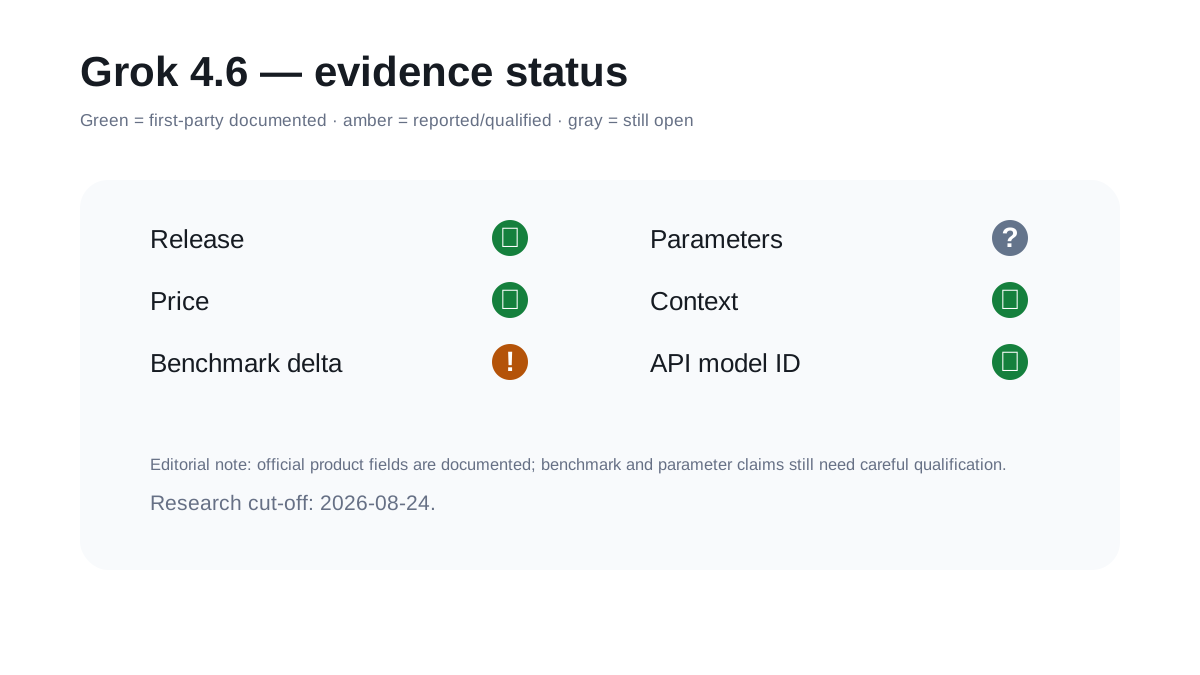
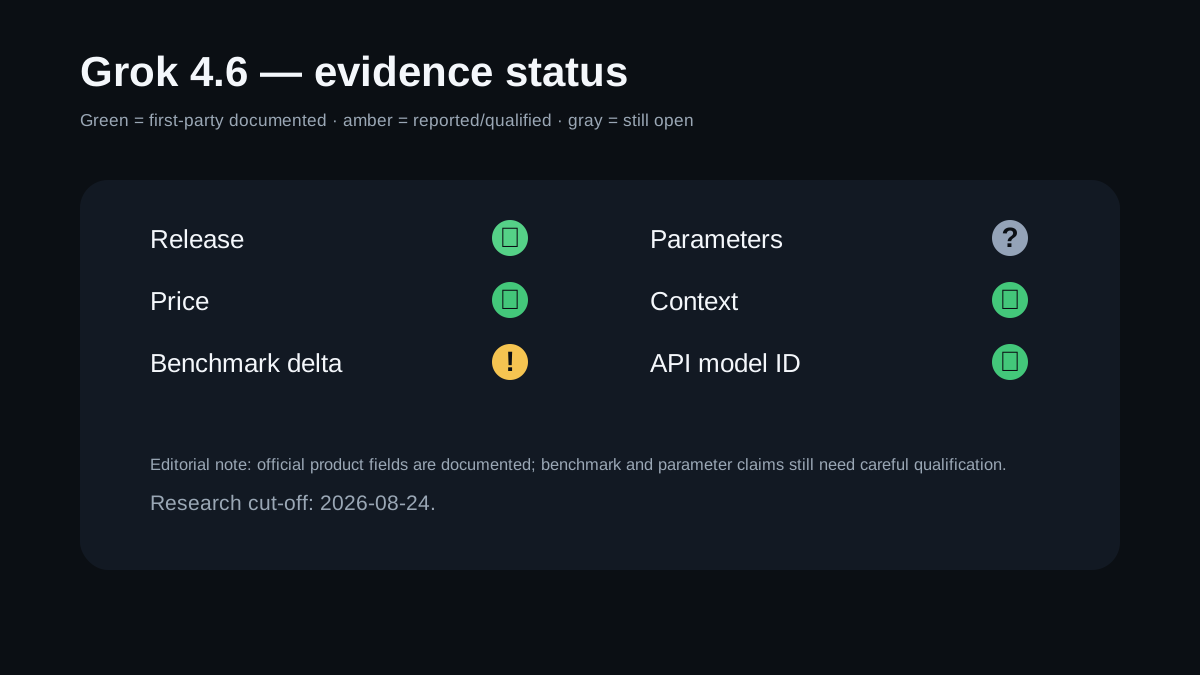
Product facts checked October 11, 2026; original research cut-off August 24. Grok 4.6 has been available since August 12, 2026. Current first-party SpaceXAI documentation confirms the model ID grok-4.6, a 500,000-token context window, text and image input, text output, and base pricing of $2 per million input tokens and $6 per million output tokens. Cached input is $0.50 per million, with higher input rates above 200,000 prompt tokens. 12
MarketWatch’s reported five-point improvement over Grok 4.5 on the Artificial Analysis Intelligence Index remains a qualified external report, not a benchmark we reproduced ourselves. 3 The final parameter count and a directly reproducible independent 4.6 score are still not cleanly documented. That separation is more useful for a Mac decision than a precise-looking but unsupported spec sheet.
Short-context and long-context cost examples
The xAI pricing table lists $2/$0.50/$6 per million input/cache-read/output tokens for normal Grok 4.6 requests, and $4/$1/$12 at 200,000 input tokens or more. The maximum context is 500,000 tokens. These are provider API rates, not a measured Mac benchmark.
| Request without caching, Batch or tools | Input | Output | Total |
|---|---|---|---|
| 100,000 input + 10,000 output | $0.20 | $0.06 | $0.26 |
| 300,000 input + 10,000 output | $1.20 | $0.12 | $1.32 |
The long-context example uses the higher tier for the entire request. Production agents can incur additional charges from repeated context, tools, and retries; these arithmetic examples do not measure model quality.
The six things to know first
- Grok 4.6 launched on August 12, 2026 and is listed in current SpaceXAI documentation. 41
- MarketWatch reports a five-point improvement over Grok 4.5 on the Artificial Analysis Intelligence Index. 3
- SpaceXAI lists $2/M input, $0.50/M cached input and $6/M output, with higher input rates above 200K prompt context. 12
- The official model ID is
grok-4.6, with Responses API and OpenAI-compatible examples. 12 - The official context window is 500,000 tokens, with text/image input and text output. 12
- The final parameter count and a directly reproducible independent 4.6 score remain open.


Why Grok 4.6 matters for agents
The official Grok 4.5 launch post is dated July 16, 2026. It does not substantiate a separate July 8 API launch date, so this guide uses the documented release instead. The model targets coding, agentic work and knowledge tasks; its official launch material emphasized multi-step software-engineering reinforcement learning, tool-heavy workloads and high serving speed. 5 Less than a month later, 4.6 extends that cadence.
The strongest post-launch signal is not a vendor adjective. It is the reported movement in independent evaluation. MarketWatch says Grok 4.6 gained five points versus 4.5 on Artificial Analysis’ Intelligence Index and moved back toward the frontier group. 3
That matters most for workloads in which a model must keep making useful decisions after dozens of tool calls rather than merely produce a good one-shot answer.
The benchmark result needs one important qualification
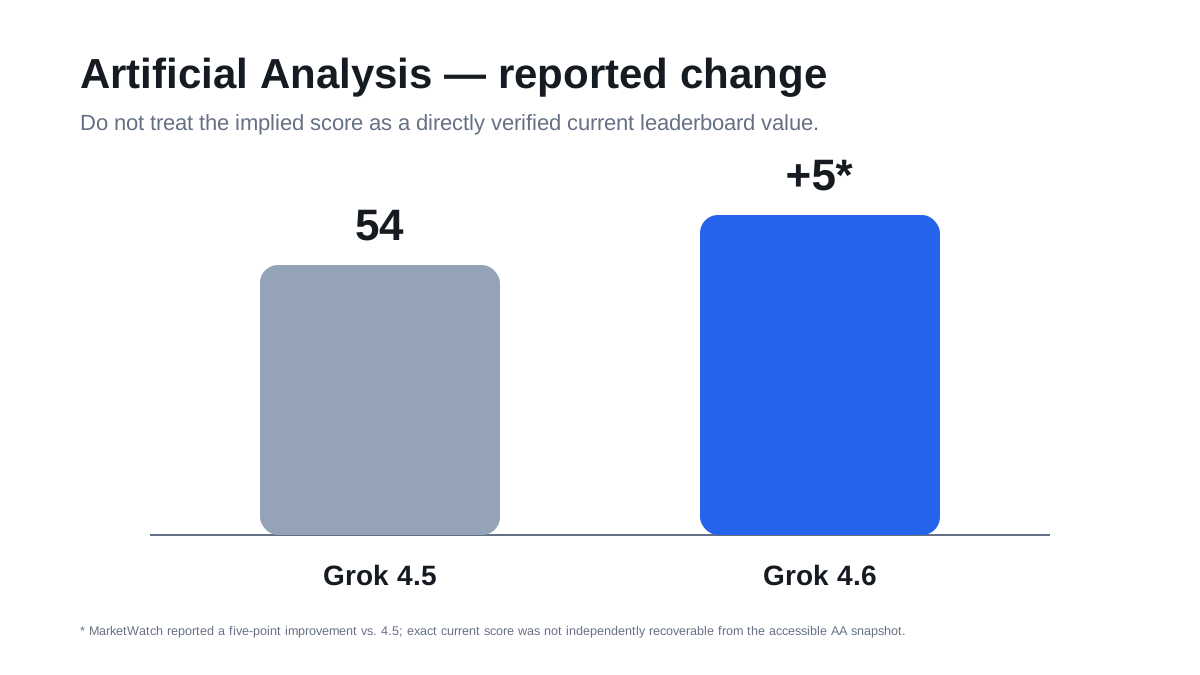
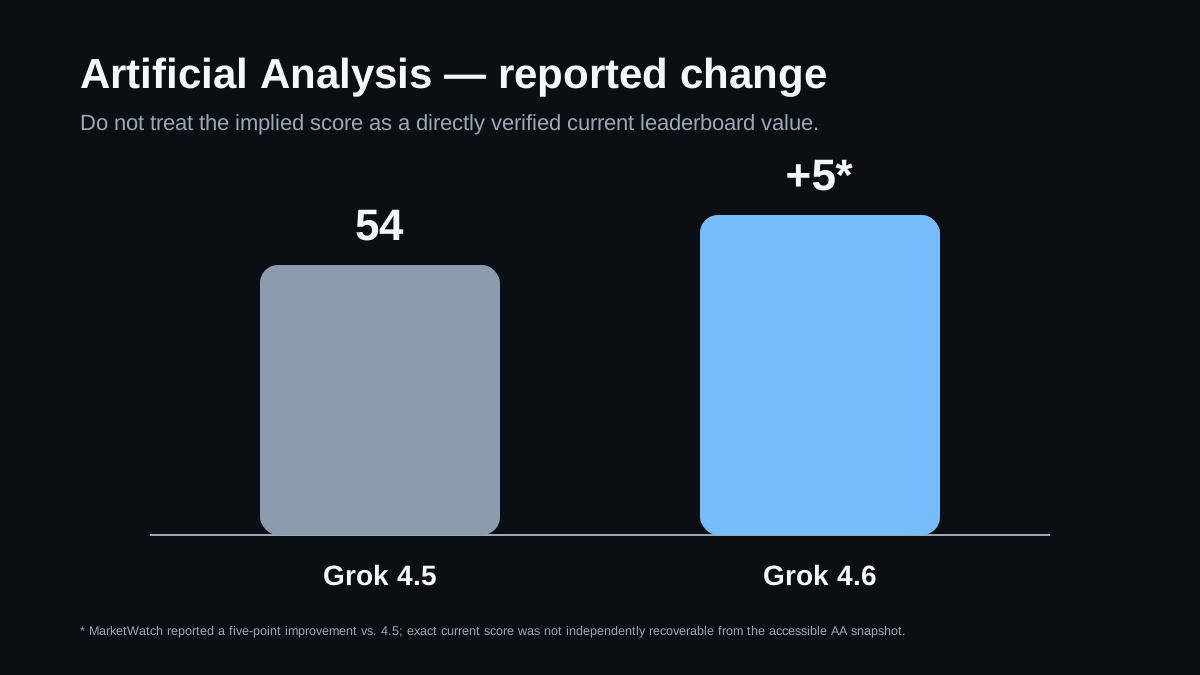
The accessible Artificial Analysis pages give Grok 4.5 a score of 54 in the July 8 snapshot. 678 A five-point increase would arithmetically imply about 59.
That does not make “Grok 4.6 scores 59” a safe headline.
There are at least three reasons to keep the wording conservative:
- the press report may refer to a newer leaderboard snapshot;
- aggregate benchmark methodology can be revised;
- the exact 4.6 model/settings entry was not directly recoverable from the accessible AA snapshot used for this research.
The defensible sentence is therefore: MarketWatch reports that Grok 4.6 improved by five points over Grok 4.5 on the Artificial Analysis Intelligence Index. 3
Pricing: the base tier is now documented
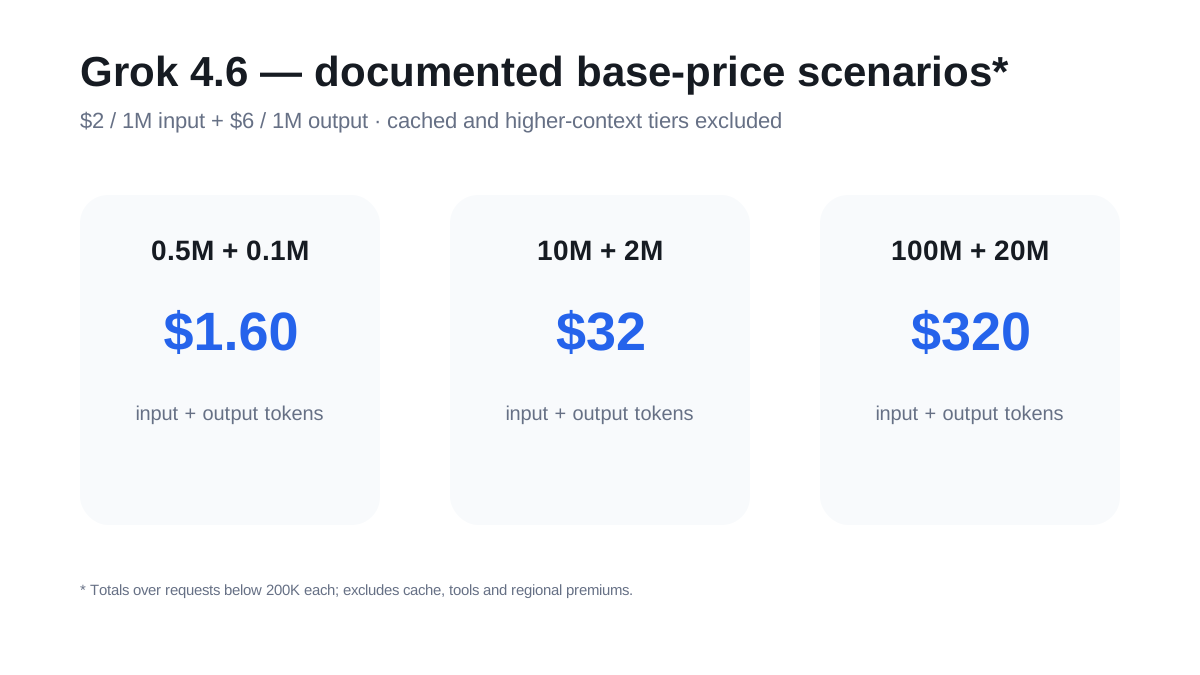
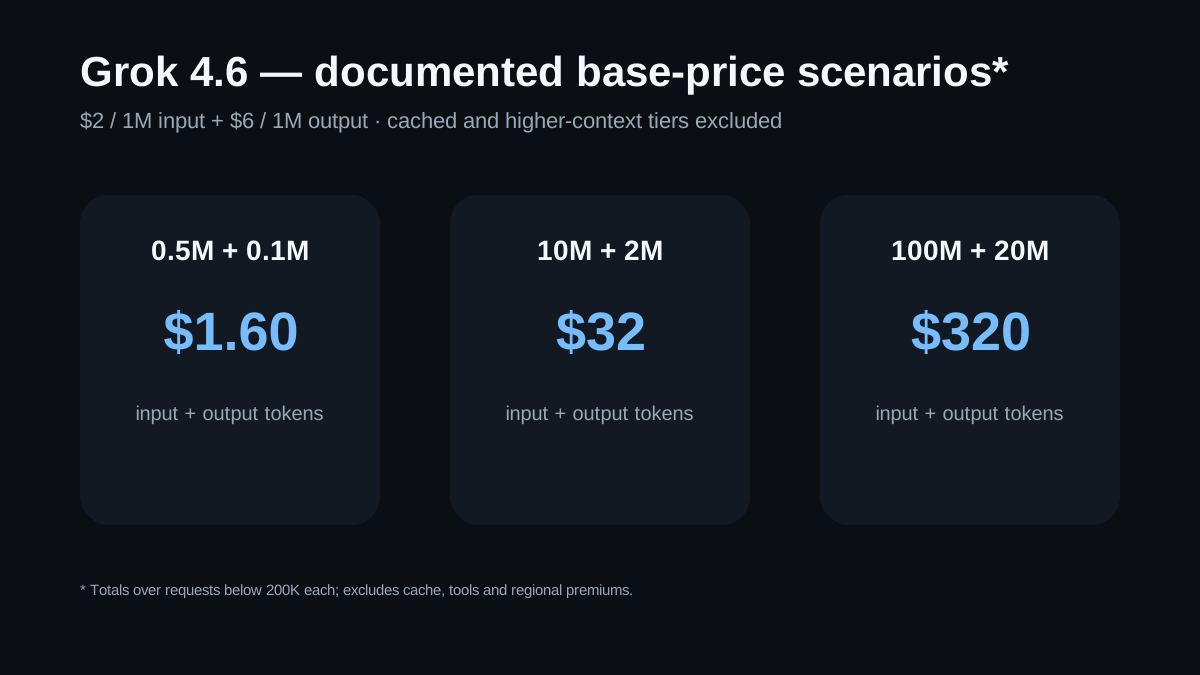
SpaceXAI’s current Grok 4.6 model page lists $2/M input tokens, $0.50/M cached input tokens and $6/M output tokens. Prompts above 200,000 tokens move to a higher input tier, so the regional pricing table should be checked before production use. 12
Using only those published rates, the following examples show aggregate token volume across multiple requests. They assume each individual request stays below 200,000 prompt tokens; for instance, 0.5M input represents many short requests rather than one 500K-context request:
| Workload | Input | Output | Formula | Estimated list cost |
|---|---|---|---|---|
| small | 0.5M | 0.1M | 0.5×$2 + 0.1×$6 | $1.60 |
| medium | 10M | 2M | 10×$2 + 2×$6 | $32 |
| heavy | 100M | 20M | 100×$2 + 20×$6 | $320 |
Base-rate illustrations, not actual invoices: If any single request reaches 200,000 prompt tokens, the higher tier applies to all tokens in that request ($4 fresh input, $1 cached input, $12 output per million). The table assumes multiple short requests and excludes cache hits, tool calls, priority processing and reseller markups. The US regional endpoint https://us.api.x.ai/v1 lists grok-4.6 and adds a 10% premium on token usage, including cached and long-context tokens. Do not confuse the global endpoint with a US-only inference commitment. Applicable U.S. state/local sales taxes and provider charges may also add to the invoice. 12
For an agent product, that distinction is material. A cheap token price can be offset by more retries, longer outputs or weak cache reuse.
1.5 trillion or 2 trillion parameters?
If you searched for Grok 4.6 before launch, you probably saw 2T.
IT之家, ComputerBase and other July coverage described a two-trillion-parameter successor to Grok 4.5. 910 Kie.ai built a detailed pre-launch explainer around the same number. 11
Later July reporting changed the story. EdgeX, The Economic Times and RB.ru attributed a 1.5T figure to Elon Musk and described improved supervised fine-tuning and reinforcement-learning work, with a larger Grok 4.7 expected later. 121314
The sound conclusion is not to pick whichever number appears in more articles. Both clusters trace back to pre-launch statements, and the accessible post-launch SpaceXAI model documentation does not settle the final production architecture.
So the spec table should say:
Parameter count: not yet verified in an accessible post-launch primary model card.
That single line is more useful than a confident but stale number.
Context, modalities and tools: now documented for 4.6
The current SpaceXAI Grok 4.6 pages list a 500,000-token context window, text and image input, text output, function calling, structured outputs and reasoning. The documentation also names grok-4.6 as the model ID and shows Responses API plus OpenAI-compatible examples. 12
| Field | Grok 4.6 |
|---|---|
| Context | 500,000 tokens 12 |
| Input/output | Text + image → text 12 |
| Base pricing | $2/$6; $0.50 cached input 1 |
| Higher context | Higher input rates above 200K 1 |
| Model ID | grok-4.6 2 |
| Reasoning | Low, medium, high, or xhigh 2 |
These are product-level capabilities, not a promise that every gateway exposes every tool or that a Mac client will behave identically across providers.
The API model ID is another easy place to hallucinate
The current SpaceXAI documentation explicitly uses:
model="grok-4.6"
It also shows the model through the Responses API and an OpenAI-compatible base URL. 12 For developers, the robust migration process is still:
- enumerate models in the actual account;
- capture the exact 4.6 identifier, aliases and region;
- run a minimal text request;
- test structured output and function calling explicitly; 1516
- compare cost through request-level cost tracking; 17
- run the same agent benchmark against 4.5 before switching production traffic.
This is slower than copying a model ID from social media, but it prevents an avoidable production failure.
Grok 4.5 baseline: directional signals without spec-sheet hype
SpaceXAI’s 4.5 announcement presented manufacturer-reported results including 62.0% on DeepSWE 1.0, 53% on DeepSWE 1.1, 83.3% on Terminal-Bench 2.1 and 64.7% on SWE Bench Pro. 5 The company also claimed high serving throughput and substantially lower token use on one software-engineering evaluation. Those are useful reference points, but they are vendor material and should not be blended with an independent 4.6 test.
Artificial Analysis independently measured 4.5 at 54 on its Intelligence Index and showed a large gain over Grok 4.3. 618 The post-launch report of another five-point move therefore makes 4.6 worth testing, especially for tasks that combine coding, tools and long sequences of decisions. 3
Who should test Grok 4.6 now?
Agent builders
The reported price/performance combination is most interesting for systems that repeatedly send large tool schemas, code context and task state. 319 Measure cost per completed task, not cost per million tokens.
Teams already on Grok 4.5
You have the cleanest A/B path: keep the harness, tools, prompts and evaluation set fixed, then swap only the model. Record success rate, human interventions, latency, token use and total cost.
Casual users
If the goal is simply “use the smartest chatbot,” one aggregate index is not enough evidence. The practical winner depends on your tasks, latency tolerance, product features and subscription constraints.
What remains open
The first-party docs settle the main product fields, but not every evaluation question. Still open or only partly comparable are:
- the final parameter count;
- a directly reproducible independent 4.6 leaderboard score;
- the full methodology behind the reported five-point improvement;
- regional pricing details for long contexts and third-party gateways;
- tool-calling, caching and long-agent reliability on a concrete Mac or provider setup.
These are not evidence against Grok 4.6. They are the boundaries of the current evidence and should be tested with a fixed workload before production migration.
Grok 4.6 is officially documented and available in production since August 12, 2026. First-party docs confirm its model ID, 500K context, modalities, tools and base pricing; the reported five-point improvement remains a qualified external claim. 312 For Mac and agent workflows, run an A/B test of cost, latency, tool failures and task success instead of overfocusing on the unresolved parameter count.
Sources and scope
Model specifications and token rates are taken from xAI’s own documentation. Older benchmark claims remain historical vendor or media reporting, not independent AI on Mac results.
Footnotes
Frequently Asked Questions
When was Grok 4.6 released?
Grok 4.6 launched August 12, 2026, as dated by xAI's official release announcement.
How does Grok 4.6 compare with Grok 4.5?
MarketWatch reports a five-point lead over Grok 4.5 on the Artificial Analysis Intelligence Index. The exact current 4.6 score was not directly reproducible from the accessible leaderboard snapshot.
How much does Grok 4.6 cost via API?
SpaceXAI's official model page lists $2 per million input tokens and $6 per million output tokens. Cached input is $0.50 per million; higher input rates apply to prompts above 200,000 tokens.
What is the Grok 4.6 context window?
SpaceXAI's official Grok 4.6 documentation lists a 500,000-token context window. That is the model maximum; provider limits, pricing tiers and latency still constrain practical use.
Is Grok 4.6 a 1.5T or 2T model?
The figures conflict: older pre-launch reports say 2T, later Musk-attributed reporting says 1.5T. No accessible final model card existed at the cut-off, so the parameter count belongs in a "still to confirm" column.
What is the official Grok 4.6 API model ID?
The official model identifier is `grok-4.6`. Current documentation shows Responses API and OpenAI-compatible examples; still check available regions and limits in your own account.