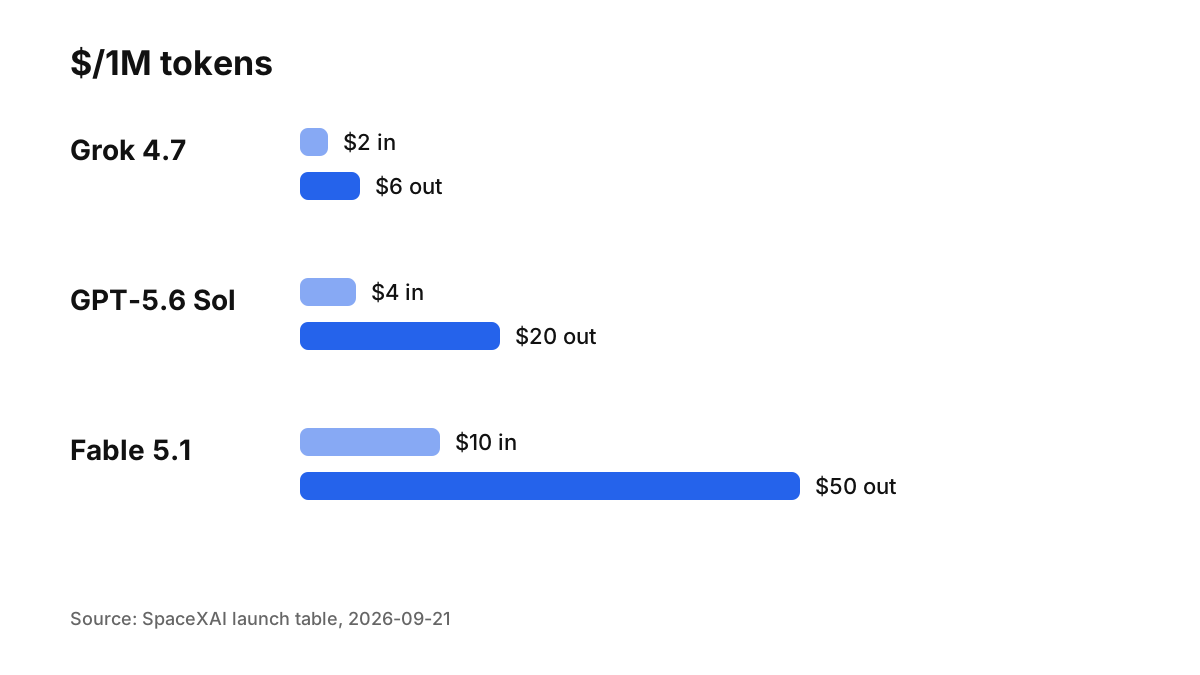
Updated October 8, 2026. The September launch benchmark numbers below remain dated, not refreshed independent benchmarks. SpaceXAI released Grok 4.7 on September 21 as its new frontier model for coding, agentic work and knowledge tasks. On the public xAI API, standard pricing starts at $2 per million input tokens, $0.50 per million cached input tokens and $6 per million output tokens. Once a request exceeds 200,000 prompt tokens, those token rates double. The maximum context window is 500,000 tokens. Grok 4.7 is a compelling option for long coding and knowledge-work sessions where output-token cost matters: It is not uniformly the strongest model, but it sits in an unusually aggressive price-performance range on several agentic evaluations.


The useful story is not that Grok 4.7 “wins” a leaderboard. It is that SpaceXAI kept the same list price as Grok 4.6 while raising performance on several long-horizon tasks. Independent evaluations also show that the size of the improvement changes materially with the agent harness. For buyers, the right unit is therefore cost per successfully completed task, not just benchmark score or price per million tokens.
What changed in Grok 4.7?
SpaceXAI says Grok 4.7 uses a larger base model than Grok 4.6 and received a longer reinforcement-learning run weighted toward problems that require many steps or hours of work. The company also says it improved self-verification and long-context management.
The API model grok-4.7 accepts text and image input and produces text. It exposes low, medium, high and xhigh reasoning effort, with high as the default. The documented tool set includes function calling, structured output, web search, X search and code execution.
Prompt caching matters for agent workloads. Matching prompt prefixes can be billed at a lower cached-input rate, and SpaceXAI recommends a stable cache key or conversation ID to improve cache locality. Hits are not guaranteed, so applications still need to work correctly on a cold cache.
Pricing and the 500k context window
| xAI API tier | Input / 1M | Cached input / 1M | Output / 1M | Maximum context |
|---|---|---|---|---|
| Standard, up to 200k prompt tokens | $2.00 | $0.50 | $6.00 | 500k |
| Long context, above 200k prompt tokens | $4.00 | $1.00 | $12.00 | 500k |
Data checked September 22, 2026.
The distinction is easy to miss: a 500k context window does not mean all 500k tokens are billed at the base rate. Cursor uses a different serving boundary, describing a 256k standard window and up to 500k long context with Cursor-specific rates.
Three cost scenarios
These are original calculations excluding tool charges, taxes, exchange rates and gateway markups.
| Scenario | Monthly volume | No caching | 70% cache hit on input |
|---|---|---|---|
| Light | 15M input + 3M output | $48.00 | $32.25 |
| Medium | 120M input + 24M output | $384.00 | $258.00 |
| Heavy | 450M input + 60M output | $1,260.00 | $787.50 |
The no-cache formula is input millions × $2 + output millions × $6. The cached scenario bills 70% of input at $0.50/M and the remainder at $2/M. Each request is assumed to stay below the 200k long-context threshold.
Benchmarks: strong gains, but harnesses matter
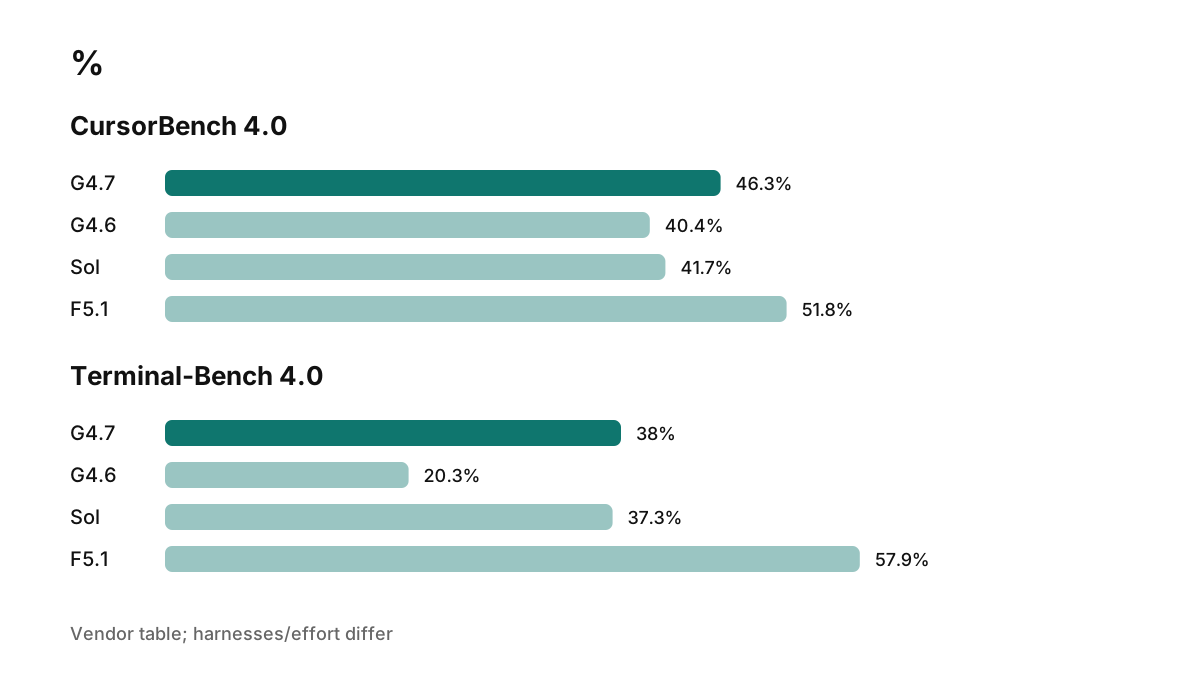
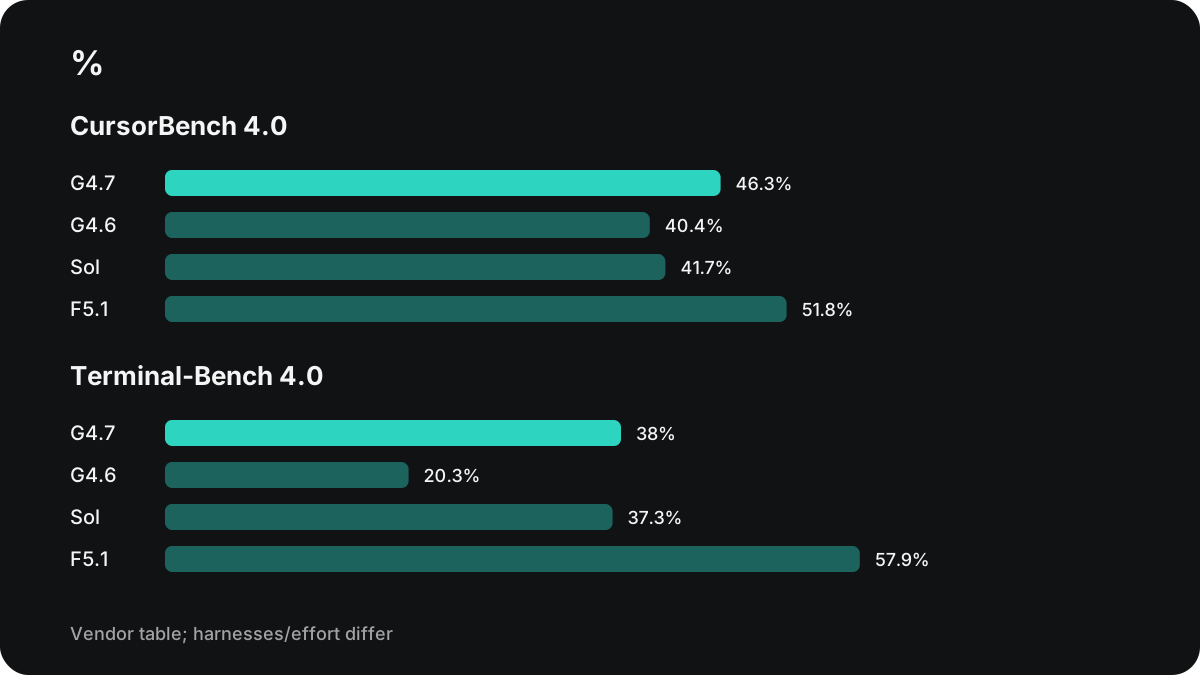
SpaceXAI’s launch table mostly compares Grok 4.7 at xhigh, Grok 4.6 at high, GPT-5.6 Sol at max, and Fable 5.1 at max. Those effort settings are not identical, so the table should not be read as a controlled universal ranking.
| Evaluation | Grok 4.7 | Grok 4.6 | GPT-5.6 Sol | Fable 5.1 |
|---|---|---|---|---|
| CursorBench 4.0 | 46.3% | 40.4% | 41.7% | 51.8% |
| DeepSWE v1.1 | 71.0%* | 65.2% | 72.7% | 70.0% |
| AA-Briefcase v1.1 | 1,657 | 1,546 | 1,487 | 1,678 |
| Terminal-Bench 4.0 | 38.0% | 20.3% | 37.3% | 57.9% |
| Harvey Legal Agent | 19.6% | 15.8% | 2.5% | 6.7% |
| HealthBench Professional | 56.7% | 48.5% | 60.5% | 62.1% |
| EEBench | 64.0% | 53.0% | 39.4% | 56.4% |
* SpaceXAI marks the Grok 4.7 DeepSWE score as high effort. All rows above are vendor-published unless separately noted.
CursorBench provides unusually useful cost data
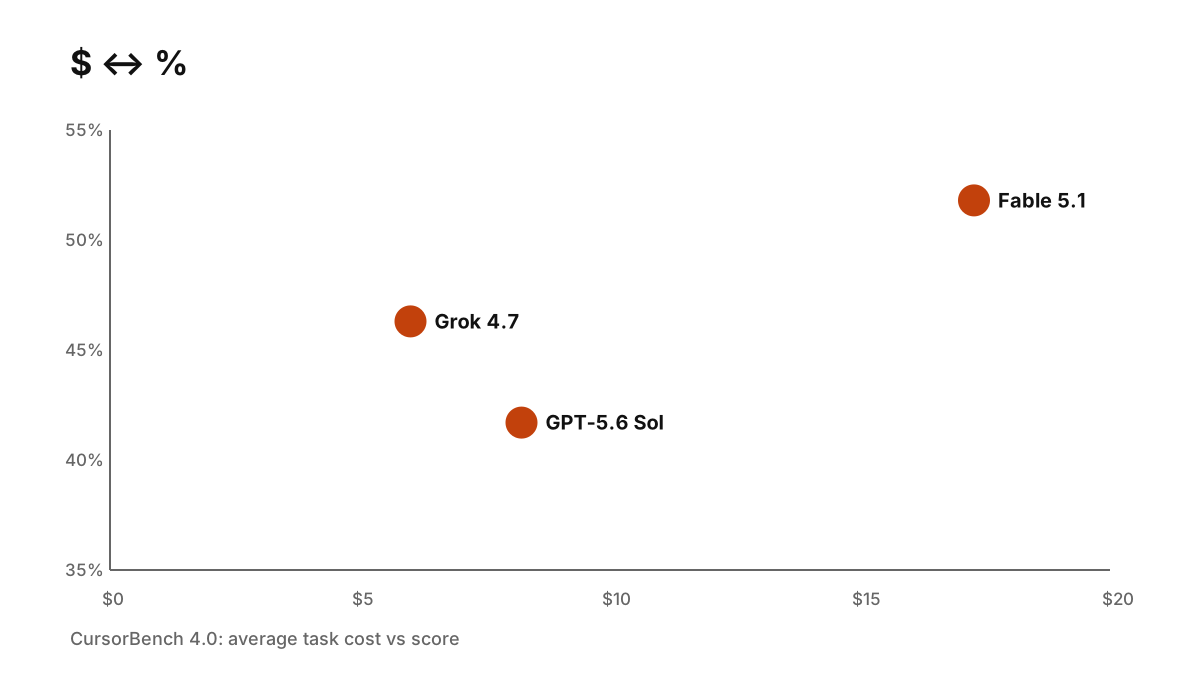
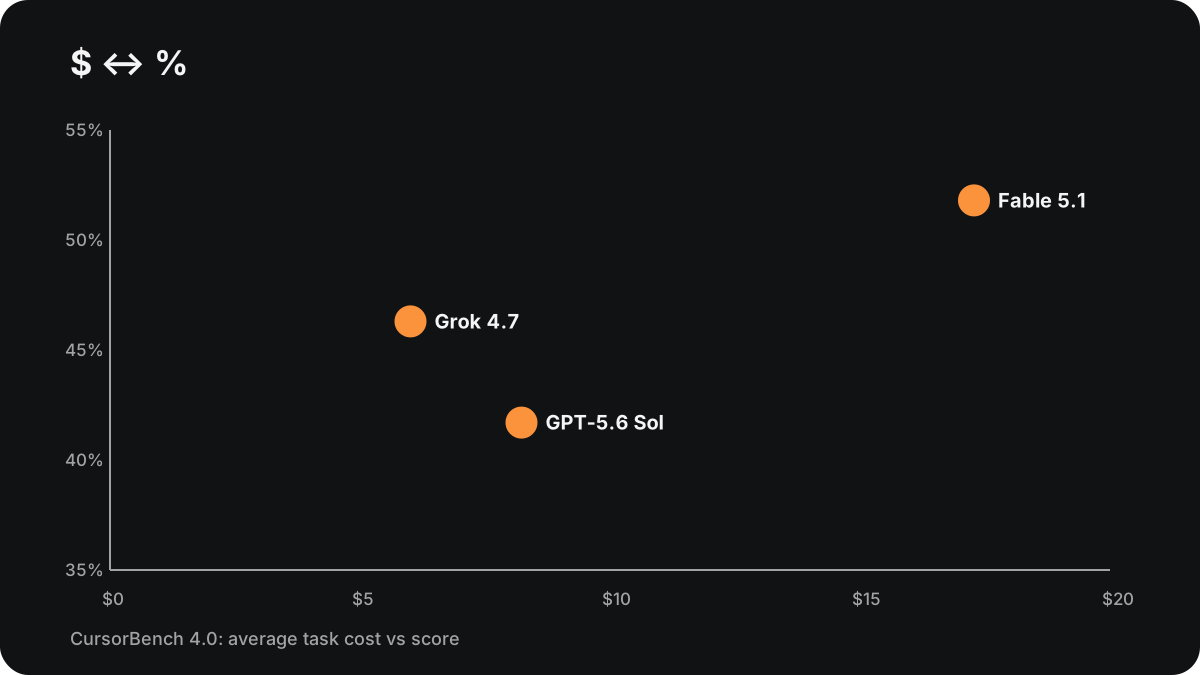
Cursor publishes score, cost, token use and steps for CursorBench 4.0. Grok 4.7 Extra High scores 46.3% at an average $6.01 per task in that run. Fable 5.1 Max scores higher at 51.8%, but costs materially more per task in the same table.
Independent evaluation confirms progress, but not every headline delta
Artificial Analysis scores Grok 4.7 at 46 on its Intelligence Index and 1,657 Elo on AA-Briefcase at xhigh. Its Grok Build coding-agent result also improves over Grok 4.6. However, Grok 4.7 uses substantially more output tokens per Intelligence Index task than its predecessor. That is why a cheap per-token rate can still turn into a non-trivial task bill.
Terminal-Bench is the clearest example of harness sensitivity. SpaceXAI reports 38.0% in its launch table, while an independent Artificial Analysis run is lower under a different setup. The mismatch is not enough to call either result wrong; it is enough to show that agent scaffolding, tool access and effort settings are part of the benchmark result.
Treat EEBench and HealthBench carefully
SpaceXAI reports 64.0% on EEBench. When the public EEBench leaderboard was checked on September 22, a separate Grok 4.7 row was not yet visible, so the 64.0% figure should remain labeled as vendor-reported until an independent row appears.
HealthBench Professional contains 525 clinician-authored tasks derived from real clinician conversations and uses physician-written rubrics. Epoch AI’s September review nevertheless found substantial issues in a sampled subset of the benchmark. The result is useful evidence about one evaluation set, not evidence that a model can safely replace supervised clinical judgment.
API deployment: caching, US region, Fast and Batch
Use the right billing surface. SpaceXAI’s Grok 4.7 API reference confirms that Grok 4.7 Fast is not a public xAI API model. That faster serving mode is limited to Cursor and Grok Build and billed under their respective plans. It is marketed at 2× standard token rates, or 1.5× for long-context requests; those multipliers do not change the public grok-4.7 API price.
Caching is not guaranteed just because prompts share a prefix. Send a stable prompt_cache_key in the Responses API (or x-grok-conv-id in Chat Completions) so repeated turns reach the same server. Without affinity, a cold server may charge full input rather than the $0.50/M cached rate. Encrypted reasoning is returned automatically by the Responses API: replay reasoning.encrypted_content unchanged in follow-up requests rather than dropping it and accidentally changing the agent’s state. xAI model guide.
| Deployment | What you actually get | Cost/limit caveat |
|---|---|---|
Public grok-4.7 API | Text+image in, text out; up to 500K context | Below 200K prompt: $2/$0.50/$6 per M input/cache/output; above 200K: $4/$1/$12 |
https://us.api.x.ai/v1 | Explicit US-region inference | 10% regional premium; verify account and endpoint configuration |
| Cursor / Grok Build Fast | Lower-latency Fast option | Not available as a model ID on the public API; plan billing applies |
| Batch API | Not supported for grok-4.7 in the current model table | Do not budget a nonexistent batch discount |
The threshold is per request prompt length, not a monthly token-volume break. Web/X search and code-execution tools may have separate usage charges. Record actual cache-hit tokens, region, reasoning effort and tool calls when comparing monthly agent costs; otherwise a $2/M headline will systematically understate spend.
API and agent capabilities
SpaceXAI recommends its Responses API for new integrations. It can keep state server-side, and the documentation says stored responses are retained for 30 days. Grok 4.7 also returns encrypted reasoning content on the Responses API for multi-turn workflows.
The documented tool stack includes function calling, JSON-schema structured output, web search, X search, Python code execution and context compaction for long agent sessions.
Data handling for business users
SpaceXAI’s enterprise FAQ says business inputs and outputs are not used to train its models by default. The consumer privacy policy explicitly separates consumer-service data handling from data processed on behalf of API and enterprise customers, which is governed by enterprise terms and the DPA.
That should not be confused with zero retention. The Responses API documentation describes a 30-day storage period unless the integration is configured differently. Teams with strict retention requirements should verify the exact API mode and contract rather than infer it from the model name.
Who should test Grok 4.7?
The strongest case is for teams running long coding, research or document workflows where frontier-level output quality is useful but high output-token pricing is hard to justify. SpaceXAI’s own comparison table places Grok 4.7 well below GPT-5.6 Sol and Fable 5.1 in list token price.
The upgrade case from Grok 4.6 is more nuanced. Grok 4.7 improves long-horizon task scores, but high reasoning settings may also consume much more output. A practical evaluation should therefore log task success, total cost, latency and human correction time on a representative task set.
Grok 4.7 for long agent workflows
Grok 4.7 combines a 500k context window, four reasoning levels, agent tools and aggressive API pricing. Its strongest public evidence comes from CursorBench and independent Artificial Analysis work on AA-Briefcase and GDPval-AA. Its main caveat is also the lesson of current agent benchmarks: the harness can move results dramatically. For production adoption, build a small reproducible eval around your own jobs and optimize for cost per successful outcome.
The previous release is covered in the Grok 4.6 fact-check.
Frequently Asked Questions
How much does Grok 4.7 cost per million tokens?
Standard tier up to 200,000 prompt tokens: $2 per million input tokens, $0.50 per million cached input tokens and $6 per million output tokens. Above 200,000 prompt tokens the rates double to $4/$1/$12 per million.
How large is the Grok 4.7 context window?
The maximum context window is 500,000 tokens. Crucially, once the 200,000 prompt-token threshold is exceeded, the long-context surcharge kicks in and every token is billed at the doubled rate.
Which reasoning effort levels does Grok 4.7 support?
The API exposes low, medium, high and xhigh. The default is high. Encrypted reasoning content is returned through the Responses API and can be carried forward in multi-turn workflows.
Is Grok 4.7 better than Grok 4.6?
SpaceXAI reports Grok 4.7 at xhigh beating Grok 4.6 at high across several long-horizon agent tests. Independent measurements from Artificial Analysis confirm the progress but show that the gap can shrink noticeably depending on harness and reasoning effort.
Are business inputs and outputs used to train models?
SpaceXAI's enterprise FAQ states that business inputs and outputs are not used to train its models by default. The consumer privacy policy is explicitly separated from data processed on behalf of API and enterprise customers, which is governed by enterprise terms and the DPA.
How long does the Responses API retain content?
The documentation describes a 30-day response retention window unless the integration is configured differently. Teams with strict retention requirements should pin the exact API mode in the contract rather than infer it from the model name.
Transparency
Sources and review basis
These primary and reference sources form the basis of the technical assessment. Vendor claims and external benchmarks are identified as such in the article.
- x.ai news / grok-4-7
- docs.x.ai models / grok-4.7
- docs.x.ai developers / grok-4-7
- docs.x.ai developers / release-notes
- docs.x.ai developers / pricing
- docs.x.ai text / reasoning
- docs.x.ai inference / responses
- docs.x.ai text / structured-outputs
- docs.x.ai tools / function-calling
- docs.x.ai tools / web-search
- docs.x.ai tools / x-search
- docs.x.ai tools / code-execution
- docs.x.ai prompt-caching / how-it-works
- docs.x.ai prompt-caching / best-practices
- docs.x.ai model-features / context-compaction
- x.ai legal / privacy-policy
- x.ai legal / terms-of-service
- x.ai enterprise-terms
- x.ai data-processing-addendum
- cursor.com models / grok-4-7
- cursor.com blog / cursorbench-4
- cursor.com blog / cursorbench-methodology
- artificialanalysis.ai models / grok-4-7
- artificialanalysis.ai articles / grok-4-7
- artificialanalysis.ai methodology / intelligence-index
- artificialanalysis.ai methodology / coding-agent-index
- artificialanalysis.ai articles / grok-build-coding-agent-benchmark
- artificialanalysis.ai leaderboards / models
- eebench.ai leaderboard
- openai.com index / healthbench
- epoch.ai benchmarks / healthbench
- huggingface.co openai / healthbench
- tbench.ai www.tbench.ai
- github.com MaxIntelligenceAgency / ALE-Benchmark