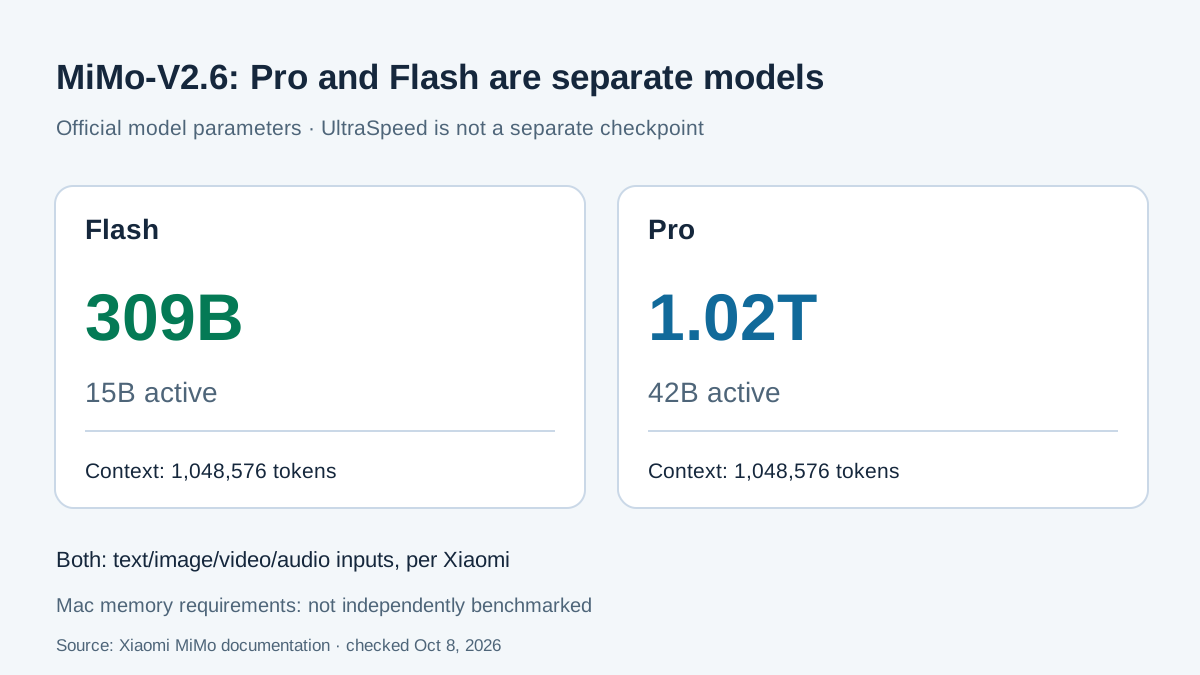
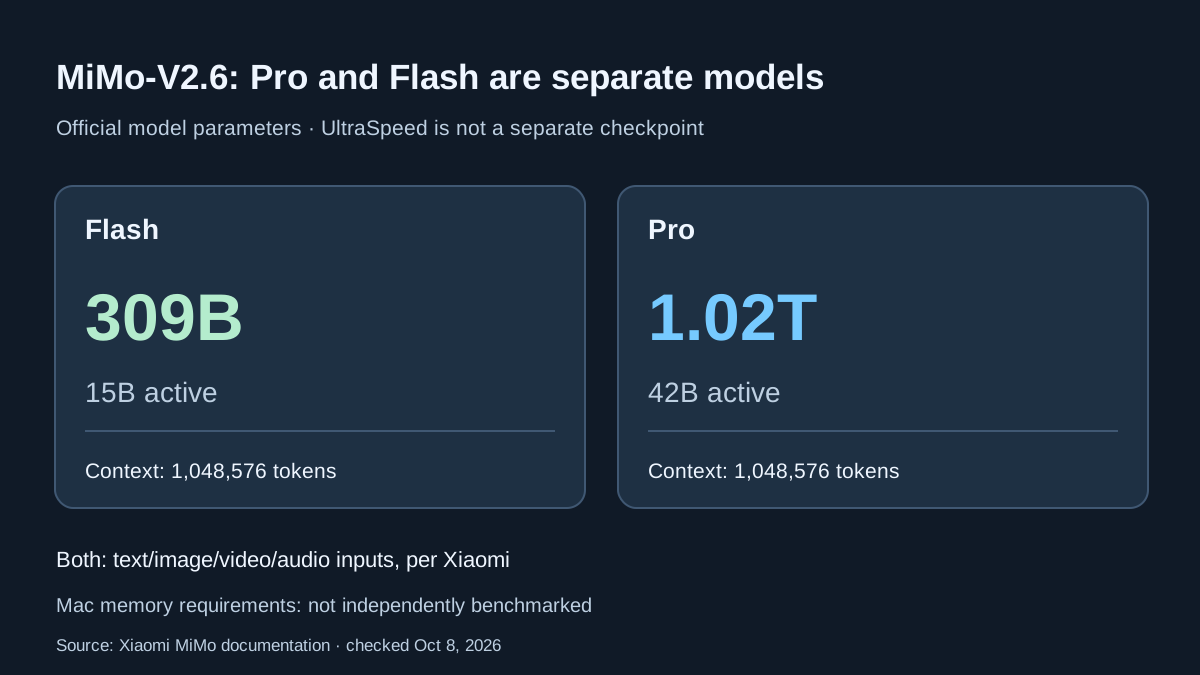
Updated October 8, 2026. Xiaomi has released the MiMo-V2.6 family, publishing open weights for MiMo-V2.6-Pro and MiMo-V2.6-Flash while offering MiMo-V2.6-Pro-UltraSpeed as a hosted high-speed mode. MiMo-V2.6-Flash costs $0.14 per million input tokens and $0.28 per million output tokens, MiMo-V2.6-Pro costs $0.435 and $0.87, and UltraSpeed costs $4.35 and $8.70 — all sharing the same 1M context window and the same 131,072-token output limit. The API IDs are mimo-v2.6-flash, mimo-v2.6-pro, and mimo-v2.6-pro-ultraspeed.
Specs and pricing
| Feature | Flash | Pro | Pro UltraSpeed |
|---|---|---|---|
| Positioning | efficiency | flagship | low-latency / high-throughput Pro |
| Architecture | Sparse MoE | Sparse MoE | Pro family |
| Total parameters | 309B | 1.02T | same Pro family |
| Active parameters | 15B | 42B | same Pro family |
| Context | 1,048,576 | 1,048,576 | 1,048,576 |
| Max output via Responses API | 131,072 | 131,072 | 131,072 |
| Inputs | text, image, video, audio | text, image, video, audio | text, image, video, audio |
| Uncached input | $0.14/M | $0.435/M | $4.35/M |
| Cache hit | $0.0028/M | $0.0036/M | $0.036/M |
| Output | $0.28/M | $0.87/M | $8.70/M |
| Batch API | $0.07/M in, $0.14/M out | $0.2175/M in, $0.435/M out | not listed |
The open-source section of Xiaomi’s launch post names Pro and Flash weights, while UltraSpeed is introduced under Desktop/API access. That makes it more accurate to treat UltraSpeed as an inference mode rather than a third independently released weight checkpoint.
Pro vs Flash: how large is the capability gap?
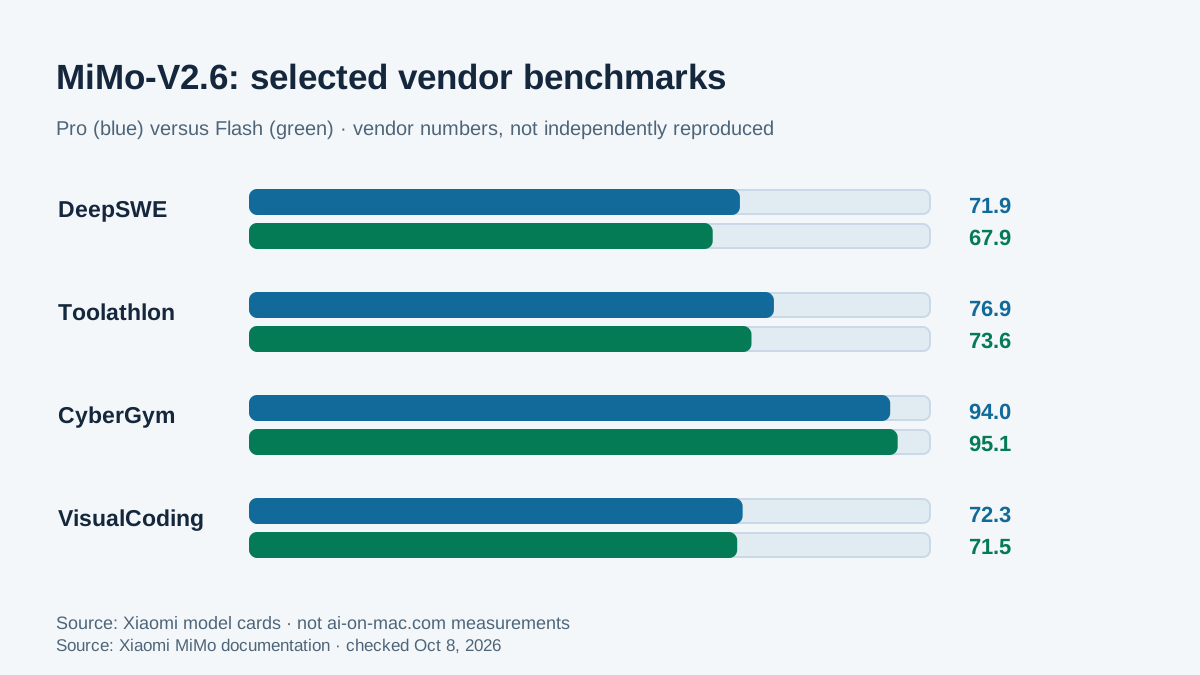
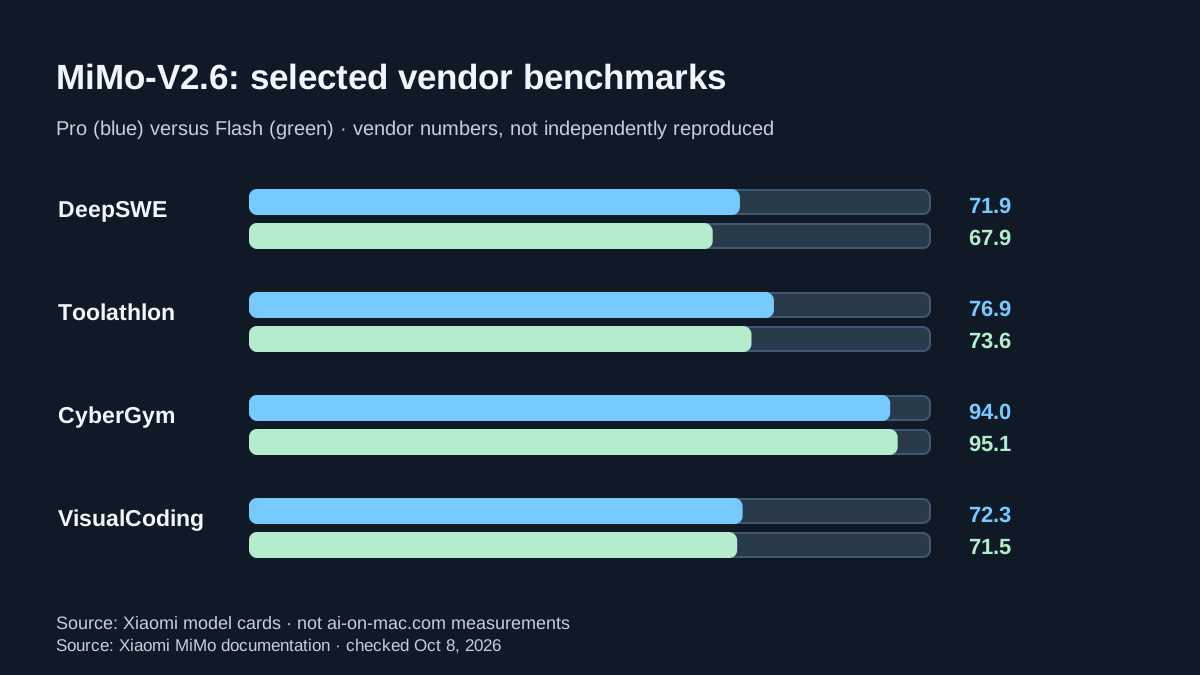
Xiaomi’s release card reports Pro ahead on most listed evaluations, but the gap varies substantially:
| Benchmark | Pro | Flash | Pro − Flash |
|---|---|---|---|
| DeepSWE v1.1 | 71.9 | 67.9 | +4.0 |
| ProgramBench | 26.5 | 26.0 | +0.5 |
| AutomationBench v1.0.6 | 53.1 | 52.3 | +0.8 |
| Toolathlon-Verified | 76.9 | 73.6 | +3.3 |
| Agents’ Last Exam | 31.6 | 27.6 | +4.0 |
| Terminal Bench 4.0 | 34.9 | 28.8 | +6.1 |
| OSWorld-Verified | 82.0 | 80.8 | +1.2 |
| CyberGym | 94.0 | 95.1 | −1.1 |
| SEC Bench Pro | 66.3 | 47.5 | +18.8 |
| MiMo VisualCoding | 72.3 | 71.5 | +0.8 |
These are vendor-reported results, not a uniform independent test suite. They are still useful for understanding Xiaomi’s intended positioning, but they should not be converted into a single universal “percent better” figure.
Benchmark quality also matters. DeepSWE v1.1 contains 113 long-horizon software-engineering tasks, and Epoch AI’s audit identified issues in at least 23 of them. Terminal-Bench and CyberGym likewise emphasize that agent configuration and run variance can materially affect scores.
The independent datapoint that matters most right now
Artificial Analysis reports 46 on its Intelligence Index for MiMo-V2.6-Pro and roughly 134.3 output tokens/s on Xiaomi’s API, with pricing matching Xiaomi’s published Pro rate.
That gives Pro a useful independent cross-check shortly after launch. Comparable independent runs for Flash and UltraSpeed were not yet present in the reviewed source set, so Xiaomi’s up-to-20× UltraSpeed claim should be read as a vendor maximum rather than guaranteed real-world acceleration.
MiMo API costs: correct cache-hit arithmetic
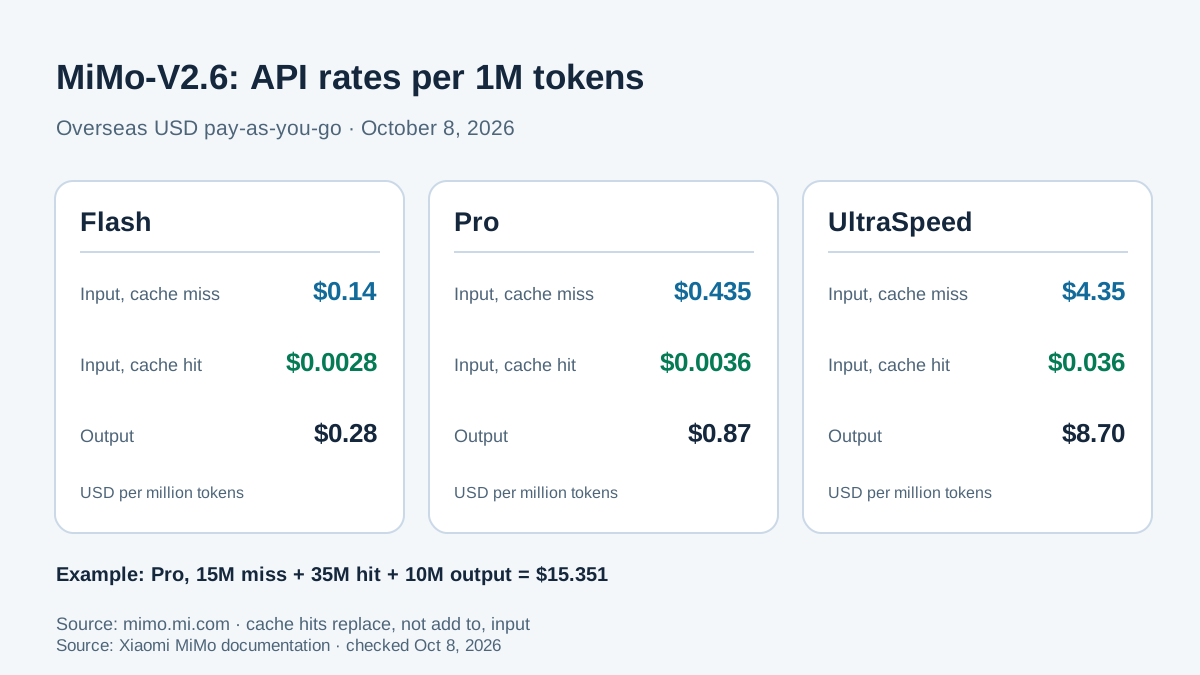
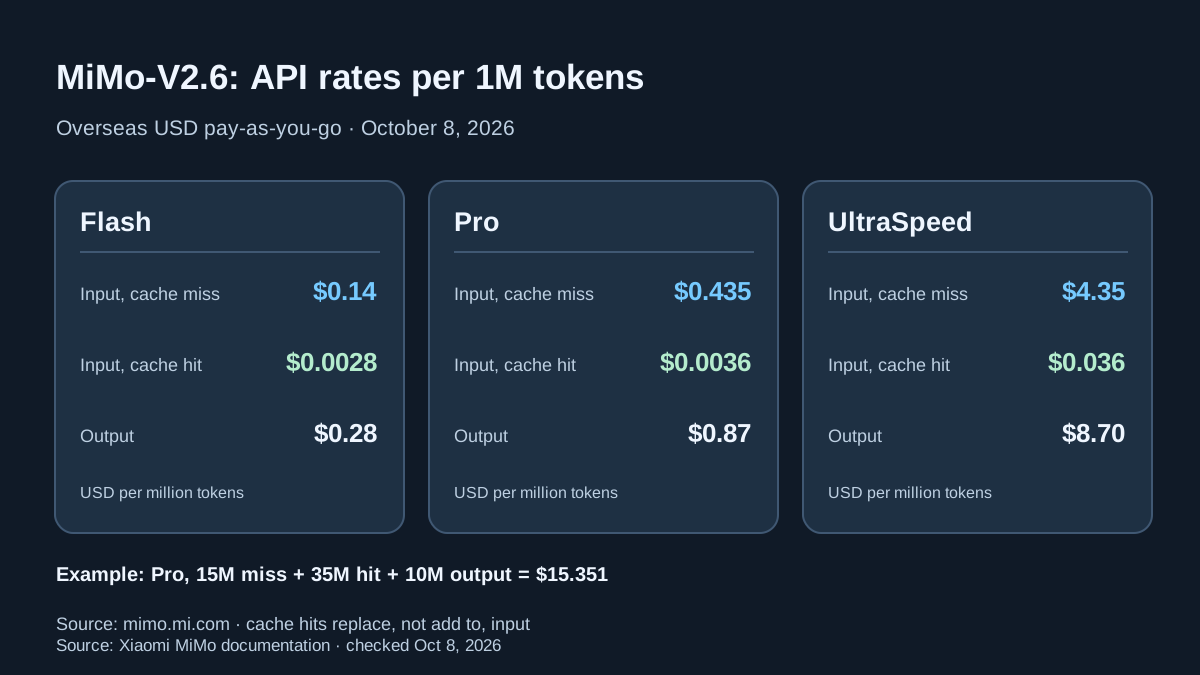
Xiaomi’s official overseas pricing continues to list the following USD pay-as-you-go rates per million tokens. Cache-hit inputs replace regular input tokens; they do not get charged twice.
| Official overseas API | Flash | Pro | UltraSpeed |
|---|---|---|---|
| Input, cache miss | $0.14 | $0.435 | $4.35 |
| Input, cache hit | $0.0028 | $0.0036 | $0.036 |
| Output | $0.28 | $0.87 | $8.70 |
| Batch input / batch output | $0.07 / $0.14 | $0.2175 / $0.435 | not offered |
Worked usage scenarios, recalculated October 8, 2026. All token counts are in millions, and cached input is a subset of total input, not an extra line item:
| Scenario | Total input | Cache hits | Output | Flash | Pro | UltraSpeed |
|---|---|---|---|---|---|---|
| Light | 5M | 0 | 1M | $0.98 | $3.045 | $30.45 |
| Mid-size agent | 50M | 35M | 10M | $4.998 | $15.351 | $153.51 |
| Heavy agent | 500M | 400M | 100M | $43.12 | $131.94 | $1,319.40 |
Formula: (total_input − cached_input) × uncached_rate + cached_input × cache_hit_rate + output × output_rate. For Pro with 50M input, 35M cache hits and 10M output: 15 × $0.435 + 35 × $0.0036 + 10 × $0.87 = $15.351. The former article’s $19.35 Pro and $193.51 UltraSpeed figures were arithmetic errors. Actual cache reuse depends on the request and platform behavior.
For U.S. customers, these are API list prices; applicable sales taxes, gateway markups and paid tools may be additional. Xiaomi lists $5 per 1,000 overseas web-search/parsing uses. UltraSpeed is precisely 10× Pro on ordinary input and output, but Xiaomi does not offer UltraSpeed through Batch API.
When UltraSpeed can make sense
UltraSpeed is primarily a latency/throughput purchase. Xiaomi says it can deliver up to 20× inference speed, while OpenRouter frames it as the same Pro checkpoint served through a much faster path.
That can be rational for interactive coding, low-latency agents or any workflow where wall-clock delay is expensive. For asynchronous research, background jobs or batch processing, the 10× token premium is difficult to justify unless measured time savings produce a larger operational gain.
Why Flash deserves its own evaluation
Flash is not a tiny model. It is a 309B-total, 15B-active MoE with the same 1M context and the same four input modalities listed for Pro. On several Xiaomi-reported evaluations it trails Pro by only one to four points, while API pricing is dramatically lower.
For high-volume agent workloads, the relevant metric is not benchmark score per dollar in isolation. Measure successful task cost: token spend plus retries, recovery steps and human correction. Flash can win economically even when Pro is more accurate per attempt.
Why Pro still matters
Pro scales to 1.02T total parameters with 42B active per token. Xiaomi’s table shows its biggest margin over Flash on some long-horizon security tasks, while general-agent and visual results are often much closer.
If one failed long-running task triggers expensive reruns, Pro’s higher per-token price may be offset by fewer failures. That is a workload hypothesis, not something the public benchmark table alone proves.
Responses API compatibility: what coding agents must handle
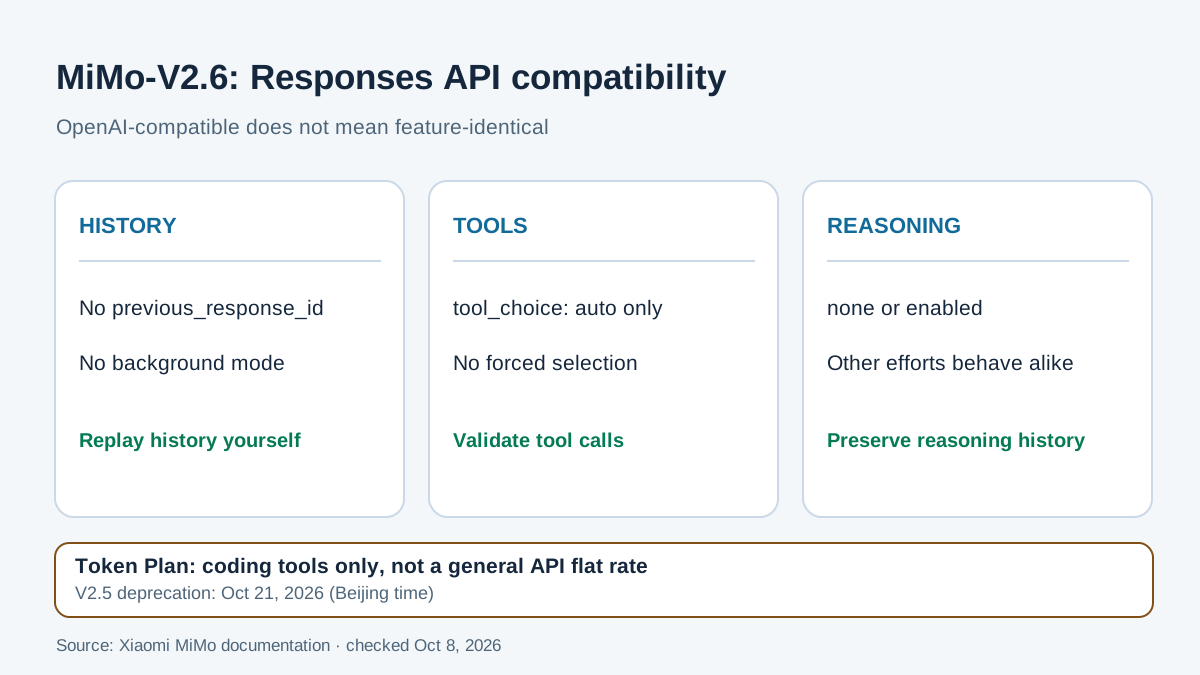
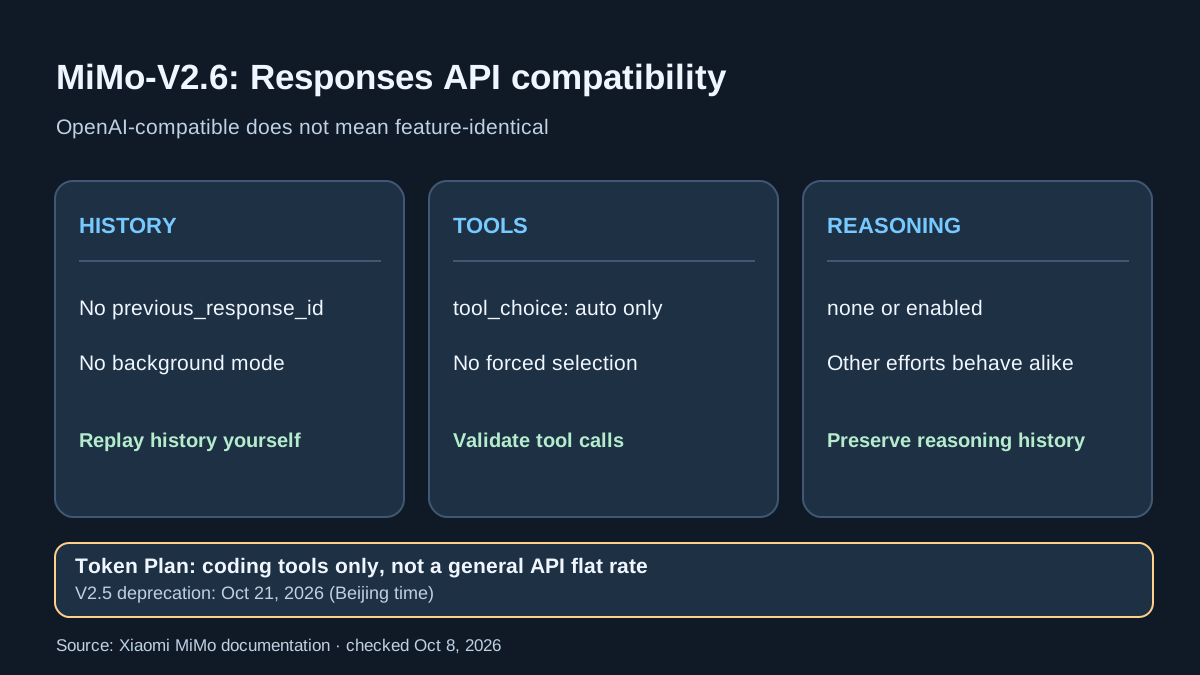
Xiaomi’s Responses specification uses https://api.xiaomimimo.com/v1/responses. All three V2.6 IDs support up to 131,072 output tokens, counting both final-answer and reasoning tokens. However, it is not feature-identical to OpenAI’s Responses API:
background,previous_response_idandcontext_managementare unsupported, so relying on server-side continuation by response ID is unsafe.- Non-
autovalues oftool_choiceare currently stripped or treated asauto. Forced tool execution cannot be assumed. reasoning.effort=noneturns thinking off. All other accepted values currently enable the same effort behavior;maxis not a special higher-compute tier.- With reasoning enabled, sampling values are forcibly set to
temperature=1.0andtop_p=0.95. - Multi-turn agents should replay prior reasoning content with tool-call history; Xiaomi’s OpenCode notes warn about HTTP 400 when required
reasoning_contentis omitted. - JSON-output syntax differs by endpoint: Chat Completions documents
response_format: {"type":"json_object"}; the Responses interface documentstext.format. Do not blindly reuse the same body between endpoints.
The coding Token Plan is not a general-purpose API subscription
Xiaomi’s Token Plan terms permit credits in coding tools such as OpenCode and Claude Code but explicitly prohibit obvious non-coding traffic from arbitrary scripts or application backends. $6/month Lite does not buy an unlimited API backend. Its monthly credit pool is metered and depends on the selected model. Xiaomi’s newer FAQ includes V2.6 Pro and Flash, whereas some older pricing tables still mention V2.5. Check the live plan dashboard for the currently eligible model IDs and quota conversion.
Upcoming deprecation: Xiaomi says the mimo-v2.5 and mimo-v2.5-pro aliases stop working on October 21, 2026 at 10:00 a.m. Beijing time. New integrations should use V2.6 names; regression-test tool history and prompt behavior when migrating.
Open weights does not mean easy local deployment
Both Pro and Flash are published on Hugging Face with MIT license metadata. But Xiaomi’s reference SGLang examples are cluster-scale: Pro uses configurations including tensor parallel 16 and two nodes, while Flash is shown with tensor parallel 8.
For Mac users, the defensible conclusion today is therefore narrower: the weights are available, but Xiaomi’s reference serving setup is designed for substantial GPU infrastructure. Quantized Mac-local performance needs a separate, reproducible test rather than an assumption based on the word “open.”
What was unusual about the training run
Xiaomi publicly streamed roughly six days of reinforcement-learning training. The company says Pro and Flash each completed 30 RL steps, costing about $2.62M for Pro and $0.85M for Flash, with roughly 750,000 trajectories in total.
The model cards describe a mixed RL run spanning coding, general agents, visual tasks and cybersecurity, with 1,568 prompts × 16 rollouts per update and billions of tokens per step. TechNode and NYU Shanghai RITS documented the live dashboard before release, while warning that the displayed benchmark checkpoints were Xiaomi-run rather than independently submitted leaderboard results.
MiMo-V2.6: two open-weight models and a premium speed mode
MiMo-V2.6 is best understood as two open-weight models plus a premium speed mode. Flash minimizes API cost, Pro raises capability headroom, and UltraSpeed trades a 10× token price for much faster Pro inference.
The useful production test is therefore not “which row has the highest benchmark score?” It is cost per successful task, retry rate, agent-step count and overall pipeline latency on your own workload.
For a price-performance comparison, see Qwen3.8-Flash and DeepSeek V4.1 Flash.
Frequently Asked Questions
What is the difference between MiMo-V2.6-Pro, Flash and UltraSpeed?
Flash is the efficiency-oriented MoE with 309B total and 15B active parameters, Pro is the flagship with 1.02T total and 42B active, and UltraSpeed is a hosted Pro-family high-throughput inference mode, not a separate weight release.
Do Flash and Pro both have 1M context?
Yes. Xiaomi's official model cards list 1,048,576 tokens for both, and the Responses API exposes all three V2.6 IDs with up to 131,072 output tokens.
Can I use the $6 Lite Token Plan as an unlimited API backend?
No. The Token Plan is metered and restricted to coding tools. Xiaomi prohibits clearly non-coding custom backends and arbitrary scripts, and standard API usage follows separate pay-as-you-go prices.
Which API tier is cheapest?
Flash, at $0.14/M uncached input and $0.28/M output on Xiaomi's overseas pay-as-you-go pricing. Pro costs about 3.11× Flash on uncached input, and UltraSpeed is exactly 10× Pro.
Are the models open source?
The weights are publicly available on Hugging Face and the model cards carry MIT license metadata. The precise phrasing supported here is 'open weights under MIT license'. Mac-local tokens/sec has not been officially measured for V2.6.
Is UltraSpeed a stronger checkpoint than Pro?
No based on the reviewed sources. Xiaomi and OpenRouter both describe UltraSpeed as a faster Pro-family inference mode, not a separately rated checkpoint. The price premium is a latency/throughput purchase.
Transparency
Sources and review basis
These primary and reference sources form the basis of the technical assessment. Vendor claims and external benchmarks are identified as such in the article.
- mimo.mi.com token-plan / Plans&Pricing
- mimo.mi.com text-generation / structured-output
- mimo.mi.com latest / v2-6
- mimo.mi.com price / pay-as-you-go
- mimo.mi.com chat / responses
- mimo.mi.com chat / openai-api
- mimo.mi.com summary / first-api-call
- mimo.mi.com guidance / rate-limit
- mimo.mi.com faq / api-integration
- mimo.mi.com price / token-plan
- mimo.mi.com integration / codex-configuration
- mimo.mi.com integration / opencode
- mimo.mi.com integration / mimo-desktop
- huggingface.co XiaomiMiMo / MiMo-V2.6-Pro-RL
- huggingface.co XiaomiMiMo / MiMo-V2.6-Flash-RL
- huggingface.co XiaomiMiMo / mimo-v26
- github.com XiaomiMiMo / MiMo
- artificialanalysis.ai models / mimo-v2-6-pro
- artificialanalysis.ai mimo-v2-6-pro / providers
- openrouter.ai xiaomi / mimo-v2.6-pro
- openrouter.ai xiaomi / mimo-v2.6-flash
- openrouter.ai xiaomi / mimo-v2.6-pro-ultraspeed
- technode.com 18 / xiaomi-livestreams-mimo-v2-6-reinforcement-learning-runs
- rits.shanghai.nyu.edu ai / xiaomi-mimo-v2-6-live-rl-dashboard
- runtimewire.com article / xiaomi-open-sources-mimo-v2-6-rl-cost-3-47m
- deepswe.datacurve.ai deepswe.datacurve.ai
- epoch.ai deepswe / review
- programbench.com programbench.com
- tbench.ai www.tbench.ai
- cybergym.io cybergym
- github.com SEC-bench / SEC-bench-Pro
- github.com MaxIntelligenceAgency / ALE-Benchmark
- designarena.ai about
- reddit.com 1wmnw89 / xiaomimimomimov26flashrl_hugging_face
- opencode.ai xiaomi / mimo-v2-6-pro