Newer DeepSeek generation: For current deployment, consult our DeepSeek V4.1 Flash guide. The historic V4 Pro checkpoint is analyzed below.
Checked October 8, 2026. Documentation reflects the historic 0813 V4 Pro checkpoint. The newer flash option is V4.1 Flash; DeepSeek confirmed that V4 Pro remains available through its direct API after reversing the planned September 14 phaseout. Official changelog.
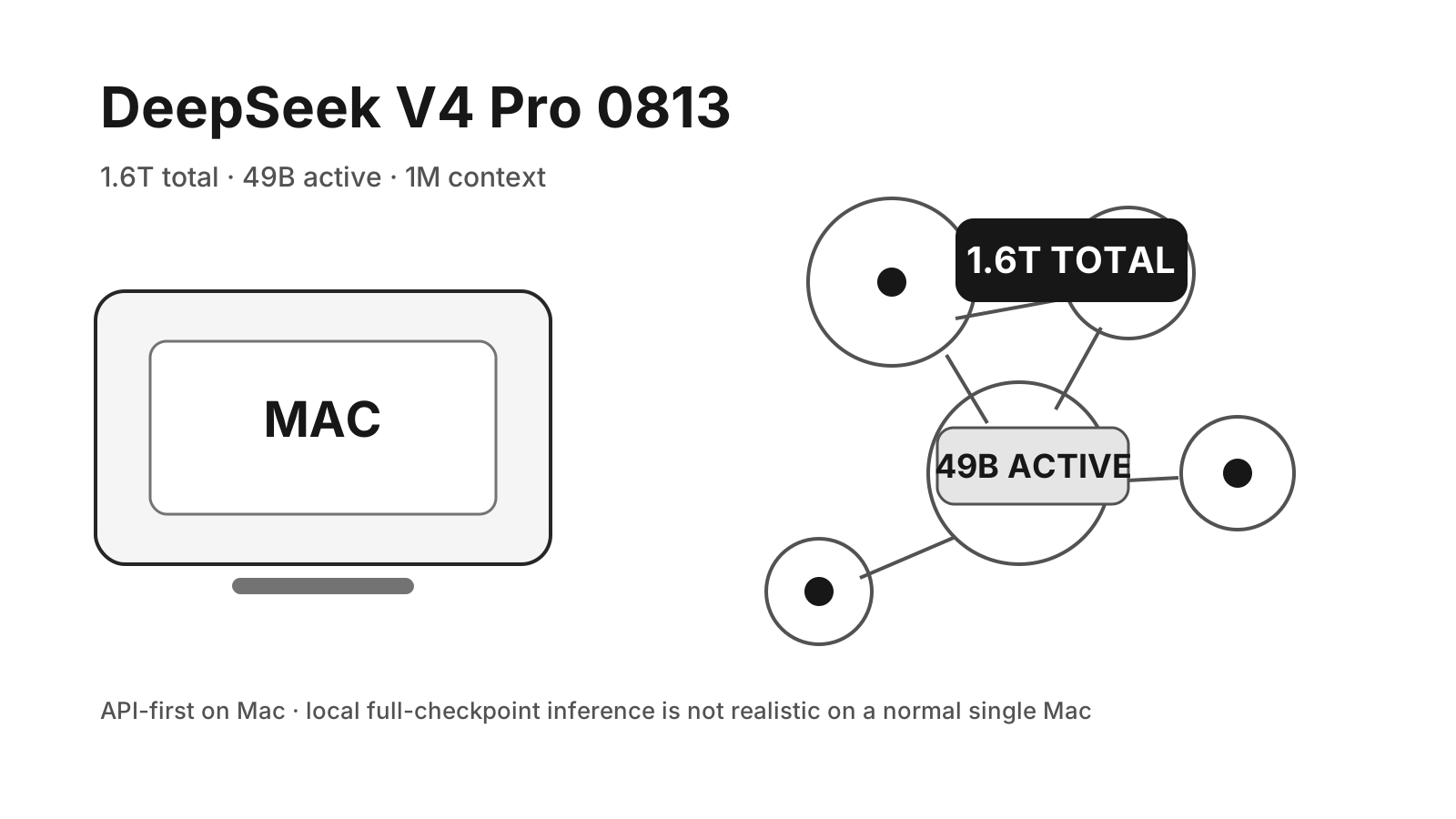
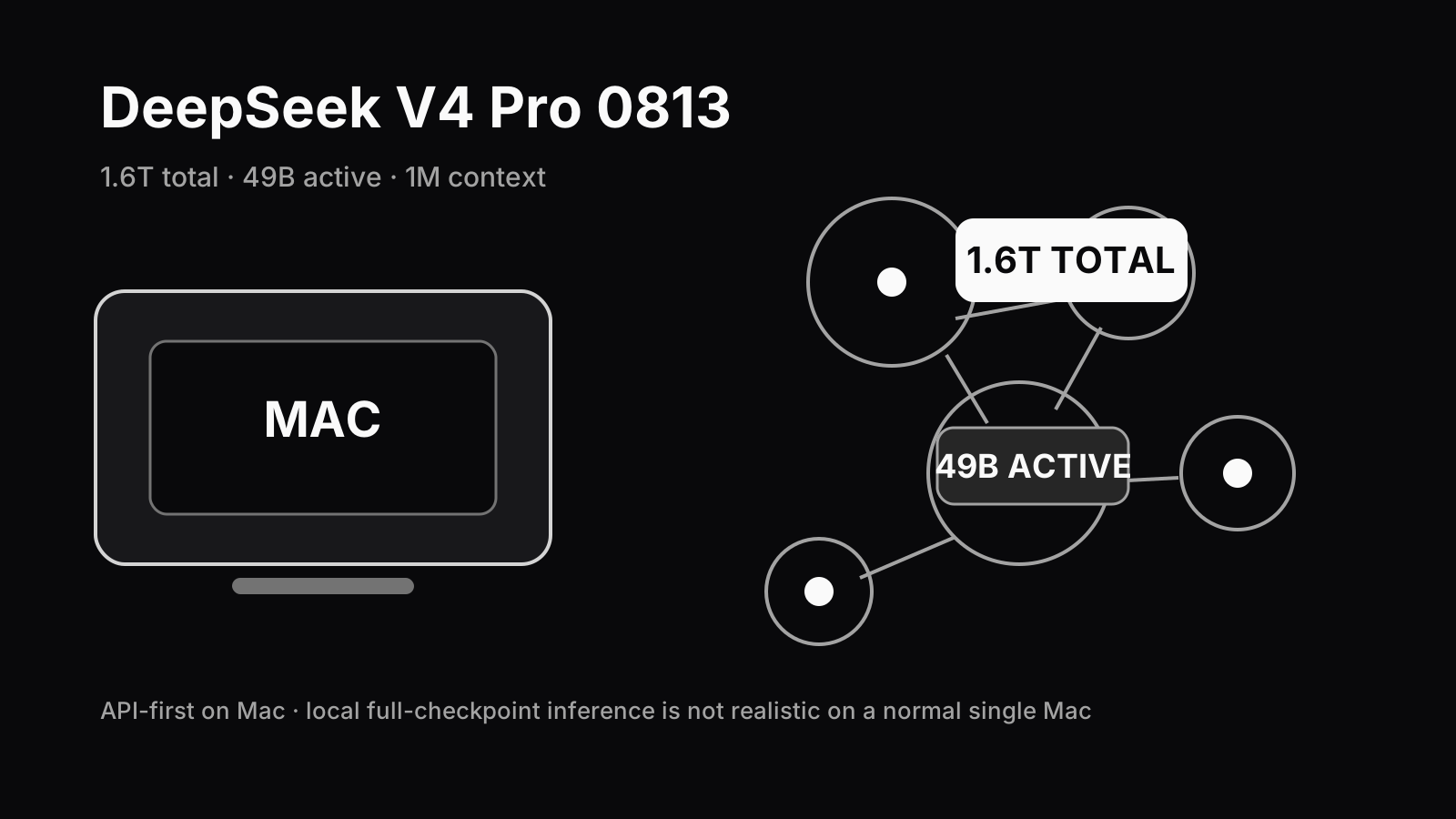
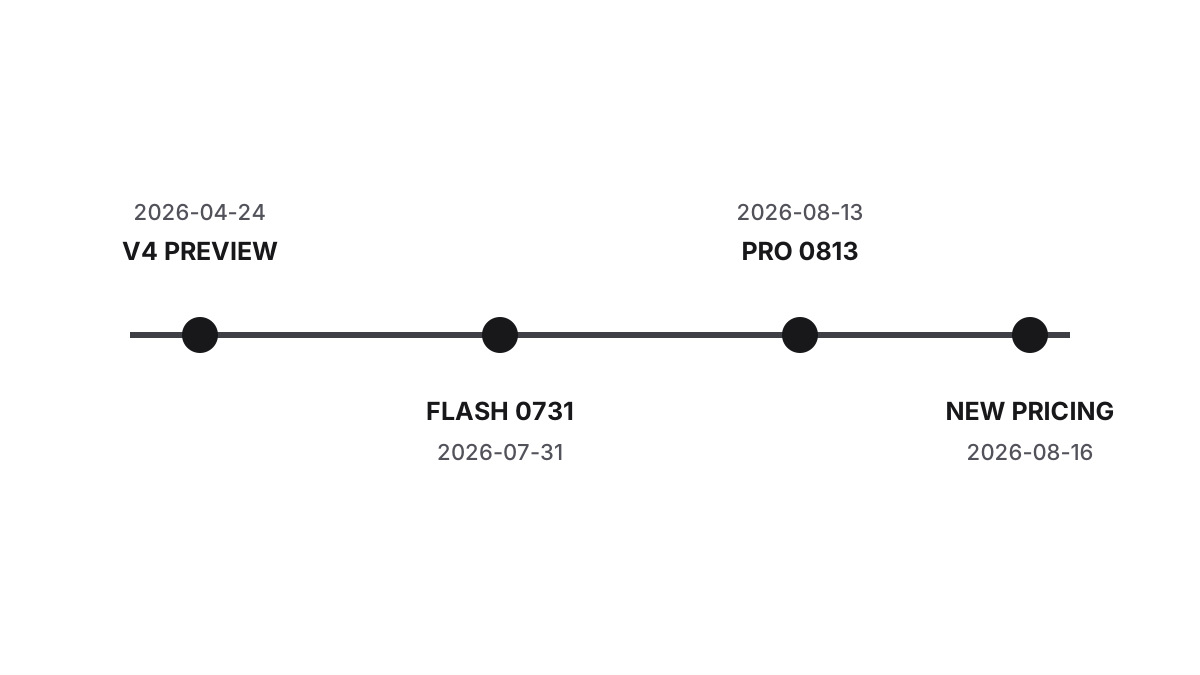
DeepSeek released DeepSeek-V4-Pro-0813 on August 13, 2026 as the GA version of its largest V4 Pro model. The headline numbers are unusual: 1.6 trillion total parameters, 49 billion active parameters per token, a one-million-token context window and three reasoning levels. The direct DeepSeek API still uses the simpler model ID deepseek-v4-pro.
The useful question is not whether the name changed. It is whether the 0813 checkpoint is materially better than the preview, whether it justifies its current price premium over V4.1 Flash, and what those 49 billion active parameters actually mean for local inference on a Mac.
The short version is straightforward: V4 Pro 0813 is much stronger on long-horizon coding and agent workloads, but it is not automatically the best default model. The newer V4.1 Flash is cheaper. August benchmark comparisons against Flash 0731 are historical snapshots, not same-harness comparisons against V4.1 Flash. And despite the 49B active figure, the full model still contains 1.6 trillion weights, which makes it unrealistic for a normal single Mac to run locally.
Core specifications
| Specification | DeepSeek V4 Pro 0813 |
|---|---|
| Release | August 13, 2026 |
| Direct API ID | deepseek-v4-pro |
| Architecture | Mixture of Experts |
| Total parameters | 1.6 trillion |
| Active parameters per token | 49 billion |
| Context window | 1M tokens |
| Maximum API output | 384K tokens |
| Reasoning | low, high, max |
| Default | Thinking, high |
| Tool calls | Yes |
| OpenAI Responses-compatible API | Yes |
| Anthropic-compatible endpoint | Yes |
| Weight license | MIT |
Sources: DeepSeek GA release, DeepSeek Models & Pricing, V4 Technical Report, Model Card.
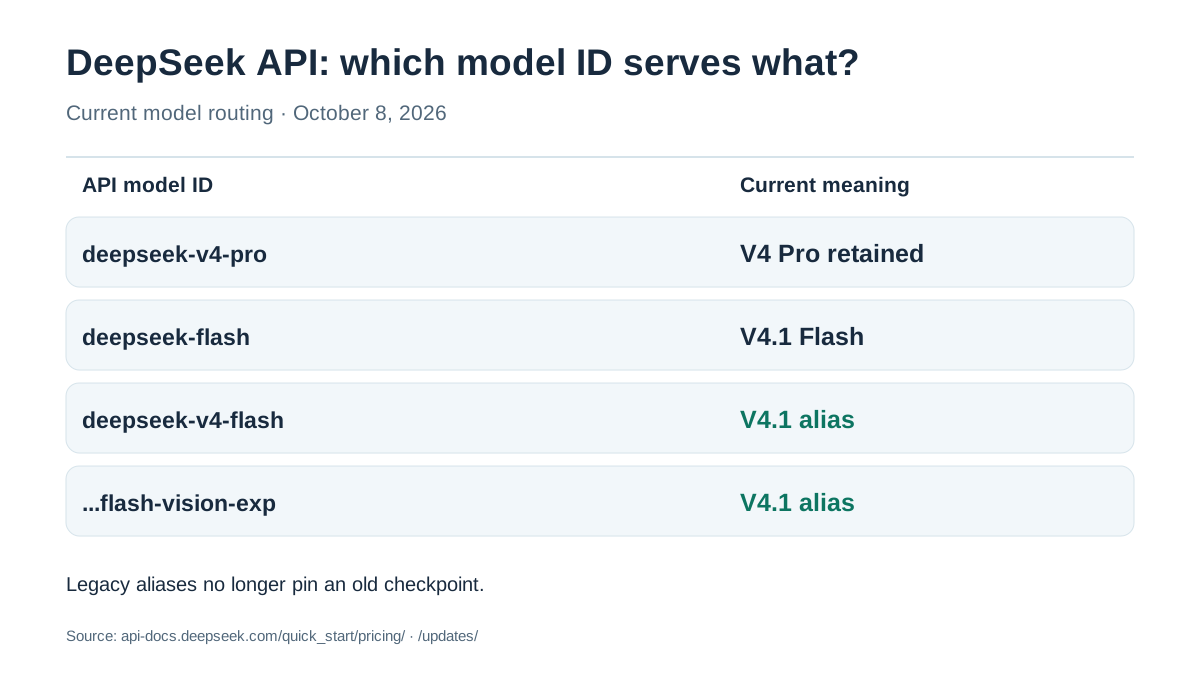
API aliases: do not accidentally benchmark a different model
| Model ID | October 2026 meaning |
|---|---|
deepseek-v4-pro | V4 Pro direct API, maintained following user requests |
deepseek-flash | current DeepSeek V4.1 Flash |
deepseek-v4-flash | old V4 Flash retired; temporarily routes to V4.1 Flash |
deepseek-v4-flash-vision-exp | old Vision Exp retired; temporarily routes to V4.1 Flash |
The 0813 launch scores for V4 Pro remain valid as historical model-specific claims, but they cannot be compared to September’s new V4.1 Flash as though the same evaluator had run an identical harness. DeepSeek release log.
0813 is the checkpoint revision, not the direct API name
The naming is easy to get wrong.
The released checkpoint is:
DeepSeek-V4-Pro-0813The direct DeepSeek API uses:
deepseek-v4-proThat distinction matters in real integrations. Copying the checkpoint name and turning it into deepseek-v4-pro-0813 is not what DeepSeek currently documents for its own API.
Third-party providers use their own IDs. Cloudflare, for example, exposes:
@cf/deepseek-ai/deepseek-v4-pro-0813OpenRouter uses:
deepseek/deepseek-v4-pro-0813Model IDs should therefore be treated as provider-specific configuration rather than a universal property of the checkpoint.
1.6 trillion total parameters does not mean a 49B local model
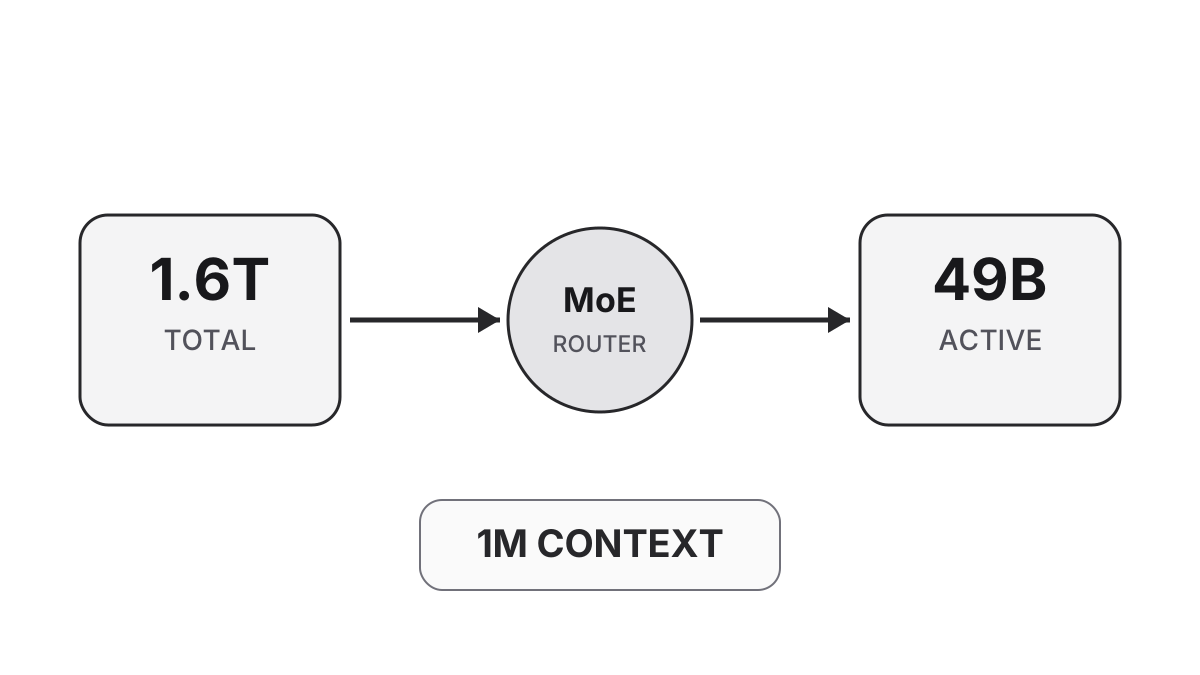
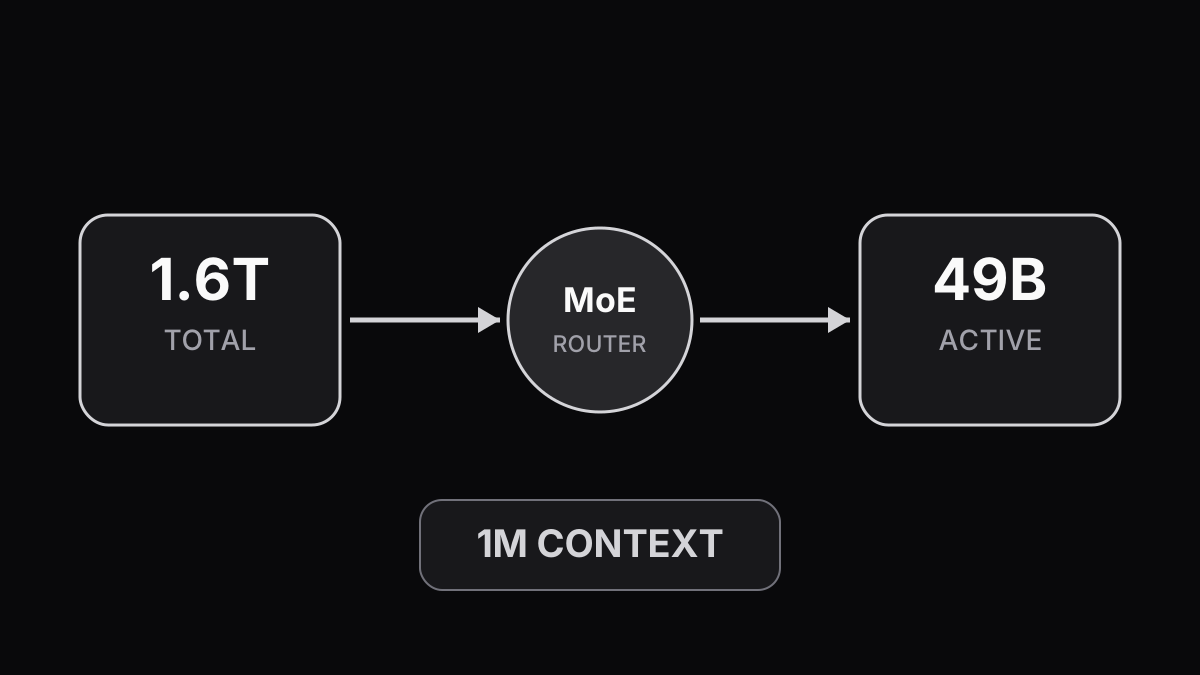
V4 Pro uses a Mixture-of-Experts architecture. Only part of the network is active for each token; DeepSeek reports 49 billion activated parameters per token.
That lowers computation compared with a dense 1.6T model. It does not solve the local memory problem. The expert weights still have to be available to the inference system.
This is where the 49B number can be misleading. 49B active does not mean the checkpoint can be loaded like an ordinary 49B model.
The V4 Technical Report also describes architecture changes aimed at long-context efficiency, including Compressed Sparse Attention and Heavily Compressed Attention. DeepSeek reports substantially lower inference FLOPs and KV-cache requirements at one-million-token context compared with V3.2. Those are first-party technical-report figures, not independent Mac measurements.
What changed in the 0813 release
The GA checkpoint is more than a renamed preview. DeepSeek strengthened its agent post-training and integrated DSpark, its speculative decoding system.
DSpark prepares multiple likely continuation tokens and then verifies several of them together. In the accompanying paper, DeepSeek reports roughly 60–85% higher per-user generation speed than its previous MTP-1 baseline at matched serving throughput.
That number needs to be interpreted narrowly. It describes a documented serving setup. It is not a promise that every hosted V4 Pro endpoint will answer 60–85% faster.
The biggest gains are in coding and agents
DeepSeek’s own 0813 evaluations show the clearest improvements on long tool-use and coding workloads:
| Benchmark | Pro 0813 | Flash 0731 | Pro Preview |
|---|---|---|---|
| HLE with tools | 60.0 | 51.5 | 48.2 |
| Terminal-Bench 2.1 | 87.9 | 82.7 | 72.1 |
| NL2Repo | 61.5 | 54.2 | 38.5 |
| CyberGym | 83.3 | 76.7 | 52.7 |
| DeepSWE | 62.7 | 54.4 | 12.8 |
| Toolathlon-Verified | 74.1 | 70.3 | 55.9 |
| AutomationBench Public | 31.8 | 25.1 | 12.8 |
Source: DeepSeek V4 Pro 0813 Model Card.
DeepSeek says its coding-agent evaluations used DeepSeek Harness with max reasoning, temperature=1.0 and top_p=0.95, among other settings. That makes the numbers most useful for comparing DeepSeek checkpoints under similar conditions. They should not be treated as a substitute for independent cross-vendor evaluation.
The pattern is still meaningful: 0813 improves the workloads where an agent has to remain coherent over many sequential steps.
Independent benchmarks show a much smaller overall gap
Historical benchmark snapshot (August 18, 2026): Artificial Analysis then reported 53 Intelligence Index points for V4 Pro 0813 Max and 52 for V4 Flash 0731 Max. These numbers do not establish the October performance of V4.1 Flash.
That matters because launch coverage cited much larger differences. Benchmark dashboards change as new runs are added or methodology is updated. For a current article, the maintained benchmark page is more useful than freezing the launch-day number.
The practical reading is therefore:
- Pro has a clear advantage on some agent and coding workloads.
- The broad composite gap to Flash is small.
- Treating Flash as dramatically less capable across the board is too simplistic.
Sources: Artificial Analysis – DeepSeek V4 Pro, Artificial Analysis – DeepSeek V4 Flash.
October API pricing: V4 Pro versus the newer V4.1 Flash
Verified October 8, 2026. The old comparison against V4 Flash 0731 is historical. DeepSeek launched V4.1 Flash on September 10, available through the current direct API model ID deepseek-flash. The old names deepseek-v4-flash and deepseek-v4-flash-vision-exp now temporarily alias to V4.1 Flash, not the older checkpoints. After initially announcing a phaseout, DeepSeek specifically confirmed continued direct V4 Pro API service at unchanged billing in response to customers. Do not assume that promise applies indefinitely or to third-party providers. Official DeepSeek changelog · Current pricing.
These are direct DeepSeek API list rates in USD per 1 million tokens, not OpenRouter or Cloudflare prices:
| Model / category | Off-peak | Peak |
|---|---|---|
| V4 Pro · cached input | $0.022 | $0.044 |
| V4 Pro · uncached input | $0.66 | $1.32 |
| V4 Pro · output | $1.98 | $3.96 |
| V4.1 Flash · cached input | $0.003 | $0.006 |
| V4.1 Flash · uncached input | $0.15 | $0.30 |
| V4.1 Flash · output | $0.60 | $1.20 |


At identical token volumes, V4 Pro lists 4.4× the uncached-input rate, 7.33× the cache-hit rate, and 3.3× the output rate versus V4.1 Flash. These are token-price ratios, not task-quality comparisons.
UTC peak windows: 01:00–04:00 and 06:00–10:00 UTC, Monday through Friday. The United States has several time zones and daylight-saving transitions, so converting this to one supposedly universal “US peak schedule” would be inaccurate. Convert from UTC for the desired location and note that the first window can begin on the prior local date. Outside the specified UTC weekday windows, including weekends, the off-peak rate applies.
For U.S. teams: These are USD API list prices, potentially excluding state/local sales taxes, payment fees, or different upstream provider markups. An American billing address or English prompt does not guarantee U.S.-only inference. Review the actual service’s data-processing and retention terms before sending private source code.
What that means in real usage
Per-million-token pricing is difficult to reason about. A few sample workloads make the difference clearer.
Light usage
Assume:
- 1M uncached input tokens
- 2M cached input tokens
- 0.25M output tokens
Pro off-peak
1 × 0.66
+ 2 × 0.022
+ 0.25 × 1.98
= 1.199 USD
Rounded: $1.20
The same workload at peak pricing costs $2.40.
Medium usage
Assume:
- 10M uncached input tokens
- 10M cached input tokens
- 3M output tokens
Result:
- $12.76 off-peak
- $25.52 peak
Heavy usage
Assume:
- 50M uncached input tokens
- 50M cached input tokens
- 15M output tokens
Result:
- $63.80 off-peak
- $127.60 peak
These examples exclude taxes, exchange-rate effects and third-party provider markups.
For batch agents, scheduling can therefore matter almost as much as model choice. Moving a workload outside DeepSeek’s peak windows halves the direct API token cost.
Providers differ in both price and speed
V4 Pro 0813 is available through DeepSeek and several third-party hosts including Baseten, Fireworks, DeepInfra, Novita, Cloudflare and OpenRouter.
Artificial Analysis tracks provider performance separately. These numbers change quickly, but the lesson is stable: the cheapest endpoint is not necessarily the fastest one.
Production comparisons should include:
- Time to First Token
- output tokens per second
- reliability and error rate
- cache billing
- tool-call behavior
- region and data handling
- provider-specific features
Current provider comparison: Artificial Analysis – V4 Pro Providers.
Does V4 Pro support images? It depends on the provider
The documentation is inconsistent across hosts.
DeepSeek’s own Responses API explicitly says image and file inputs are not supported. Its official Codex configuration is also text-only.
Cloudflare, however, marks its Workers AI deployment of V4 Pro 0813 as Vision: Yes.
The safe conclusion is therefore:
Treat the direct DeepSeek API as text-only unless DeepSeek documents otherwise. Some hosted implementations may expose additional multimodal serving paths.
This is a good example of why provider behavior should not be generalized to the underlying checkpoint.
Sources: DeepSeek Responses API, Cloudflare Workers AI.
OpenAI Responses-compatible is not the same as OpenAI feature parity
DeepSeek supports an OpenAI Responses-style API, so the model can be called with the OpenAI SDK:
from openai import OpenAI
import os

client = OpenAI(
    api_key=os.environ["DEEPSEEK_API_KEY"],
    base_url="https://api.deepseek.com",
)

response = client.responses.create(
    model="deepseek-v4-pro",
    instructions="You are a careful coding assistant.",
    input="Review this function for correctness.",
    reasoning={"effort": "high"},
)

print(response.output_text)
That makes migrations easier, but it does not mean DeepSeek implements the entire OpenAI Responses platform.
DeepSeek lists several unsupported features, including:
backgroundstoreconversationprevious_response_idfile_searchcode_interpretercomputer_use- general MCP tools
Some unsupported parameters may be silently ignored. An agent migration therefore needs semantic testing, not just a successful HTTP response.
Source: DeepSeek Responses API.
Anthropic-compatible endpoint and Claude Code-style workflows
DeepSeek also exposes an Anthropic-compatible endpoint:
https://api.deepseek.com/anthropicIts documented model mapping includes:
claude-opus*→deepseek-v4-proclaude-sonnet*→ V4 Flashclaude-haiku*→ V4 Flash
That makes V4 Pro easier to slot into workflows built for Anthropic-style APIs without rewriting every integration from scratch.
As with the OpenAI-compatible endpoint, transport compatibility should not be confused with full behavioral parity.
Source: DeepSeek Anthropic API.
Can DeepSeek V4 Pro 0813 run locally on a Mac?
For a normal single Mac, the practical answer is no.
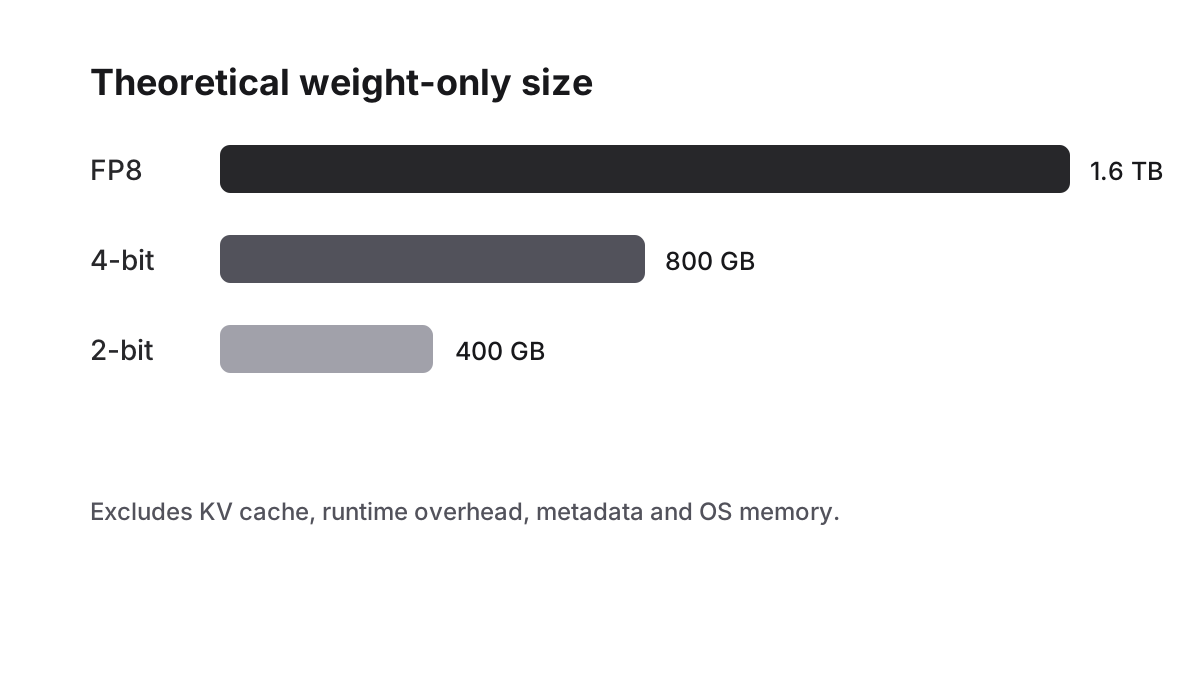
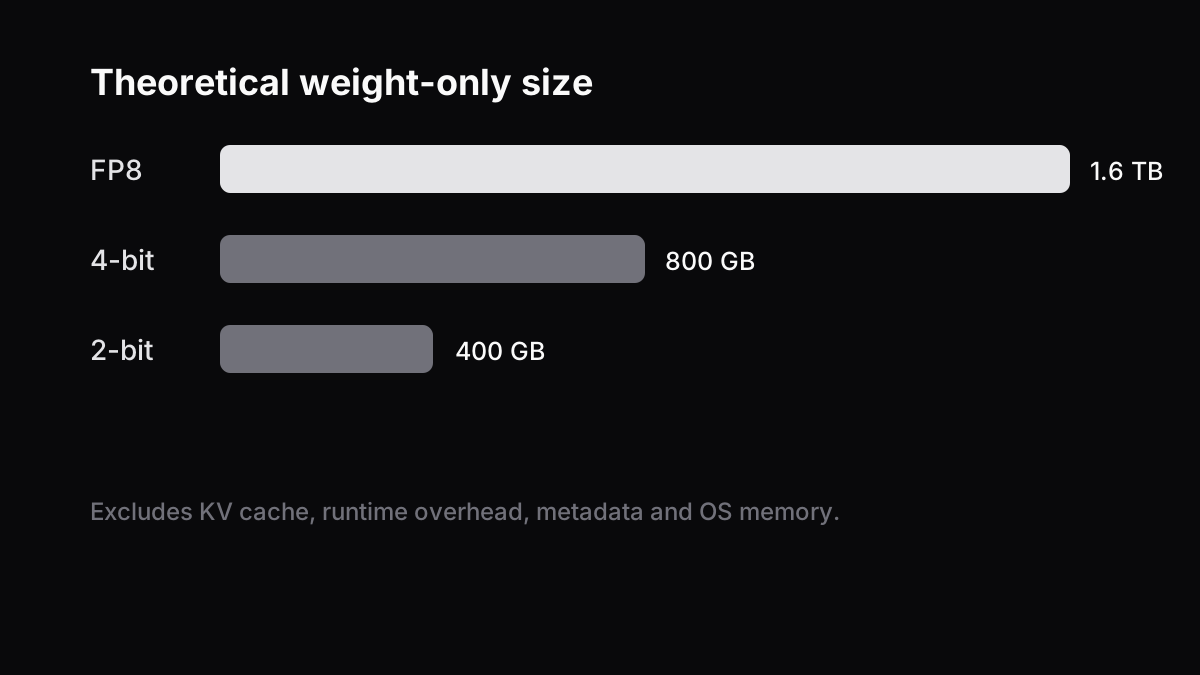
The important number is not 49 billion active parameters. It is 1.6 trillion total weights.
Theoretical lower bound for weight storage
Own calculation:
| Representation | Theoretical weight-only size |
|---|---|
| FP16/BF16 | ~3.2 TB |
| FP8 | ~1.6 TB |
| 4-bit | ~800 GB |
| 2-bit | ~400 GB |
Formula:
1.6 trillion parameters × bits per parameter ÷ 8Those figures are weight-only lower bounds. They exclude:
- quantization metadata
- KV cache
- runtime overhead
- temporary tensors
- macOS
- other running software
Even an aggressive 4-bit estimate lands around 800 GB before runtime memory is considered.
MoE sparsity reduces computation per token. It does not transform 1.6 trillion weights into a 49B checkpoint.
DeepSeek’s own vLLM example uses a 4×GB300 node for V4 Pro 0813, which is a much better indication of the intended hardware class than a consumer Mac.
Source: DeepSeek V4 Pro 0813 Model Card.
What about Ollama?
Ollama lists:
ollama run deepseek-v4-pro:0813-cloudThe important word is cloud.
That entry is not evidence that Ollama is loading the full 1.6T checkpoint into Apple unified memory. It is a cloud-hosted model.
Source: Ollama – DeepSeek V4 Pro 0813 Cloud.
For real on-device inference on Apple Silicon, substantially smaller open-weight models remain the practical category. Model size, quantization, desired context and available unified memory all need to be considered together.
Pro or Flash: which should you use?
The most useful decision rule is based on workflow rather than a single benchmark number.
Choose current V4.1 Flash first when
- token cost matters,
- the agent performs many routine steps,
- low latency matters more than maximum reasoning depth,
- most tasks finish in a few tool calls,
- a failed run is cheap to retry.
Use Pro 0813 when
- an agent works across large repositories,
- many tool steps depend on one another,
- failures late in the task are expensive,
- terminal, repository or automation work is central,
- maximum reasoning depth matters more than token cost.
That suggests a practical routing strategy:
Flash for routine paths, Pro for difficult escalations.
For many agent systems, that is more efficient than routing every request to the most expensive model.
Conclusion: a historical Pro checkpoint versus the newer Flash
DeepSeek V4 Pro 0813 is a meaningful upgrade over the preview, especially where modern agents tend to fail: long coding tasks, tool chains, terminal work and multi-step automation.
It is still not an automatic default choice. On the current direct API, V4 Pro lists 4.4× uncached input, 7.33× cache hit, and 3.3× output compared with V4.1 Flash. The previous benchmark comparisons were made against Flash 0731 and cannot establish V4.1 Flash’s relative quality.
For Mac users, the conclusion is even clearer. V4 Pro is interesting as an API model, not as a realistic local 49B model. The 49 billion active parameters describe computation per token; local memory is still dominated by the model’s 1.6 trillion total weights.
A simple rule therefore works well:
Test V4.1 Flash first. Escalate to V4 Pro only if your own repeatable workflow demonstrably benefits from the more expensive route.
Frequently Asked Questions
Can DeepSeek V4 Pro 0813 run locally on a Mac?
For a normal single Mac: no. The deciding number is the 1.6 trillion total weights, not the 49 billion active parameters. Even an aggressive 4-bit estimate lands around 800 GB before runtime overhead and KV cache are considered. DeepSeek itself demonstrates V4 Pro on a 4×GB300 node.
How much more expensive is V4 Pro than Flash?
Compared with the newer V4.1 Flash, V4 Pro lists 4.4× uncached input, 7.33× cached input, and 3.3× output rates. Peak token rates are double the off-peak prices for either model.
What is the difference between deepseek-v4-pro and DeepSeek-V4-Pro-0813?
DeepSeek-V4-Pro-0813 is the released checkpoint. The direct DeepSeek API still uses the shorter ID deepseek-v4-pro. Third parties such as Cloudflare or OpenRouter use their own IDs, which must be checked per provider.
What does "49 billion active parameters" mean?
V4 Pro is a mixture-of-experts model. Only 49 billion of the 1.6 trillion weights are activated per token. That lowers computation, but it does not turn the model into a 49B local model – the full weights still have to be available for local inference.
Does V4 Pro support images?
It depends on the provider. DeepSeek's own Responses API explicitly documents image and file inputs as unsupported, while Cloudflare marks its Workers AI deployment with Vision: Yes. The direct DeepSeek API should be treated as text-only for now.
When should you use Pro instead of Flash?
Flash is the better default for routine paths, low latency and many simple steps. Pro pays off for large repositories, dependent tool chains and long tasks where a failure is expensive to restart. A tiered strategy – Flash by default, Pro for difficult escalations – is usually more efficient.
Why do the old DeepSeek Flash API IDs now serve V4.1 Flash?
DeepSeek retired V4 Flash and V4 Flash Vision Exp and temporarily forwards those aliases to V4.1 Flash. For new integrations use deepseek-flash. V4 Pro is separately retained on DeepSeek’s direct API under its existing name.
Transparency
Sources and review basis
These primary and reference sources form the basis of the technical assessment. Vendor claims and external benchmarks are identified as such in the article.
- api-docs.deepseek.com news / news260813
- api-docs.deepseek.com quick_start / pricing
- api-docs.deepseek.com guides / thinking_mode
- api-docs.deepseek.com guides / responses_api
- api-docs.deepseek.com guides / anthropic_api
- api-docs.deepseek.com agent_integrations / codex
- huggingface.co main / README.md
- arxiv.org abs / 2606.19348
- arxiv.org abs / 2607.05147
- artificialanalysis.ai models / deepseek-v4-pro
- artificialanalysis.ai models / deepseek-v4-flash
- artificialanalysis.ai deepseek-v4-pro / providers
- developers.cloudflare.com models / deepseek-v4-pro-0813
- ollama.com library / deepseek-v4-pro:0813-cloud
- reuters.com china / deepseek-releases-official-v4-pro-model-it-steps-up-expansion-2026-08-13