Pricing and license checked October 10, 2026. MiniMax H3 is a multimodal video-generation system built to accept combinations of text, images, video and audio, then generate video and stereo sound together. MiniMax launched H3 on July 31 and currently advertises 768P/2K output, 4–15 second clips and 24 fps for the hosted product. MiniMax Research · Model overview
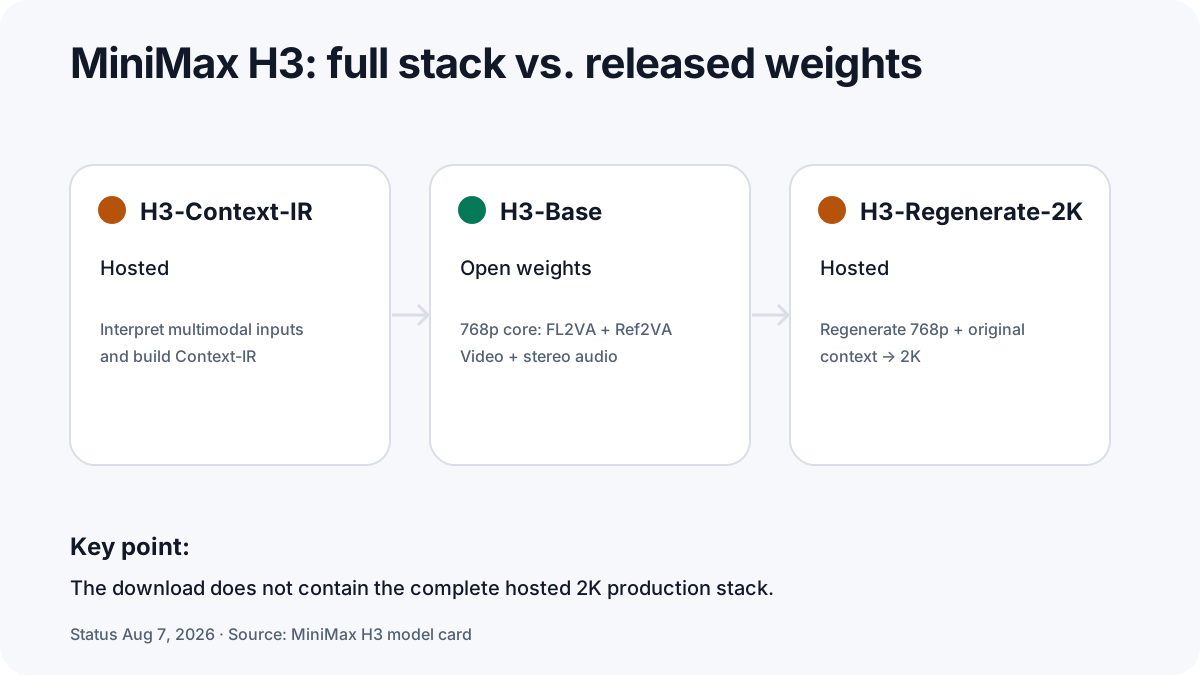
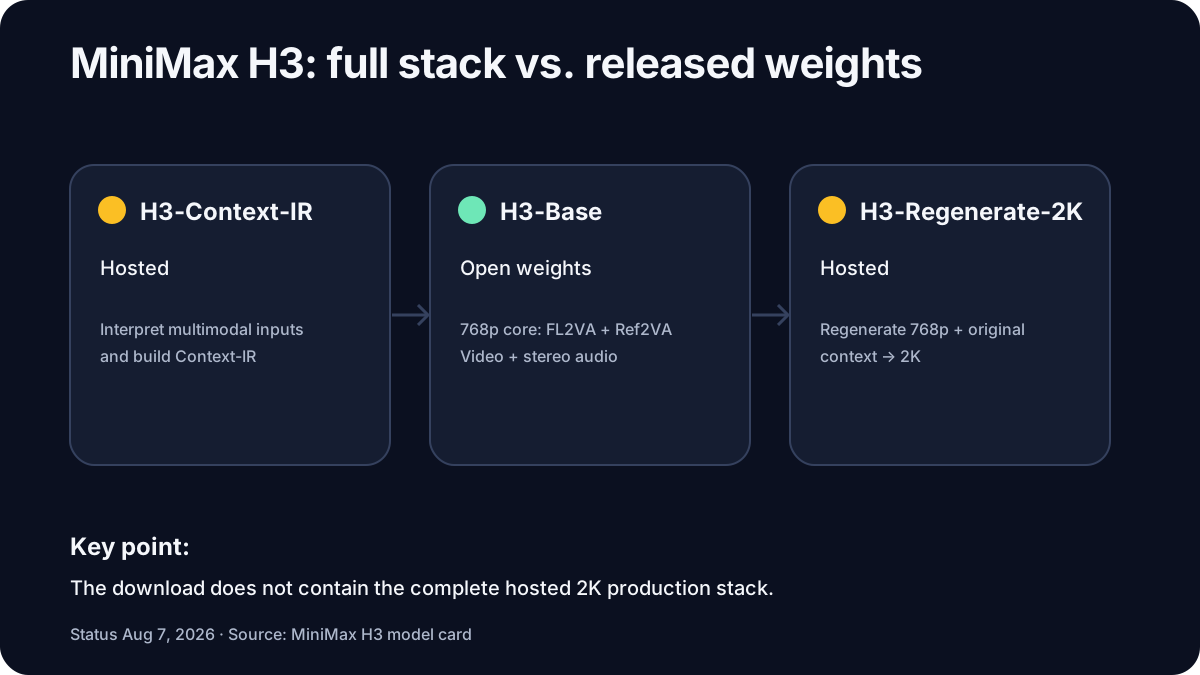
For local-AI users, the important distinction is: the released weights are the H3-Base layer, not the entire hosted H3 production system. MiniMax’s own model card separates H3 into a hosted context-processing stage, an open H3-Base generation core, and a hosted 2K regeneration stage. The licensing story is similarly non-standard: the weights are public, but the MiniMax H3 Community License explicitly excludes the European Union, United Kingdom, Republic of Korea and United States from its “Applicable Territory.” MiniMax’s separate license Q&A states that the hosted H3 API can be used globally because MiniMax controls the service and its safeguards; the LICENSE defines Hosted Services as a category distinct from the territorial-restricted Materials grant, which is structurally consistent with that statement. License Q&A · H3 model card · License
H3 in one minute
- Launch: July 31, 2026.
- Weight/license release: August 2, 2026.
- Hosted output: 768P or 2K, 4–15 seconds, 24 fps.
- Sound: video and native stereo audio are generated jointly; the model card specifies 32 kHz stereo.
- Open variants:
H3-Base-FL2VAandH3-Base-Ref2VA. - Core architecture: a 33B dense H3 Omni Transformer plus a full Qwen3-VL-32B encoder.
- Official output price: $0.08 per second at 768P and $0.13 per second at 2K.
- Local 2K: not the same as the full hosted 2K workflow; the regeneration stage is hosted in the initial release.
- Mac: early Apple-Silicon runs exist, but there is no official Mac performance or minimum-memory target.
- License: public weights do not equal a worldwide permissive license.
Why H3 is more than a text-to-video model
Earlier video generators often exposed capabilities as separate product modes: text-to-video, image animation, first/last-frame control, subject reference, motion reference, voice reference, editing and so on. H3 is designed to move more of those relationships into one multimodal context.
MiniMax’s research post describes a training strategy that mixes text, image, video and audio tasks early and uses natural language to describe relationships between references and the target. That allows prompts such as “take the motion from this clip, the character from this image, and the voice from this audio” to be represented as one generation problem rather than a hand-wired chain of independent models. MiniMax Research
The open model card makes the implementation idea more concrete: modality-specific encoders and VAEs feed a packed multimodal sequence, and the H3 Omni Transformer predicts video and audio latents jointly. H3 model card
That does not prove H3 wins every quality comparison. MiniMax’s examples and “commercial-grade” language are vendor claims. The useful technical fact is that audio/video co-generation and multimodal reference conditioning are first-class parts of the model design rather than bolt-on post-processing.
The three-part H3 system
The cleanest way to understand H3 is to stop treating “MiniMax H3” as one downloadable file.
1. H3-Context-IR — hosted
Complex references can require a lot of understanding before diffusion even starts. MiniMax says its Contextual Omni Representation workflow may process roughly 100K inference tokens of source material and distill it to an average of about 4K tokens. In the released system description, H3-Context-IR is a dedicated preprocessing/orchestration system that is not included in the initial open release. MiniMax provides an API and prompt-writing guidance instead. MiniMax Research · H3 model card
2. H3-Base — open weights
This is the part you can currently download.
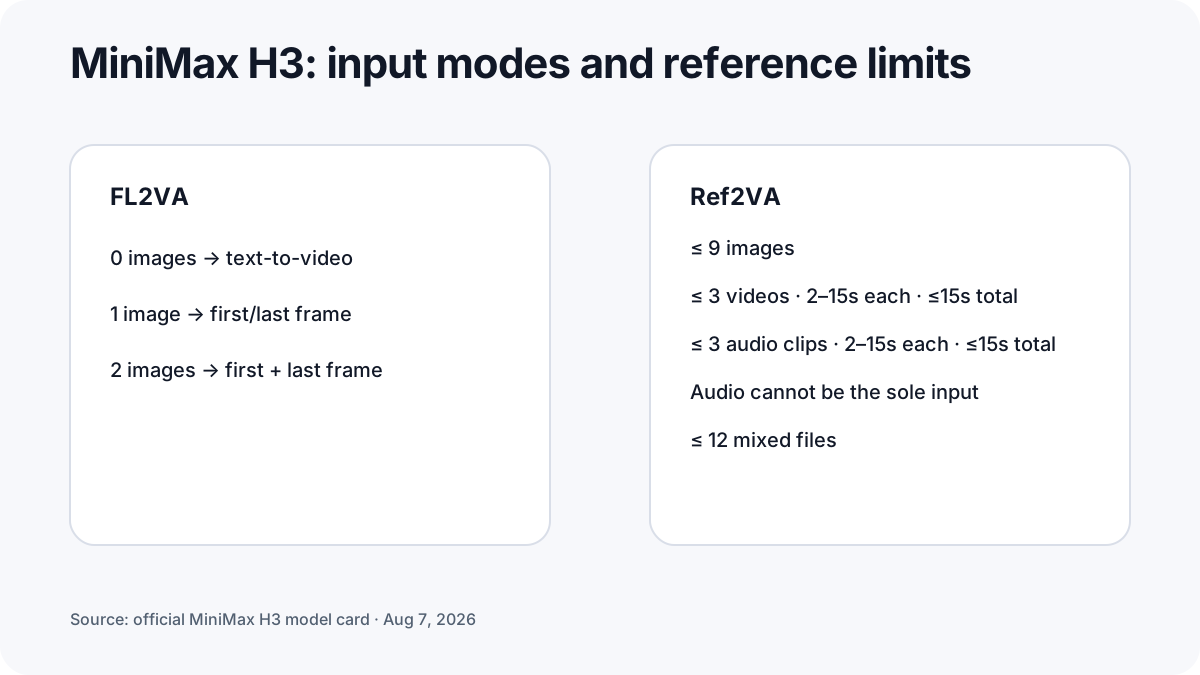
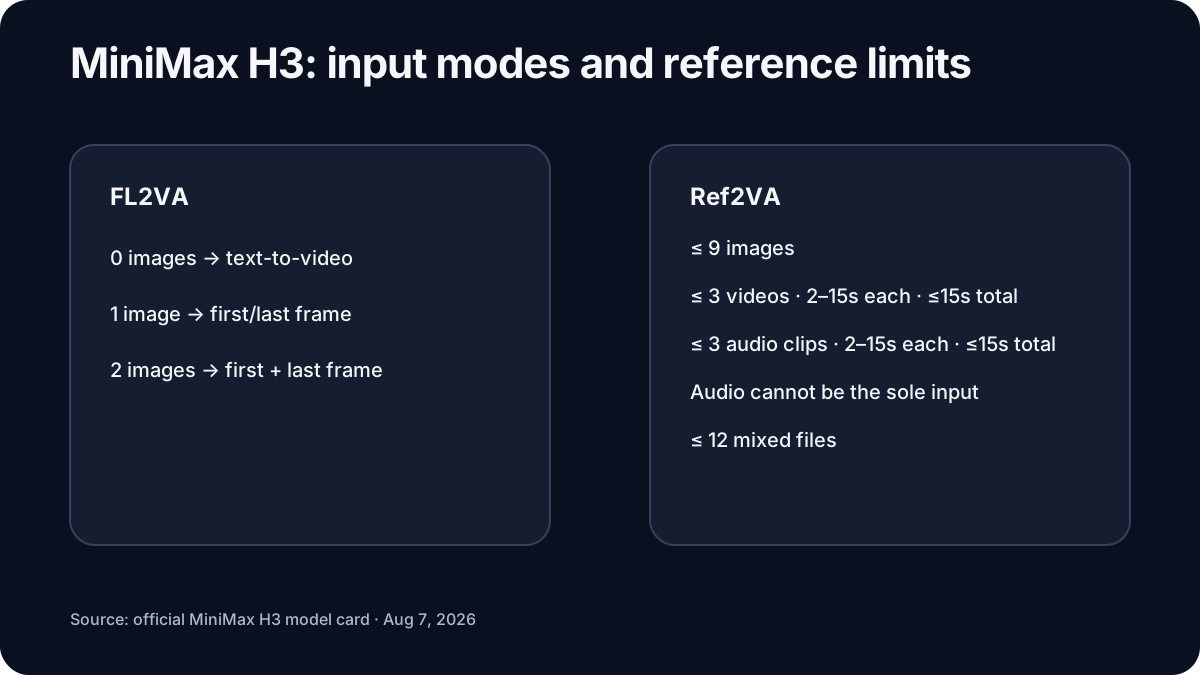
H3-Base-FL2VA handles text-only and first/last-frame workflows:
- zero images → text-to-video;
- one image → first-frame or last-frame generation;
- two images → first-and-last-frame generation.
H3-Base-Ref2VA handles multimodal references:
- up to 9 images;
- up to 3 video clips, each 2–15 seconds, 15 seconds total;
- up to 3 audio clips, each 2–15 seconds, 15 seconds total;
- audio cannot be the only reference modality;
- up to 12 mixed reference files total.
Source: MiniMax H3 model card.
3. H3-Regenerate-2K — hosted
MiniMax’s 2K path is described as in-context regeneration, not a conventional super-resolution pass. The base output is fed back alongside the original context so the model can regenerate details using information from the initial prompt and references. MiniMax argues this is especially useful for details that a generic upscaler would have to guess. MiniMax Research
In the initial release, this is a hosted stage. That distinction matters whenever somebody says “the open H3 model supports 2K.” The H3 product supports 2K; the open H3-Base core is not the complete local 2K stack.
Architecture: 33B is only part of the memory story
The Hugging Face model card lists the H3 Omni Transformer as a 33-billion-parameter dense model. But local inference also needs the H3 encoder, which uses the full pretrained Qwen3-VL-32B weights. Video and audio have separate VAE paths, and the packed multimodal sequence is processed by the joint transformer. H3 model card
This is why a simple “33B model” label understates deployment complexity.
Hugging Face Diffusers documents approximately 61.7 GB for the transformer partition and 62.1 GB for the conditioner side when describing its modular loading strategy. The integration therefore assumes component movement, quantization or multiple accelerators rather than a small single-GPU footprint. Diffusers H3
Sparse attention is a future local optimization
MiniMax says H3 was designed for sparse-attention training and inference, but the initial open inference release provides full attention. The vendor says its sparse-attention implementation will be released later. That matters because sequence length grows with video duration and spatial resolution, and full attention can become expensive quickly. H3 model card
Official H3 API pricing
MiniMax’s current direct API pricing table, checked October 10, 2026, lists these output-only USD rates for MiniMax-H3:
| H3 output | Official list price |
|---|---|
| 768P | $0.08 per generated second |
| 2K | $0.13 per generated second |
Input materials have separate rules:
- audio reference input: free;
- first five images: free, then $0.04 per extra image;
- video references: billed by input duration at the selected output-resolution rate;
- 768P→2K regeneration output: $0.05 per second;
- regeneration re-bills original input materials under the regeneration input schedule;
- Context-IR is token-priced at $0.90 per million input tokens and $3.60 per million output tokens (rechecked October 10, 2026 in MiniMax’s official pricing docs).
Source: MiniMax pay-as-you-go pricing.


Clip-cost calculator
These are calculated estimates from the official output rates. They exclude reference inputs, Context-IR, regeneration input rebilling, taxes and credits.
| Duration | 768P | 2K |
|---|---|---|
| 5 s | $0.40 | $0.65 |
| 10 s | $0.80 | $1.30 |
| 15 s | $1.20 | $1.95 |
The arithmetic is straightforward: duration × output rate.
A few scale examples:
- 10 five-second 768P generations: $4
- 50 eight-second 768P generations: $32
- 100 fifteen-second 2K generations: $195
The last figure is a better planning number than “13 cents per second” for a creator who generates many variants.
How much hardware does local H3 need?
There is no single answer because H3 can trade accelerator memory for host memory and time.
Hugging Face Diffusers currently documents a consumer path that quantizes the transformer and text encoder to INT8 and streams blocks from CPU memory. Its guidance says:
- 24–32 GB GPUs can use quantization plus offload;
- 12–16 GB CUDA cards can use the same basic approach if the video VAE is also offloaded and the canvas is kept small, such as 960×544;
- that low-VRAM setup should expect around 75 GB of host RAM for INT8 weights;
- two 80 GB cards can split the full BF16 pipeline;
- two 48 GB cards can use the split with INT8.
Source: Diffusers H3 memory guide.
So a headline like “H3 runs on 12 GB” is technically possible but operationally incomplete.
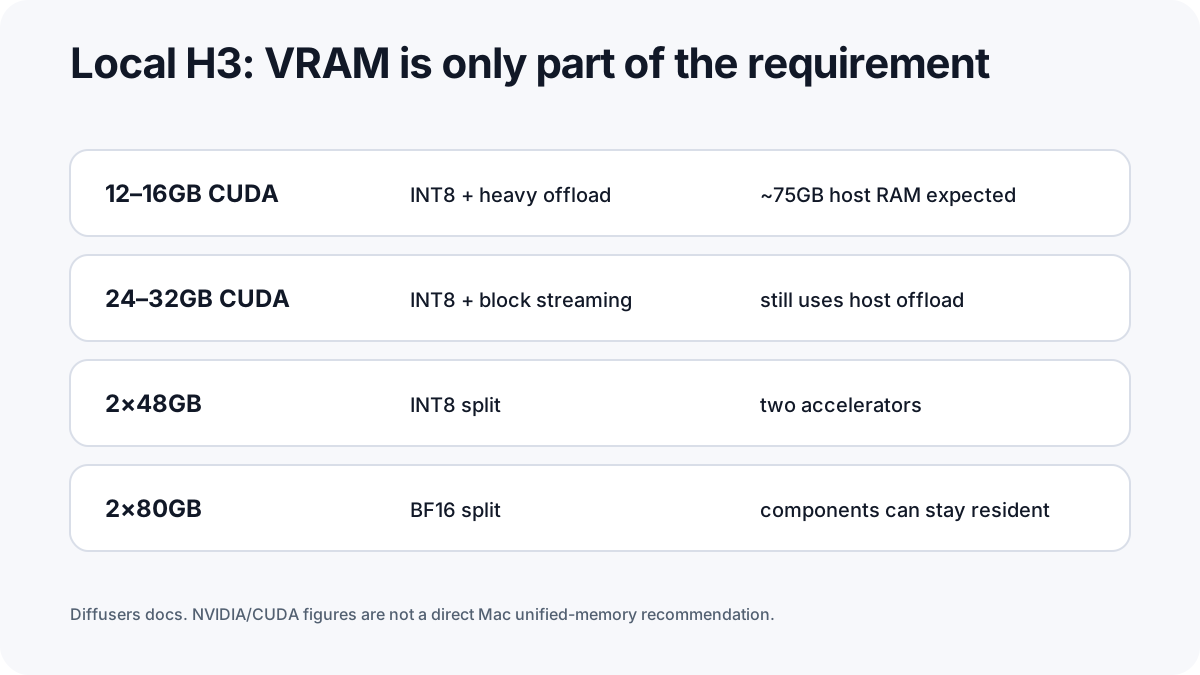
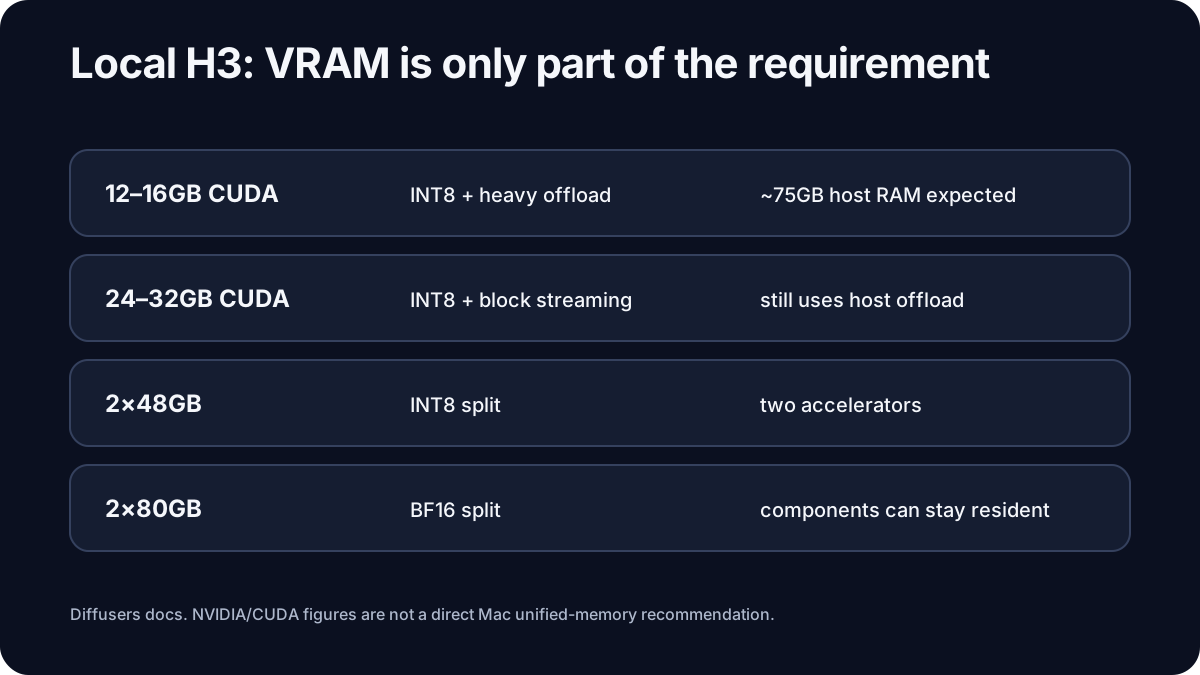
It describes accelerator residency, not the total memory and data-movement cost.
Controlled server benchmarks: useful, but configuration-specific
SGLang’s H3 cookbook publishes the test shape alongside results. Its main benchmark workload uses 1344×768, 124 frames at 24 fps, about 5.167 seconds, 50 denoising steps and one request after warmup. SGLang H3
The results demonstrate how different deployment strategies are:
- high-end B-series and H-series multi-GPU hosts can reach much lower latency with resident or parallelized components;
- a validated 2× RTX 5090 capacity setup with layerwise offload took 559.67 seconds for the full 50-step 1344×768 five-second request, with a sampled peak of 26.3 GiB per GPU.
Do not compare that 559.67-second result directly with a four-H100 or eight-B300 number without reading the topology, warmup and precision details. SGLang explicitly scopes validation to the listed hardware and configuration.
What about a Mac?
Early community reports show local H3 runs on Apple Silicon, but the workflow is still operationally awkward.
The unified-memory architecture can make enormous models approachable in ways that a fixed-VRAM consumer GPU cannot, but most fast diffusion tooling is still developed first around CUDA. During the first week of the H3 weight release, users began posting successful ComfyUI runs on M5-class Macs. The timings vary enough that the variability is the result worth reporting.
Examples from early community threads:
- M5 Max, 608×352, 5 seconds: 438 seconds in one report.
- M5 Pro, roughly 0.4-resolution, 5 seconds: ~30 minutes.
- M5 Max, 768p, 5 seconds: ~27 minutes in one thread.
- M5 Max 128 GB, optimized INT8: a user reported ~15 minutes at 768p for 5 seconds and just under six minutes for a lower-resolution draft.
- a Q4 512×512 five-second workflow was reported at ~18 minutes with an 18 GB peak.
Sources: Mac discussion, early Mac setup, M5 Max 128 GB.
These are not controlled benchmarks. They use different quantizations, nodes, resolutions and patches. An M3/M4/M5 label alone is not enough to predict runtime.
A practical Mac conclusion
For August 2026:
- Can H3 run on Apple Silicon? Early evidence says yes in some quantized community workflows.
- Is there an official Mac minimum? No official MiniMax requirement was found.
- Is it production-friendly? Not yet for most users. Expect experimentation and potentially long generations.
- Does more unified memory help? Capacity, yes; it does not remove compute cost.
- Fastest route to a full 2K H3 result? The hosted API is currently much simpler.
The license issue many launch summaries miss
U.S.-specific warning (October 10, 2026): The United States of America is an Excluded Territory in the publicly distributed H3 weights license. Downloading the checkpoint does not establish a right to locally run or redistribute it in the United States. MiniMax says its own hosted H3 API is globally usable, which is a different offering subject to its service rules. Organizations seeking self-hosting should request a separate license from MiniMax before deployment. This is an informational reading of the publisher’s text, not legal advice. Official license · Official License Q&A.
The H3 weights are downloadable from Hugging Face, but the published license is not a conventional worldwide permissive open-source license.
The MiniMax H3 Community License, dated August 2, defines the “Applicable Territory” as worldwide excluding:
- the European Union;
- the United Kingdom;
- the Republic of Korea;
- the United States.
Its grant of rights is explicitly limited to that Applicable Territory. H3 Community License


For a U.S. developer, that is not a minor footnote. Public availability of a checkpoint does not by itself grant rights that the attached license withholds from a territory.
MiniMax’s license Q&A says the restriction reflects the current regulatory, copyright, likeness and safety environment for generative video. The same Q&A says the hosted H3 API can be used globally because MiniMax controls the service and its safeguards. License Q&A
This article is not legal advice. If you intend to use the weights in an excluded territory or integrate them commercially, read the current agreement and obtain appropriate authorization/advice rather than relying on a blog summary.
The license also includes additional commercial terms, including separate written authorization above $20 million in annual revenue for products/services using H3 and a visible “MiniMax H3” attribution requirement for commercial products or services. License
A U.S. deployment checklist: the weight license is not the hosted API contract
The published H3 Community License governs model materials, derivatives, and outputs generated under that license. Its general grant applies only within the Applicable Territory: the European Union, United Kingdom, Republic of Korea and United States are its explicitly named Excluded Territories. The relevant contract clauses should be read together rather than interpreting the availability of a download button as an unrestricted grant:
| Question | What the published weight license says |
|---|---|
| May I self-host the weights in the United States? | Not under the public grant: the United States is an Excluded Territory. Separate authorization must actually be obtained. |
| What about the EU, UK and South Korea? | Also specifically excluded from the general public grant. |
| May a self-hosted product distribute its outputs outside permitted territories? | Section V.4 explicitly restricts outputs as well as model materials outside the Applicable Territory. Plan any downstream distribution under a separate authorization. |
| Can H3 outputs train a completely different model? | Section V.3 prohibits using H3 works or their outputs to improve other AI models beyond H3 or its derivatives. |
| What changes for commercial deployment in permitted countries? | The license calls for visible “MiniMax H3” UI attribution and prior written authorization for products/services above $20 million in annual revenue, plus distribution and safeguards obligations. |
| Does the official MiniMax H3 API follow these exact same weight-grant rules? | Do not assume so. MiniMax says its own hosted API is globally available in the official licensing Q&A. Its API-specific contract, privacy policy, eligibility, and data-processing controls need separate review. |
One official FAQ heading is easy to misread: it does not override the LICENSE’s explicit definition of excluded territories. Section II describes contacting MiniMax to request territory-specific permission; it does not grant permission by default. Consult the signed authorization and applicable platform terms for a real U.S. product. This analysis is not legal advice or deployment approval.
Regeneration billing: compare complete tasks, not just output-per-second stickers
The MiniMax pay-as-you-go table lists $0.05 per output second for 768P-to-2K regeneration, and says the original input materials are charged again at regeneration input rates. A transparent example using 10 seconds and six reference images:
- Generate at 768P: 10 × $0.08 = $0.80 output, with the first five reference images free and the sixth costing $0.04.
- Regenerate those ten seconds at 2K: 10 × $0.05 = $0.50 output; the sixth previously submitted reference image costs $0.025 again at the regeneration input rate.
- Combined: $1.365 before taxes in this simplified example without Context-IR, reference-video fees, or additional API calls. Direct 2K output of the same duration costs $1.30 in output charges, plus applicable material fees.
This is a calculation, not an actual billed API run or a quality equivalence claim. Usage windows and input combinations depend on the exact API. Budget and log output, original materials, second-pass materials, and Context-IR as distinct line items.
ComfyUI is the easiest way to explore the open release today
ComfyUI shipped native H3 workflows almost immediately. Its documentation currently covers text-to-video, image-to-video and reference-to-video, and the workflow JSON files are public. ComfyUI H3
That is a major usability advantage for experimentation. It also means screenshots and third-party workflows can age quickly. If a node name, file layout or memory behavior looks different from an August 2026 tutorial, update ComfyUI and compare against the native templates before debugging old custom nodes.
Prompting H3: describe relationships, not just aesthetics
MiniMax’s own prompting guides are unusually important because the model’s differentiator is multimodal relationships.
The base guide structures prompts around an integrated multimodal description, overall soundscape and optional non-diegetic music. The reference guide goes further with subject definitions, a retention analysis, detailed scene description and explicit reference relationships. Base guide · Reference guide
A good H3 prompt therefore answers more than “what should it look like?” It can specify:
- which reference controls identity;
- which reference controls motion;
- how dialogue should align with a speaker;
- when shots change;
- what belongs to diegetic sound versus music;
- what must remain unchanged across edits.
That is a better mental model than treating H3 as a one-line cinematic-prompt engine.
Where H3 still falls short
MiniMax itself lists room for improvement in multimodal understanding, model scale and visual detail. MiniMax Research
The open ecosystem adds more immediate limitations:
- full-attention inference in the initial release;
- no open Context-IR module yet;
- no open Regenerate-2K module yet;
- large model + encoder memory footprint;
- very young Mac support;
- rapidly changing quantization and acceleration workflows;
- quality/runtime trade-offs when using aggressive caches, reduced steps or heavy quantization.
None of those makes H3 uninteresting. They simply define what “open H3” actually means in its first week.
MiniMax H3 vs H3-Max: different API costs
The current MiniMax price sheet now lists MiniMax-H3-Max alongside H3. These are separate video API products; do not apply H3’s reference-image allowance or 2K rate to H3-Max.
| Official direct video API | Per output second | 10 s output only | Included reference images |
|---|---|---|---|
| H3 at 768P | $0.08 | $0.80 | first 5 |
| H3 at 2K | $0.13 | $1.30 | first 5 |
| H3-Max at 480P | $0.05 | $0.50 | first 2 |
| H3-Max at 768P | $0.08 | $0.80 | first 2 |


Reference-video example: An H3 clip using 10 seconds of reference video plus 10 seconds of generated output costs $1.60 at 768P ($0.80+$0.80) or $2.60 at 2K ($1.30+$1.30), before other billable material. H3-Max prices reference video differently: $0.0553/s at 480P or $0.143/s at 768P. Beyond the first two included reference images it also charges $0.074 per image, not H3’s $0.04 rate after five. MiniMax video billing.
Regeneration is not free upscaling. With H3, generating a 768P draft ($0.08/s) and regenerating it at 2K ($0.05/s) adds up to $0.13/s in output fees—the same as direct 2K—before the originally supplied references are billed again under the regeneration schedule. The strategy saves output cost primarily when you discard cheap drafts and upgrade only the ones you keep. Official regeneration table.
For U.S. developers: All dollar amounts above are direct API list rates, not Hailuo subscription credits. Applicable sales taxes and payment fees may be extra. U.S. availability through MiniMax’s hosted API does not convey the right to deploy its open weights in the United States. Those weights have a separate territory-restricted license.
H3 vs. Hailuo 2.3: the product shift
MiniMax’s own model overview shows the change clearly.
| Feature | MiniMax H3 | Hailuo 2.3 |
|---|---|---|
| Text-to-video | Yes | Yes |
| Image-to-video | Yes | Yes |
| First/last frame | Explicit H3 mode | Not listed as equivalent H3-style mode |
| Multimodal reference | Explicit H3 mode | Not listed in the same form |
| Joint native audio/video | Core H3 feature | Not listed as equivalent core feature |
| Duration | 4–15 s | 6/10 s depending on resolution |
| Resolution | 768P / 2K | 768p / 1080p |
| FPS | 24 | 24 |
Source: MiniMax model overview. This is a feature comparison, not a quality ranking.
Which route should you choose?
| Goal | Best current route |
|---|---|
| Full official H3 experience at 2K | Hosted MiniMax API/Hailuo |
| Multimodal references without hardware setup | API |
| Research, modify workflows, inspect open weights | Local H3-Base, if your region/license allows |
| EU user without separate weight authorization | Do not assume the public checkpoint grants local rights; evaluate hosted API / licensing |
| Mac experimentation | Local is possible, but expect immature tooling and long runs |
| Mac production workflow | API is currently more practical |
| Low VRAM but lots of system RAM | Quantization/offload can work; expect latency |
| Fully local official 2K stack | Wait for missing components or build substitutes |
Practical conclusion
MiniMax H3 combines multimodal reference control, joint audio-video generation and a published local H3 core.
But the accurate version of the story has two caveats that should appear near the top of any technical article:
The released H3-Base weights are not the complete hosted H3 system.
The weights are public under a custom license whose territory excludes the EU, UK, South Korea and US.
For Mac users, early community reports show that H3 can be run locally, but it is not yet an easy production tool. Those reports indicate that quantized inference is possible, while also showing why you should not copy a single generation time and call it “the H3 Mac benchmark.” Until optimized Apple paths stabilize, the API remains the straightforward route to the complete 2K experience.
The license is published by Nanonoble Pte. Ltd. (definition 15 of the License Agreement), which operates publicly under the MiniMax brand.
The MiniMax family continues in the M3.1 Flash launch guide, and a similar EU access problem is described in the Sakana Fugu Ultra article.
Frequently Asked Questions
Is MiniMax H3 open source?
'Open weights under the MiniMax H3 Community License' is more accurate. The license has territory and commercial restrictions and should not be described as a standard worldwide permissive open-source license.
Can I run H3 locally?
H3-Base is publicly downloadable and supported by Diffusers, ComfyUI and SGLang, but the public Community License excludes the United States, EU, UK and South Korea. Local deployment in these territories requires separate authorization. Elsewhere, hardware demands and offloading still matter.
Can I run H3 on an Apple Silicon Mac?
Early community reports show successful runs, especially with quantized checkpoints and Apple-Silicon-specific tooling. There is no official MiniMax Mac minimum or stable performance target yet.
Does local H3 generate 2K?
The initial open H3-Base is the local generation core. MiniMax's full 2K path uses a separate hosted Regenerate-2K stage, so the complete official 2K stack is not yet fully open.
How much is a 15-second H3 generation?
H3 output-only pricing checked October 10, 2026 is $1.20 for 15 seconds at 768P or $1.95 at 2K. H3-Max has separate 480P/768P rates, and input references, regeneration, taxes and provider charges can increase the total.
Can U.S. developers locally deploy MiniMax H3 weights?
Not under the ordinary public H3 Community License, which expressly excludes the United States. MiniMax may issue separate authorization, while its own hosted H3 API is described as globally available under separate service terms.
What is the difference between H3-Base-FL2VA and H3-Base-Ref2VA?
H3-Base-FL2VA handles text-only and first or last-frame workflows (zero, one or two images). H3-Base-Ref2VA is the multi-reference variant: up to 9 images, 3 video clips and 3 audio clips, 15 seconds total, with a hard cap of 12 mixed reference files.
Do I need a multi-GPU NVIDIA card for H3?
Not strictly, but without multiple GPUs you will rely on quantization and offload. The Diffusers memory guide documents 12 to 16 GB CUDA VRAM with video-VAE offload and roughly 75 GB of host RAM in INT8; for a full BF16 split without constant shuffling it lists two 80 GB GPUs.
When does the hosted API make more sense than the local stack?
The hosted API is currently the pragmatic choice whenever you need the full 2K pipeline with Context-IR and Regenerate-2K, do not have multi-GPU hardware, or are not in the Applicable Territory. Local H3-Base makes most sense when you want to explore, modify or benchmark the open weights yourself.
What does the EU license point mean for a product team?
The MiniMax H3 Community License excludes the EU from the Applicable Territory. Any product or service that reaches users in the EU requires a separate written authorization from MiniMax, and above 20 million US dollars in annual revenue a separate approval is required even inside the Applicable Territory.