Version note: Kimi K2.7 Code is the specialized coding generation; the newer flagship Kimi K3 is also available.
Checked October 8, 2026. Kimi K2.7 Code is a coding-agent model from Moonshot AI. You can operate it from several Mac interfaces, but an interface does not automatically make inference local. A useful decision requires separating five paths: the Ollama cloud tag, the separate Kimi Code product, the direct Kimi API, providers such as OpenRouter, and a very large third-party GGUF.
The short decision
- Quick Mac evaluation:
kimi-k2.7-code:cloudin Ollama is the simplest route if cloud processing is acceptable. - Product integration: the direct Kimi API provides OpenAI- and Anthropic-compatible interfaces and uses the model name
kimi-k2.7-code. - Kimi Code CLI: the product has its own model IDs, membership plans and quotas. Its prices are not automatically API token prices.
- Offline Apple Silicon: do not treat it as a normal Mac setup. Third-party GGUF documentation does describe Metal support, but lists roughly 310–605 GB of total memory depending on quantization.
- Privacy: cloud paths send code, prompts and any included files away from the Mac under the selected provider’s terms.
No original Apple Silicon speed test is included. The local assessment therefore separates documented prerequisites from theoretical feasibility.
What “on a Mac” actually means
| Access path | What runs locally? | Where inference runs | Context in the current source |
|---|---|---|---|
Ollama :cloud | Ollama, terminal or agent client | Ollama Cloud | 256K; text and image |
| Kimi Code | CLI/IDE and local session control | Kimi service | depends on current model routing and plan; not permanently fixed at 256K |
| Kimi API | your SDK, terminal or server | Kimi API | 256K; text, image and video in the official API |
| OpenRouter | your client | selected routing provider | check provider metadata; currently 262K shown |
| GGUF with llama.cpp/Unsloth | runtime and weights | your Mac, if memory is sufficient | depends on runtime and configured context |
“Kimi on Mac” therefore often describes the operating location of the client. Only the last row represents a local inference path, requiring an exceptionally large third-party memory footprint.
Model facts from the model card
Moonshot publishes Kimi K2.7 Code as a mixture-of-experts model with:
- 1 trillion total parameters and 32 billion activated parameters per token;
- 384 experts, with eight selected per token plus a shared expert;
- 61 layers and MLA attention;
- a 256K context length;
- a MoonViT vision encoder with 400 million parameters;
- native INT4 quantization;
- image and video input in the official API.
“32B active” does not mean that a 32B model is loaded into memory. The weights, runtime, activations and KV cache still matter. The official model card recommends Transformers, vLLM and SGLang; it does not present a convenient standard workflow for an ordinary Mac.
Ollama Cloud: the straightforward Mac route
Ollama currently lists a cloud tag:
ollama launch claude --model kimi-k2.7-code:cloudThe Ollama page also lists integrations for OpenCode, Hermes Agent and OpenClaw. The client starts on the Mac, but the :cloud suffix is the important part: it signals remote inference. The current tag shows a 256K context window and text/image input.
Check availability, quotas and billing directly with Ollama before production use. Those details can change independently of the model version. ollama run or ollama launch is not evidence that several hundred gigabytes of model weights are stored locally.
Kimi Code is a separate product
Kimi Code and the Kimi API are not the same billing layer:
- The API platform uses the model name
kimi-k2.7-codeand pay-as-you-go billing. - Kimi Code exposes the alias
kimi-for-codingwith separate membership quotas. Moonshot can map the alias to a newer backend snapshot; the pinned K2.7 Code API model is a different access route. - The API HighSpeed variant is
kimi-k2.7-code-highspeed; the corresponding Kimi Code product ID iskimi-for-coding-highspeed. - K2.7 Code remains a 256K model in both variants. HighSpeed changes output speed, not the model class or context window.
Always compare the model ID, product, plan and billing method. A Kimi Code membership price must not be presented as an API token price.
Direct Moonshot API pricing: K2.7 Code versus K3
Moonshot’s official international API platform lists these USD token rates per million tokens on October 8, 2026. These are API prices, not Kimi Code membership fees. The newer Kimi K3 adds a 1M-token context window and a higher-price flagship tier. Official Kimi platform.
| Direct Kimi API | Fresh input | Cache hit | Output | Context |
|---|---|---|---|---|
| Kimi K2.7 Code | $0.95 | $0.19 | $4.00 | 256K |
| Kimi K3 | $3.00 | $0.30 | $15.00 | 1M |
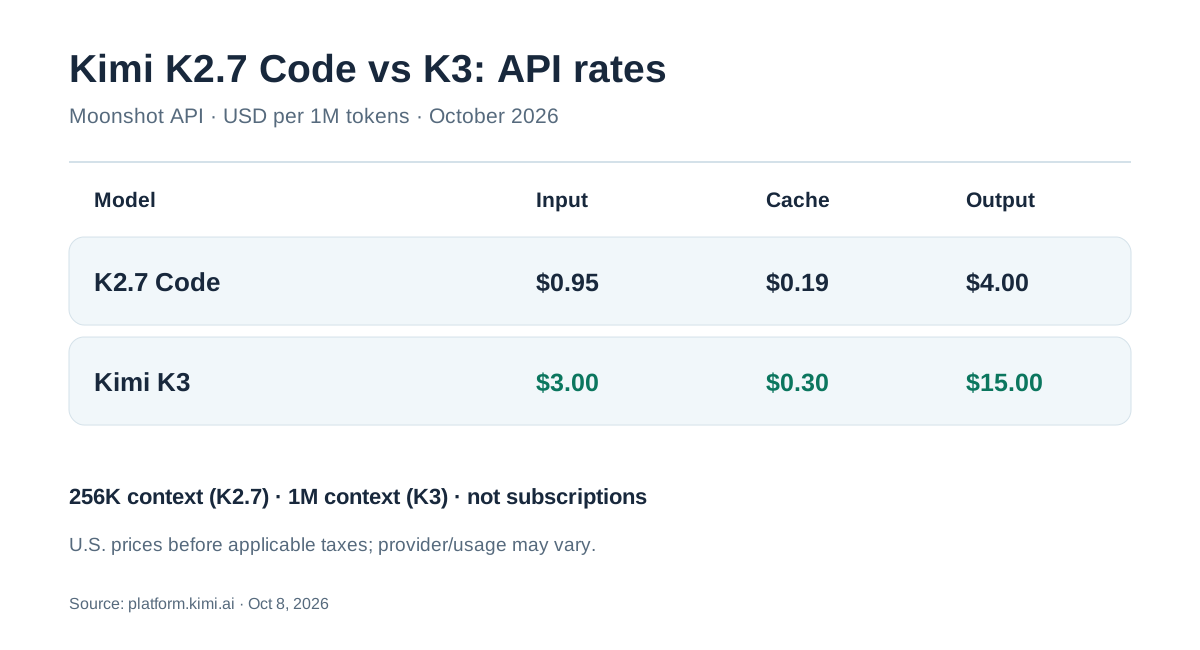
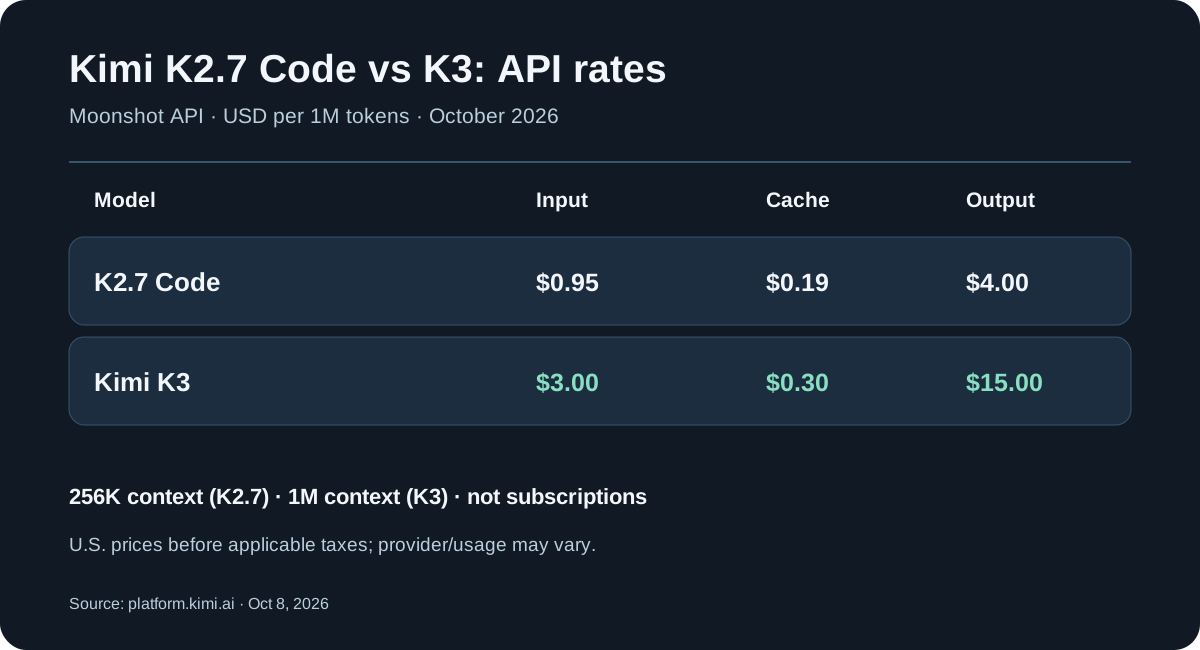
At identical fresh token volumes, K3 input costs about 3.16× as much and output about 3.75× as much as K2.7 Code. That is not a quality benchmark: a stronger model might complete a difficult coding task in fewer attempts, while a simpler task might cost more for no gain. Measure cost per passing regression test, not price per million tokens alone.
OpenRouter is a separate purchase route. The $0.67 input / $3.40 output figures recorded in the original August review were a provider-specific snapshot, not guaranteed current or official Moonshot prices. Check the actual selected upstream provider, region, caching terms and bill. OpenRouter K2.7 Code.
Kimi Code is a different product. The membership-facing ID kimi-for-coding can be routed to a newer backend by Moonshot. Do not assume it permanently resolves to the API’s pinned kimi-k2.7-code revision. Compare exact model IDs and subscriptions separately. Kimi Code model docs.
United States: The published prices are USD API list rates. Applicable state or local sales taxes and processing fees depend on the biller and billing address. A U.S. account, language choice or IP address does not guarantee U.S.-only inference or retention; review provider terms for sensitive code.
K2.7 Code API parameters to preserve
- Thinking is always enabled for K2.7 Code; preserve the documented thinking content across tool calls.
temperature=1.0andtop_p=0.95are pinned for K2.7 Code; forcing different defaults can cause errors.- K3 has different context limits and features. Do not blindly replace the model string in an agent without testing token accounting and tool messages.
- For image or video inputs, test what the specific serving route actually supports.
Sources: K2.7 Code Quickstart · Thinking Models · API Model Overview.
Local GGUF inference: possible, but not a normal Mac setup
Moonshot’s deployment guide shows server paths using vLLM or SGLang, including an H200 node with tensor parallelism 8. That is a server reference, not an Apple Silicon guide.
Independent Unsloth documentation additionally describes GGUF quantizations for llama.cpp and Unsloth Studio, including Metal builds for Apple Macs. Its approximate total-memory figures are:
| Quantization | Documented total requirement |
|---|---|
| Dynamic 1-bit | about 310 GB |
| Dynamic 2-bit | about 325–350 GB |
| Dynamic Q3 | about 385–470 GB |
| Q8, described as near-lossless | about 605 GB |
These are not Mac benchmarks measured by ai-on-mac.com. They come from a third-party guide and refer to a specific GGUF/runtime combination. A Mac Studio with very large Unified Memory may theoretically enter this class; for typical 16-, 24-, 32-, 64- or 128-GB Macs, the published sizes do not support a normal recommendation. Even with enough memory, speed, context length, Metal support and image/video behavior must be tested separately.
“Open weights” therefore does not mean “suitable for every Mac.” The model card and license make local use possible, but the practical hardware threshold remains unusually high.
Read the benchmarks correctly
The model card publishes figures including:
| Benchmark | Kimi K2.7 Code | GPT-5.5 | Claude Opus 4.8 |
|---|---|---|---|
| Kimi Code Bench v2 | 62.0 | 69.0 | 67.4 |
| Program Bench | 53.6 | 69.1 | 63.8 |
| MCP Mark Verified | 81.1 | 92.9 | 76.4 |
These are vendor-published model-card figures, not an independent leaderboard. The tables use different agent harnesses and do not automatically transfer to your repository. The defensible conclusion is narrower: Moonshot reports an improvement over K2.6, and K2.7 Code is strong on selected agentic tables; that is not a general win against every frontier model.
Privacy and a safer evaluation
With Ollama Cloud, Kimi Code, the Kimi API and OpenRouter, submitted prompts leave the Mac. A coding agent may also transmit file contents, diff context, tool output or images. For an evaluation:
- use a separate non-production repository;
- do not copy keys, cookies, customer data or production files into it;
- restrict the files and shell commands the agent can access;
- review changes as a diff before applying them;
- measure cost, latency, tool failures and abort behavior on your own tasks;
- recheck the provider, model ID and quotas after the test.
The weights use a Modified MIT License. In addition to the usual MIT conditions, it includes an attribution requirement for very large commercial products or services (more than 100 million monthly active users or more than $20 million in monthly revenue). The full license text controls any commercial use.
Practical Mac recommendation
Kimi K2.7 Code is most useful on a Mac as a cloud coding agent. Ollama Cloud is the easiest entry point; Kimi Code and the direct API are separate products with different IDs, quotas and prices. OpenRouter is another provider with its own metadata.
A local GGUF route is not imaginary, but it belongs in the category theoretically possible on very large hardware, not “install it on a Mac and start coding.” If you need offline operation or strict on-device data residency, choose a much smaller model with a concrete Apple Silicon workflow.
Sources
- Kimi API: Model List: official IDs and 256K context.
- Kimi API: K2.7 Code: capabilities, modalities and API rules.
- Kimi API: K2.7 Code pricing: official price page and billing notes.
- Kimi API: Model Parameter Reference: fixed parameters and HighSpeed distinction.
- Moonshot AI: Kimi-K2.7-Code on Hugging Face: model card, benchmarks, deployment and license reference.
- Moonshot AI: deployment guide: vLLM/SGLang server examples.
- Moonshot AI: Modified MIT license: complete license terms.
- Ollama: Kimi K2.7 Code and tags: current cloud tag and integrations.
- Kimi Code: model configuration: product IDs, plans and quotas.
- Unsloth: run Kimi K2.7 Code locally: independent GGUF/memory figures; not a benchmark measured by ai-on-mac.com.
- OpenRouter: Kimi K2.7 Code: provider-specific metadata and routing note.
Frequently Asked Questions
Does Kimi K2.7 Code run locally on an ordinary Mac with Ollama?
No. The current Ollama entry is a :cloud tag. The client and terminal run locally, while inference runs with the cloud provider. A local GGUF route is separate and requires several hundred gigabytes of total memory depending on the quantization.
What does Kimi K2.7 Code cost through the official API?
As of October 8, 2026, Moonshot's international API lists K2.7 Code at $0.95 input, $0.19 cache hit, and $4.00 output per million tokens. K3 lists $3.00/$0.30/$15.00 with 1M context. U.S. applicable taxes or billing fees are separate.
Is Kimi K2.7 Code the same product as Kimi Code?
No. The API uses the model name kimi-k2.7-code. The separate Kimi Code product uses IDs such as kimi-for-coding and its own membership quotas.
Can Kimi K2.7 Code run without thinking mode?
No. Kimi's official documentation says thinking is always enabled for K2.7 Code, and preserved thinking is enabled as well.