Short answer
Restored on July 1, 2026 after the June 2026 export-control pause, Claude Fable 5 is classified by Anthropic as a legacy model as of October 14, 2026. For new cloud workloads, start with Sonnet 5.5 ($2/$10), Opus 5.5 ($4/$20), or Fable 5.1 ($10/$50 with cache reads cut by 75% to $0.25/1M); for confidential data that must remain on a Mac, use local models via Ollama, LM Studio, or MLX.
- Model IDs
- claude-fable-5 (Anthropic API, Google Cloud, Microsoft Foundry), anthropic.claude-fable-5 (Amazon Bedrock), anthropic/claude-fable-5 (OpenRouter)
- U.S. API list price
- $10.00 input / $50.00 output / $1.00 cache read per 1M tokens (net USD before applicable U.S. state/local sales tax and optional +10% inference_geo: 'us' surcharge)
- Context & output
- 1,000,000-token context window, 128,000-token max output, adaptive thinking always on
- Data retention
- Designated Covered Model requiring 30-day retention on the direct Claude API; unavailable under standard Zero Data Retention (ZDR)
- Local Mac runtime
- No documented Apple-Silicon local path; offline workflows require MLX, Ollama, or LM Studio in Unified Memory
Last reviewed: October 14, 2026
Newer version: The following analysis covers Claude Fable 5 (claude-fable-5). Its direct successor Claude Fable 5.1 launched on September 1, 2026 and cuts prompt-cache read costs by 75% at the same base input and output price.1
Updated October 14, 2026: Our editorial log preserves the July 1, 2026 redeployment history and updates model positioning for October 2026. Anthropic classifies
claude-fable-5as a legacy model following the releases of Fable 5.1 (claude-fable-5-1), Claude Opus 5.5 (claude-opus-5-5), and Claude Sonnet 5.5 (claude-sonnet-5-5).234561 Legacy status does not mean access is disabled across API providers: Unlike Fable 5.1, Fable 5 continues to support the Priority Tier.71 Mythos 5 (claude-mythos-5) remains restricted to approved organizations.238
Fable 5 has been restored globally since July 1, 2026. For Mac users as of October 14, 2026, however, it remains an expensive cloud legacy model rather than a documented local Mac runtime.234 It is relevant primarily for existing agentic, coding, and long-context analysis pipelines pinned to claude-fable-5. For new deployments, Claude Sonnet 5.5 ($2.00 input / $10.00 output per 1M tokens) and Claude Opus 5.5 ($4.00 / $20.00) are better evaluation starting points, while Claude Fable 5.1 ($0.25 vs. $1.00 per 1M cache-read tokens) is the current Mythos-class option.9561 If sensitive code or documents must remain on your Mac, use local models via Ollama, LM Studio, or MLX instead.
The decision in one table
| If you need to … | Sensible starting point on a Mac (as of October 14, 2026) |
|---|---|
maintain an existing claude-fable-5 integration or use the Priority Tier | keep Fable 5 active, log costs and stop_reason: "refusal" fallbacks, and test migration to Fable 5.171 |
| get maximum Mythos-class capability for new long-running coding agents | evaluate Claude Fable 5.1 (75% cheaper cache reads) against Opus 5.551 |
| handle routine coding, writing, or repository analysis | start with Sonnet 5.5; step up to Opus 5.5 for harder multi-step agents56 |
| use Claude Code on macOS and see Fable in the model picker | reserve it for complex architecture runs and monitor usage credits and weekly limits2 |
| run through AWS Bedrock, Google Cloud, or Microsoft Foundry | verify the exact provider model ID and regional entitlement in your cloud account37 |
| keep confidential code or regulated data completely off cloud services | run a local open-weight model through Ollama, LM Studio, or MLX in Unified Memory |
| maintain strict Zero Data Retention (ZDR) on the direct Claude API | do not use Fable 5 or Fable 5.1 (both require 30-day Covered Model retention unless expressly authorized)10117 |
Specifications and provider model IDs
Anthropic released Claude Fable 5 on June 9, 2026, paused access on June 12, 2026 following a U.S. export-control directive, and announced global redeployment on June 30, 2026 taking effect July 1, 2026.21213
| Property | Claude Fable 5 (claude-fable-5) |
|---|---|
| Status (October 14, 2026) | Generally available legacy model across API and cloud platforms; restored since July 1, 2026; succeeded by claude-fable-5-12341 |
| Native Anthropic ID | claude-fable-5 (Claude API, Claude Platform on AWS, Google Cloud Vertex, Microsoft Foundry)347 |
| AWS Bedrock ID | anthropic.claude-fable-57 |
| OpenRouter ID | anthropic/claude-fable-5 |
| Restricted sibling model | claude-mythos-5 (vetted organizations in Project Glasswing only)138 |
| Context window | 1,000,000 tokens47 |
| Maximum output | 128,000 tokens per request47 |
| Modalities | Input: Text and images · Output: Text34 |
| Thinking mode | Adaptive thinking always on (disabled or manual budget_tokens return HTTP 400)71 |
| U.S. API list price | $10.00 input / $50.00 output per million tokens94 |
| Prompt caching (USD) | $12.50 (5m write) · $20.00 (1h write) · $1.00 (cache read) per million tokens97 |
| Batch API (USD) | $5.00 input / $25.00 output per million tokens (50% discount)91 |
| Priority Tier | Supported on claude-fable-5 (not supported on claude-fable-5-1)1 |
| Local Mac runtime | No documented Apple-Silicon local path34 |
The 1-million-token context window is not a quality guarantee. Larger prompts cost more and increase latency, and placing a detail inside the context window does not ensure the model will use it reliably. For production work, the decisive question is whether Fable 5 saves enough manual rework compared with Opus 5.5 or Sonnet 5.5 to justify paying 2.5x to 5x more per token.3956
What happened during the June 2026 shutdown
On June 12, 2026, Anthropic states that the U.S. government ordered it under export-control authority to block access to Fable 5 and Mythos 5 for foreign nationals, regardless of location. Because Anthropic could not reliably verify user nationality in real time, it disabled both models for all customers worldwide.212
Anthropic says the directive concerned a demonstrated method to bypass Fable 5’s cyber safeguards. The company described the jailbreak as narrow and stated that the vulnerabilities identified during the test were already known and discoverable using other public models. That is Anthropic’s assessment; according to the company, the government directive itself did not provide specific technical details.1214
On June 30, 2026, Anthropic announced that the export controls had been lifted, and on July 2, 2026 it published a four-axis jailbreak scoring framework (Capability Gain, Breadth, Ease of Weaponization, Discoverability) alongside a HackerOne bug-bounty program.214 The June 2026 statement that Fable 5 is shut down is therefore outdated:
- Fable 5 returned globally starting July 1, 2026.2
- Claude.ai, Claude Platform, Claude Code, and Claude Cowork were the first restored access points.2
- Amazon Bedrock, Google Cloud, and Microsoft Foundry were re-enabled and appear as available platforms in the October 2026 models overview.23
- Mythos 5 remains limited to approved organizations in Project Glasswing.238
- Anthropic states that other Claude models were not affected by the June 2026 interruption.12
Fable 5 and Mythos 5 are not the same offer
Although the model names sound like two separate capability tiers, the practical difference is access control and active safety filtering:
- Claude Fable 5 (
claude-fable-5) is the broadly released model and runs additional safety classifiers covering sensitive cybersecurity, biology, and chemistry requests.138 - Claude Mythos 5 (
claude-mythos-5) shares the same core model weights, specifications, and$10/$50pricing, removes those classifiers in approved defensive domains, and remains restricted to Project Glasswing and verified partner programs.1384
When Fable 5 refuses a request through its classifiers, the Messages API does not throw an HTTP 5xx error; instead, it returns HTTP 200 with stop_reason: "refusal" and a stop_details.category value (such as "cyber", "bio", or "reasoning_extraction").871 Another Claude model takes over only when the calling application has configured a fallback; the integration documentation covers server-side (fallbacks: "default"), client-side, and manual paths.287 Note that server-side fallbacks: "default" does not retry requests declined with reasoning_extraction (triggered when prompts instruct the model to transcribe its internal chain of thought in the response text).7
Anthropic reports that the safety logic affects fewer than 5% of sessions on average, though security, reverse-engineering, or life-science workflows encounter higher refusal rates.21314 Anyone integrating Fable 5 into an application should:
- Handle
stop_reason == "refusal"as a distinct branch in response parsing. - Define an explicit fallback model (such as
claude-opus-5-5). - Log the exact model identity and token cost of the response that actually ran.
What the vendor benchmarks actually show
The chart below is a vendor presentation from Anthropic’s June 9, 2026 launch announcement. For each benchmark, the combined column shows the higher score achieved by either Fable 5 or Mythos 5; evaluation harnesses, permitted tools, and effort levels vary by test.13
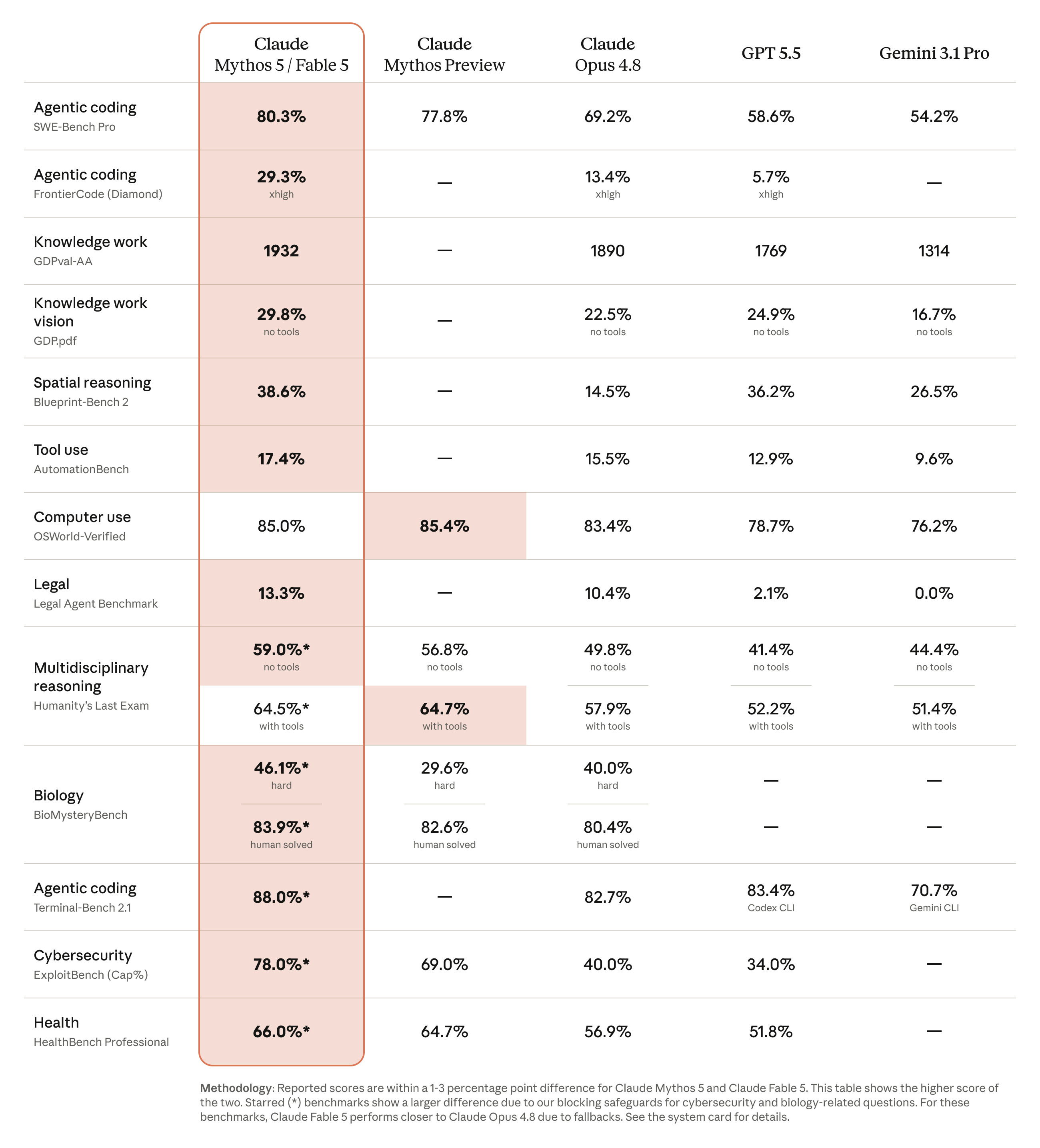
When reviewing these numbers in October 2026, keep four constraints in mind:
- The combined column reports the higher Fable 5 or Mythos 5 score for each evaluation: not every number belongs to the filtered Fable 5 model.13
- The figures are a historical June 2026 launch snapshot from Anthropic and launch partners prior to the releases of Fable 5.1, Opus 5.5, and Sonnet 5.5.13561
- Harnesses, tool permissions, and effort settings are not uniform across all competitor comparisons.13
- None of the scores answers the operational question for your team: does Fable 5 save enough repair iterations on your repository to justify paying 2.5x the Opus 5.5 rate or 5x the Sonnet 5.5 rate?956
Cybersecurity: Refusals, fallbacks, and billing rules
Cybersecurity is where the Fable-Mythos split becomes concrete. Fable 5 evaluates sensitive requests with additional classifiers.13814 Depending on when a classifier triggers, the API may:
- complete the
claude-fable-5response normally (stop_reason: "end_turn"or"tool_use"), - refuse prior to generating output with
stop_reason: "refusal",8 - or halt generation mid-stream after output has started.8
According to Anthropic’s July 2, 2026 safeguard documentation, benign defensive tasks such as standard debugging or patching known vulnerabilities are intended to pass, but can still trigger false positives inside the classifier’s safety margin.214 Malware analysis and offensive vulnerability research trigger refusals much more frequently than general software engineering.1314
Anthropic does not bill input tokens when a request is refused before any output is generated.8 If a classifier fires mid-stream, or if a configured fallback model completes the request, billing follows Anthropic’s documented rules and the fallback model’s token rates.89
Biology and chemistry: Vendor reports and access limits
Anthropic reports internal and partner case studies in protein design, genomics, and biological hypothesis generation.13 Because Fable 5 filters dual-use biology and chemistry prompts (stop_reason: "refusal", category "bio"), legitimate academic bioinformatics queries can also be declined unless a fallback model is configured.1381
For research teams working on macOS, four boundaries apply:
- Fable 5 is a cloud-only service, not a local bioinformatics runtime.
- Sensitive research prompts sent to Covered Models on the direct Claude API are subject to mandatory 30-day retention.1011
- Vendor case studies do not replace reproducible pipelines or independent peer review.
- Drug, protein, and genomics outputs require specialist verification and wet-lab validation.
Reproducible API connectivity check and breaking changes
Developers testing claude-fable-5 from macOS or migrating from earlier Claude 4 releases must account for strict Messages API validation rules. The following parameters return a 400 invalid_request_error on claude-fable-5 (as well as claude-fable-5-1):71
- Disabled or manual thinking budgets: Sending
thinking: {"type": "disabled"}orthinking: {"type": "enabled", "budget_tokens": N}returns HTTP 400. Omitthinkingor pass{"type": "adaptive"}.71 - Forced tool selection: Passing
tool_choice: {"type": "any"}ortool_choice: {"type": "tool", "name": "..."}returns HTTP 400 (tool_choice: type "tool" and "any" are not supported for this model). Only{"type": "auto"}and{"type": "none"}are accepted.71 - Assistant prefill and sampling parameters: Prefilling the
assistantturn or setting non-defaulttemperature,top_p, ortop_kvalues returns HTTP 400.1 - Missing 30-day retention override: Calling
claude-fable-5from a Zero Data Retention workspace without an approved Covered Model retention override returns HTTP 400 (invalid_request_error).107
The minimal Python snippet below tests API connectivity and stop_reason: "refusal" handling on macOS (it is not a repository audit, as no local files or tool definitions are attached):
# Prerequisites on macOS (Python >= 3.11)
python3 -m venv .venv && source .venv/bin/activate
pip install "anthropic>=0.49.0"
export ANTHROPIC_API_KEY="sk-ant-..." # Never hardcode API keys in source files
import os
from anthropic import Anthropic, BadRequestError
# Minimal example for API connectivity and refusal inspection (not a repo audit)
client = Anthropic(api_key=os.environ["ANTHROPIC_API_KEY"])
try:
response = client.messages.create(
model="claude-fable-5",
max_tokens=1024,
# Adaptive thinking is always active; do not pass temperature or top_p
messages=[
{
"role": "user",
"content": "Return a 3-point checklist for verifying an Astro i18n build."
}
],
)
print(f"Executed model: {response.model}")
print(f"Stop reason: {response.stop_reason}")
print(f"Tokens: in={response.usage.input_tokens}, out={response.usage.output_tokens}")
if response.stop_reason == "refusal":
print("Request declined by safety classifier -> trigger fallback to claude-opus-5-5.")
else:
for block in response.content:
if block.type == "text":
print(block.text)
except BadRequestError as err:
print(f"HTTP 400 configuration or ZDR retention error: {err}")How to benchmark Fable 5 against newer Claude models
Use the exact same task set, tool permissions, and time budget across claude-fable-5, claude-fable-5-1, claude-opus-5-5, and claude-sonnet-5-5:
- Create an isolated Git branch or clean working copy for each model run.
- Provide identical requirements and verifiable acceptance criteria across 10 to 20 representative engineering tasks.
- Grant the same CLI/editor tools and maximum wall-clock runtime.
- Log
input_tokens,cache_creation_input_tokens,cache_read_input_tokens,output_tokens, runtime, failed tool calls,stop_reason: "refusal"events, and manual rework minutes. - Run builds, test suites, and code review independently of the evaluated model.
For a bilingual Astro migration, four pass/fail criteria apply: npm run build succeeds, internal links remain intact and locale-pure, hreflang mappings validate, and no files change outside the agreed scope. Rank models by total cost per accepted task, not per-token sticker price alone.
API pricing in October 2026: Legacy versus current models
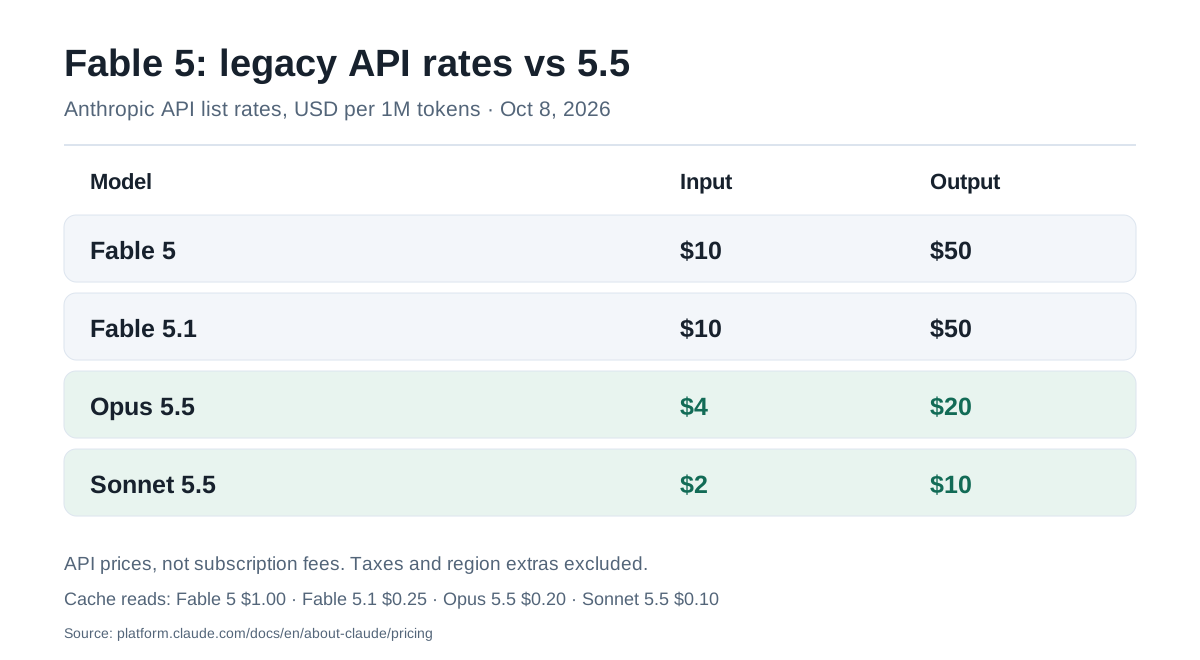
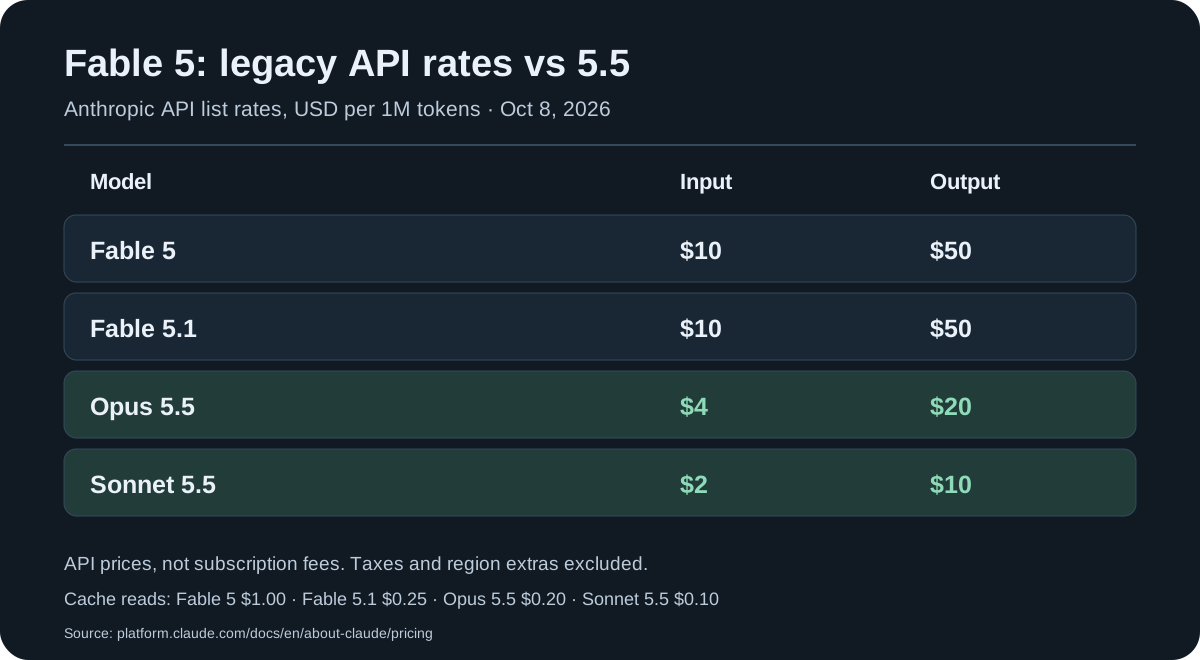
Comparing Fable 5 only against older Opus releases is no longer sufficient for new projects. The table below lists Anthropic’s official U.S. API list prices in USD per 1 million tokens, verified October 14, 2026.94561
| Model | Anthropic API ID | Fresh input / 1M | Cache write (5m / 1h) / 1M | Cache read / 1M | Output / 1M | Batch in / out / 1M |
|---|---|---|---|---|---|---|
| Claude Fable 5 (legacy) | claude-fable-5 | $10.00 | $12.50 / $20.00 | $1.00 | $50.00 | $5.00 / $25.00 |
| Claude Fable 5.1 | claude-fable-5-1 | $10.00 | $12.50 / $20.00 | $0.25 | $50.00 | $5.00 / $25.00 |
| Claude Opus 5.5 | claude-opus-5-5 | $4.00 | $5.00 / $8.00 | $0.20 | $20.00 | $2.00 / $10.00 |
| Claude Sonnet 5.5 | claude-sonnet-5-5 | $2.00 | $2.50 / $4.00 | $0.10 | $10.00 | $1.00 / $5.00 |
At identical uncached token volumes, Opus 5.5 input and output tokens cost 40% of Fable 5’s base rate, and Sonnet 5.5 costs 20%. Moving from Fable 5 to Fable 5.1 keeps fresh input and output rates identical while reducing prompt-cache read costs by 75% ($0.25 vs. $1.00 per 1M tokens).91 Equal token volumes provide an illustrative rate comparison, not a guarantee that every model generates the exact same number of thinking and output tokens on a given task.56
For U.S. readers: All figures above are net USD API list rates, separate from Claude consumer or team subscription plans ($20, $100, or $200 monthly tiers). Applicable U.S. state and local sales taxes and third-party router fees are billed separately. Explicitly forcing U.S.-only data residency via inference_geo: "us" adds a 10% surcharge on supported models (Claude 4.6 and newer); using English prompts alone does not trigger that surcharge.9
Explicit API cost formula and two worked examples
Fixed-workload API cost calculations follow this formula (excluding tool charges, third-party router markups, the optional inference_geo: "us" +10% surcharge, and U.S. sales tax):
Total = fresh_input_M * rate_input + cache_write_M * rate_write + cache_read_M * rate_read + output_M * rate_output
- Scenario A (Single uncached run):
0.20M(200,000) fresh input tokens,0Mcache write,0Mcache read, and0.02M(20,000) output tokens:- Claude Fable 5 / Fable 5.1:
0.20 * 10.00 + 0 + 0 + 0.02 * 50.00 = 2.00 + 1.00 = $3.00 - Claude Opus 5.5:
0.20 * 4.00 + 0 + 0 + 0.02 * 20.00 = 0.80 + 0.40 = $1.20 - Claude Sonnet 5.5:
0.20 * 2.00 + 0 + 0 + 0.02 * 10.00 = 0.40 + 0.20 = $0.60
- Claude Fable 5 / Fable 5.1:
- Scenario B (Multi-turn agent session with 5-minute prompt caching):
0.20Mfresh input,0.10M5-minute cache write,1.00Mcache read across turns, and0.05Moutput tokens:- Claude Fable 5 (legacy):
0.20 * 10.00 + 0.10 * 12.50 + 1.00 * 1.00 + 0.05 * 50.00 = 2.00 + 1.25 + 1.00 + 2.50 = $6.75 - Claude Fable 5.1:
0.20 * 10.00 + 0.10 * 12.50 + 1.00 * 0.25 + 0.05 * 50.00 = 2.00 + 1.25 + 0.25 + 2.50 = $6.00(saves$0.75per 1M cached input reads over Fable 5) - Claude Opus 5.5:
0.20 * 4.00 + 0.10 * 5.00 + 1.00 * 0.20 + 0.05 * 20.00 = 0.80 + 0.50 + 0.20 + 1.00 = $2.50 - Claude Sonnet 5.5:
0.20 * 2.00 + 0.10 * 2.50 + 1.00 * 0.10 + 0.05 * 10.00 = 0.40 + 0.25 + 0.10 + 0.50 = $1.25
- Claude Fable 5 (legacy):
Availability: October 2026 model docs versus historical rollout
The summer 2026 timeline explains earlier outage reports but should be separated from October 2026 availability:
- Anthropic documents restoration starting July 1, 2026 across Claude Platform, Claude.ai, Claude Code, and Claude Cowork.2
- On Pro, Max, Team, and select Enterprise plans, Fable 5 historically counted for up to 50% of shared weekly usage limits through July 7, 2026 (not an extra 50% allowance on top of the plan limit), transitioning afterward to usage credits.2
- As of October 14, 2026, Anthropic’s models overview lists
claude-fable-5as generally available on the Claude API, Claude Platform on AWS, Amazon Bedrock (anthropic.claude-fable-5), Google Cloud, and Microsoft Foundry; account-level and regional entitlements can still vary.37 claude-mythos-5remains restricted to approved organizations.38
For production workloads, query the Models API or inspect your cloud console directly rather than relying solely on launch announcements.
Covered Models and 30-day data retention
On the direct Claude API, claude-fable-5 and claude-mythos-5 (along with claude-fable-5-1 and claude-mythos-5-1) are designated Covered Models. They require 30-day data retention and are unavailable under standard Zero Data Retention (ZDR) agreements unless expressly authorized in writing by Anthropic. A request sent from a ZDR workspace without the required retention override fails with 400 invalid_request_error.10117
Anthropic documents the following rules for Covered Model retention:
- Retained API prompts and outputs are not used for model training without explicit customer permission.1011
- Data is automatically deleted after 30 days unless flagged for a safety investigation or subject to legal retention obligations.11
- Internal access is restricted to a small set of authorized reviewers for defined safety and policy cases.11
Separating data paths for U.S. enterprises: Direct Anthropic API access, third-party routers (such as OpenRouter), and cloud hyperscalers (Amazon Bedrock, Google Cloud Vertex AI, Microsoft Foundry) operate under distinct data-processing terms and sub-processor agreements.1011 Furthermore, do not assume HIPAA eligibility on Covered Models unless your organization holds both an executed Business Associate Agreement (BAA) and explicit platform confirmation for non-ZDR Covered Models. Never include credentials or secret keys in prompts.
Is there a documented Apple-Silicon path?
The official Anthropic documentation reviewed on October 14, 2026 covers cloud API and partner platforms only; no local Apple-Silicon runtime or weight download exists for Fable 5.384
When source code, regulated records, or proprietary research cannot leave your Mac, run an open-weight model locally via MLX, Ollama, or LM Studio. Practical model size and context length depend primarily on your Mac’s unified memory:
- Local memory sizing formula (planning estimate):
Total Memory = Model Weights + Quantization Metadata + KV Cache + Runtime Overhead + macOS/Apps + Peak Buffers + Modality Overhead - Distinguish between decimal gigabytes (
GB, Apple’s hardware spec) and binary gibibytes (GiB, reported by system monitors), and do not confuse active Mixture-of-Experts (MoE) parameters with total stored weights. As a planning estimate (rather than an empirical hardware lab benchmark), 4-bit quantized 7B–8B models fit comfortably in16 GBUnified Memory, 27B–32B models require32 GBto64 GB, and 70B+ or large long-context MoE coding models require64 GBto128 GB+Unified Memory.
See our step-by-step setup guides for Ollama on a Mac mini M4 and LM Studio vs. Ollama on Mac.
Recommendation
Whether Fable 5 still fits your Mac workflow in October 2026 depends on four factors: model-ID compatibility, cost per accepted task, 30-day data retention, and refusal fallback behavior.39107
- Existing workloads: Keep
claude-fable-5only where Priority Tier support or hard-pinned legacy model IDs are required; otherwise evaluate migrating Mythos-class workloads to Claude Fable 5.1.71 - New cloud projects: Start routine engineering and analysis with Claude Sonnet 5.5 (
$2/$10) and benchmark Claude Opus 5.5 ($4/$20) for harder multi-step agents.956 - Strict privacy & offline workloads: Use local open-weight models via Ollama, LM Studio, or MLX whenever data cannot leave your Mac or requires Zero Data Retention.
Sources and methodology note
Verification date and boundaries: All model IDs, USD API list prices, breaking-change rules, and retention terms were verified on October 14, 2026 against Anthropic’s official documentation. No independent Mac hardware benchmarks for Fable 5 were executed for this guide.
Footnotes
-
https://platform.claude.com/docs/en/models/fable-5-1/whats-new-fable-5-1 ↩ ↩2 ↩3 ↩4 ↩5 ↩6 ↩7 ↩8 ↩9 ↩10 ↩11 ↩12 ↩13 ↩14 ↩15 ↩16 ↩17 ↩18 ↩19 ↩20
-
https://www.anthropic.com/news/redeploying-fable-5 ↩ ↩2 ↩3 ↩4 ↩5 ↩6 ↩7 ↩8 ↩9 ↩10 ↩11 ↩12 ↩13 ↩14 ↩15 ↩16 ↩17
-
https://platform.claude.com/docs/en/about-claude/models/overview ↩ ↩2 ↩3 ↩4 ↩5 ↩6 ↩7 ↩8 ↩9 ↩10 ↩11 ↩12 ↩13 ↩14 ↩15
-
https://platform.claude.com/docs/en/models/fable-5/overview ↩ ↩2 ↩3 ↩4 ↩5 ↩6 ↩7 ↩8 ↩9 ↩10 ↩11 ↩12
-
https://platform.claude.com/docs/en/models/opus-5-5/overview ↩ ↩2 ↩3 ↩4 ↩5 ↩6 ↩7 ↩8 ↩9 ↩10
-
https://platform.claude.com/docs/en/models/sonnet-5-5/overview ↩ ↩2 ↩3 ↩4 ↩5 ↩6 ↩7 ↩8 ↩9
-
https://platform.claude.com/docs/en/models/fable-5/migration-guide ↩ ↩2 ↩3 ↩4 ↩5 ↩6 ↩7 ↩8 ↩9 ↩10 ↩11 ↩12 ↩13 ↩14 ↩15 ↩16 ↩17 ↩18 ↩19 ↩20 ↩21
-
https://platform.claude.com/docs/en/about-claude/models/introducing-claude-fable-5-and-claude-mythos-5 ↩ ↩2 ↩3 ↩4 ↩5 ↩6 ↩7 ↩8 ↩9 ↩10 ↩11 ↩12 ↩13 ↩14 ↩15
-
https://platform.claude.com/docs/en/about-claude/pricing ↩ ↩2 ↩3 ↩4 ↩5 ↩6 ↩7 ↩8 ↩9 ↩10 ↩11 ↩12
-
https://platform.claude.com/docs/en/manage-claude/api-and-data-retention ↩ ↩2 ↩3 ↩4 ↩5 ↩6 ↩7
-
https://privacy.claude.com/en/articles/15425996-data-retention-practices-for-mythos-class-models ↩ ↩2 ↩3 ↩4 ↩5 ↩6 ↩7
-
https://www.anthropic.com/news/fable-mythos-access ↩ ↩2 ↩3 ↩4
-
https://www.anthropic.com/news/claude-fable-5-mythos-5 ↩ ↩2 ↩3 ↩4 ↩5 ↩6 ↩7 ↩8 ↩9 ↩10 ↩11 ↩12 ↩13
-
https://www.anthropic.com/news/fable-safeguards-jailbreak-framework ↩ ↩2 ↩3 ↩4 ↩5 ↩6
Frequently Asked Questions
Is Claude Fable 5 available again in October 2026?
Yes. Fable 5 was restored on July 1, 2026 after the June 12, 2026 interruption. As of October 14, 2026, Anthropic's models overview lists claude-fable-5 as a generally available legacy model on the Claude API, Claude Platform on AWS, Amazon Bedrock, Google Cloud, and Microsoft Foundry. Check the active model list for your specific account and region.
Can Claude Fable 5 run locally on a Mac?
No. The official Anthropic materials reviewed on October 14, 2026 document cloud API and partner-platform access only, with no local Apple-Silicon runtime or downloadable weights.
How much does Claude Fable 5 cost on the API?
Anthropic's published U.S. API list price is $10.00 per million fresh input tokens and $50.00 per million output tokens. Prompt-cache writes cost $12.50 (5-minute TTL) or $20.00 (1-hour TTL) per million tokens, and prompt-cache reads cost $1.00 per million tokens.
What is the difference between Fable 5 and Mythos 5?
Anthropic states that both share the same underlying model, 1M-token context window, and $10/$50 pricing. Fable 5 is the broadly released version with active safety classifiers for cyber, biology, and chemistry requests. Mythos 5 removes those classifiers in approved domains and remains restricted to vetted organizations in Project Glasswing.
Does Zero Data Retention apply to Fable 5?
Not on the direct Claude API without express authorization from Anthropic. Fable 5 and Mythos 5 are designated Covered Models and require 30-day retention there; calling them from a standard ZDR workspace returns a 400 invalid_request_error. Amazon Bedrock, Google Cloud, and Microsoft Foundry apply their own platform data-handling terms.