Fact-checked October 27, 2026. OpenAI introduced GPT-6.1 Terra on October 26 as a relatively inexpensive model for visual reasoning, computer use and everyday knowledge work. A model picker such as OpenRouter may show four different selections: Terra, Terra Pro, Terra (batch), and Terra Pro (batch). These are four configurations of one underlying model, not four distinct sets of model weights. The additional labels describe reasoning execution and request scheduling. OpenAI release · OpenRouter’s Terra Pro listing · OpenAI reasoning guide
For teams automating repetitive work, this distinction matters more than naming: choosing the wrong configuration can mean unnecessary inference spending, unpredictable latency or routing sensitive information through an endpoint that does not meet the team’s location requirements.
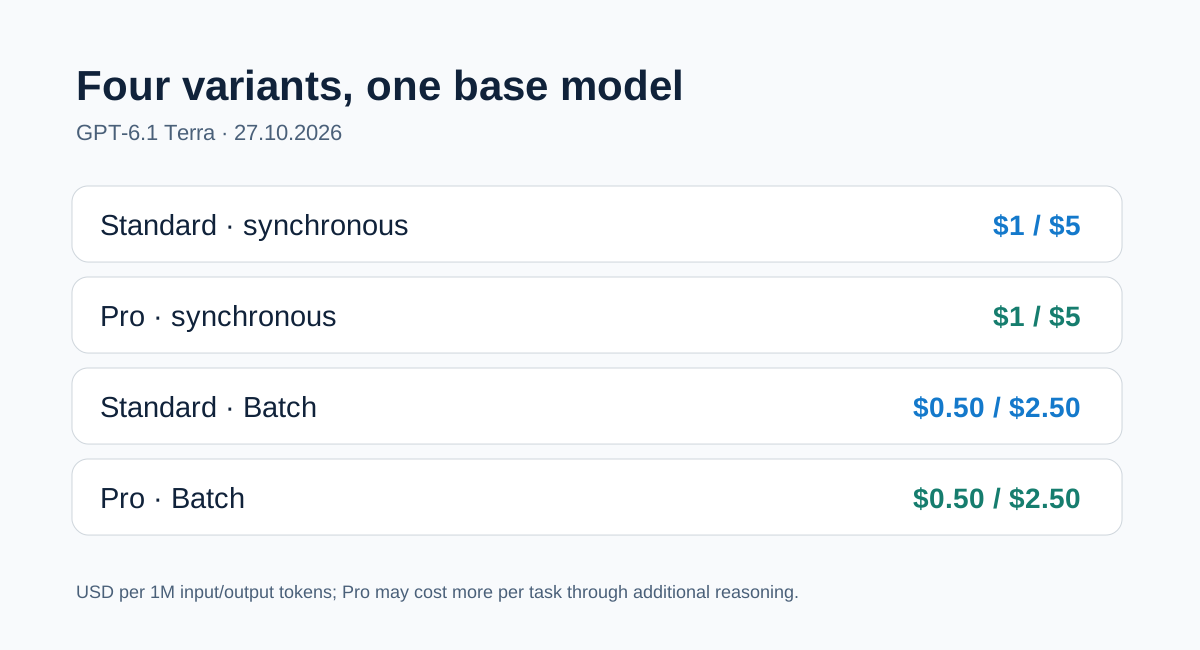
A four-way comparison with actual model IDs
| OpenRouter model ID | Reasoning mode | Service style | Input / 1M tokens | Output / 1M tokens |
|---|---|---|---|---|
openai/gpt-6.1-terra | Standard | Interactive | $1.00 | $5.00 |
openai/gpt-6.1-terra-pro | Pro | Interactive | $1.00 | $5.00 |
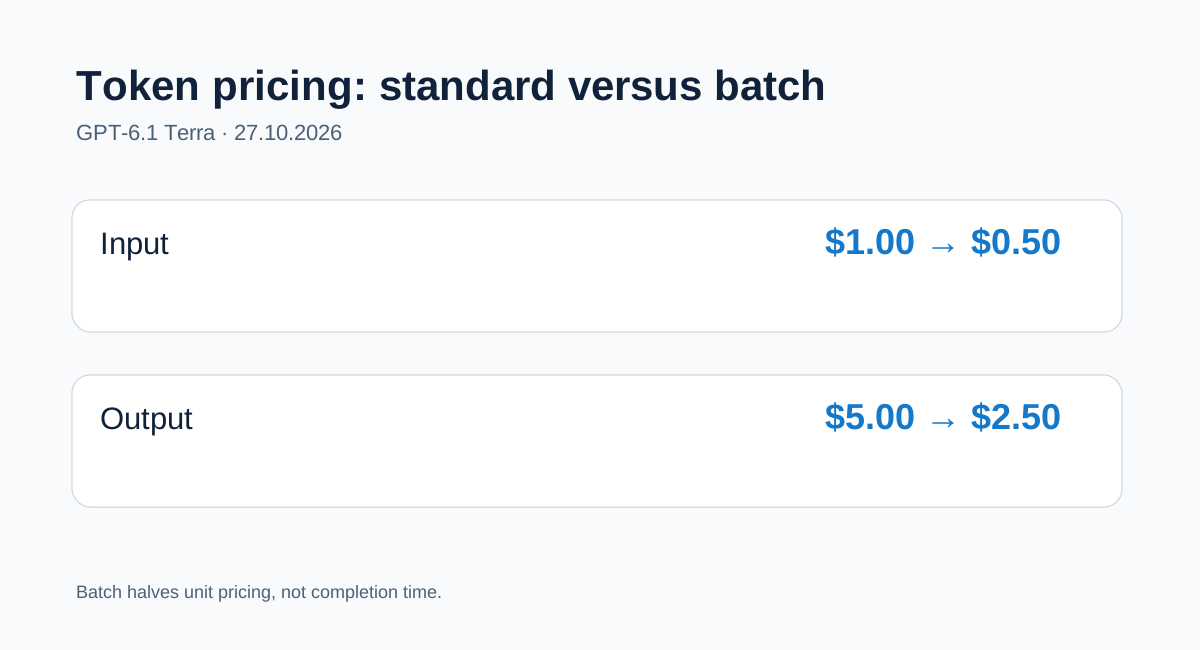
openai/gpt-6.1-terra:batch | Standard | Asynchronous batch | $0.50 | $2.50 |
openai/gpt-6.1-terra-pro:batch | Pro | Asynchronous batch | $0.50 | $2.50 |
Prices were checked October 27, 2026. They are list rates in USD and exclude applicable taxes, tooling charges and routing fees. Pro execution can increase billed reasoning-token consumption even though the nominal per-token rate is the same. Official OpenAI pricing · OpenRouter Terra · OpenRouter Terra Pro (batch).
Pro changes how much work the model performs
The OpenAI Responses API documents reasoning.mode as either standard or pro for GPT-6-family models. Mode and effort are separate settings: the model can run at a selected effort level within the chosen mode. Terra’s model card lists none, low, medium, high, xhigh and max; medium is the default. Pro is designed to spend more work on difficult requests, with correspondingly higher latency and token use. OpenAI reasoning models · GPT-6.1 Terra card
OpenRouter wraps that feature in the convenient openai/gpt-6.1-terra-pro model selection. It does not establish a different underlying foundation model. For workflows involving expensive decisions, a longer review or deeper reasoning may be valuable. But higher reasoning spend is not a guaranteed accuracy improvement for every request. Teams should evaluate the effect on their own tasks rather than assuming that the Pro suffix is always worthwhile.
Batch is a scheduling and pricing decision
OpenRouter’s Batch API is intended for independent, non-urgent requests. A provider may complete work within a 24-hour processing window, in exchange for lower token prices. In platform-wide beta data predating this specific model, many batches completed well before 24 hours, but that is not a Terra service-level guarantee. OpenRouter Batch announcement · Quickstart
Batch fits evaluation datasets, large catalog enrichment tasks, repository classification and deferred text extraction. It is a poor default for an interactive assistant that must inspect a screen, decide on an action and immediately consume the result. A lower per-token price does not make a sequential desktop agent faster.
What the unit rates mean in practice
These are editorial calculations, not billed usage observations. The assumptions are: ordinary uncached input, ordinary output, no tools, no regional premium, and every individual request below the long-context threshold.
| Workload | Input volume | Output volume | Standard | Batch |
|---|---|---|---|---|
| One substantial request | 50,000 | 5,000 | $0.075 | $0.0375 |
| Moderate monthly workload | 1,000,000 | 100,000 | $1.50 | $0.75 |
| High-volume processing | 10,000,000 | 2,000,000 | $20.00 | $10.00 |
Each total is input_tokens / 1,000,000 × input_rate + output_tokens / 1,000,000 × output_rate. A Pro quote cannot be added to this table without knowing how many reasoning tokens it uses. For high-volume jobs, the table assumes many individual requests rather than one impossibly large request.
The two costs hidden behind a simple token rate
Prompt caching. GPT-6.1 Terra cached reads cost $0.05 per million tokens at Standard rates. An eligible 30-minute cache write costs $1.25 per million tokens; 12-hour writes cost $2.50. These are distinct billing categories, not a blanket charge added to all prompt tokens. Cache efficiency depends on how often identical prefixes are reused. OpenAI caching guide
Long context. Requests exceeding 272,000 input tokens are billed with 2× input and cache rates and 1.5× output rates for the whole request, according to the Terra model page. That produces a sharp cost discontinuity around the boundary. For example, a 300,000-input, 10,000-output Standard request costs 0.3 × $2.00 + 0.01 × $7.50 = $0.675, excluding caching and tools; the ordinary-rate calculation would be $0.35. Official model rates and thresholds
API capabilities and the Apple silicon distinction
Terra has a 1,050,000-token context window, a maximum of 128,000 output tokens, and a June 1, 2026 knowledge cutoff. It accepts text and image inputs and produces text. For tool calls, OpenAI specifies the Responses API. Supported tools listed on its model page include web search, file search, computer use and structured output support. That does not mean a model alone can operate your Mac: a computer-use workflow needs a controlled browser or desktop runtime and a tool loop. Terra model card · Computer-use integration
Can GPT-6.1 Terra run locally on an M-series Mac? No downloadable Terra weights are provided. You can use it from a Mac through the API or products that expose it, but the model itself runs remotely. Its million-token context capacity describes a hosted API capability, not an estimate of unified memory required to execute a local model. Artificial Analysis profile
To make a direct API request, install the official Python SDK (python3 -m pip install -U openai) and configure OPENAI_API_KEY as a secret environment variable:
from openai import OpenAI

client = OpenAI()
result = client.responses.create(
    model="gpt-6.1-terra",
    reasoning={"mode": "standard", "effort": "medium"},
    input="Identify possible failure modes in this migration plan."
)
print(result.output_text)
For agents performing actions in external applications, keep the runtime sandboxed, require approval for consequential actions, and independently verify the final state. These requirements remain relevant regardless of benchmark scores. OpenAI computer-use guidance
Benchmark performance: independent versus vendor tests
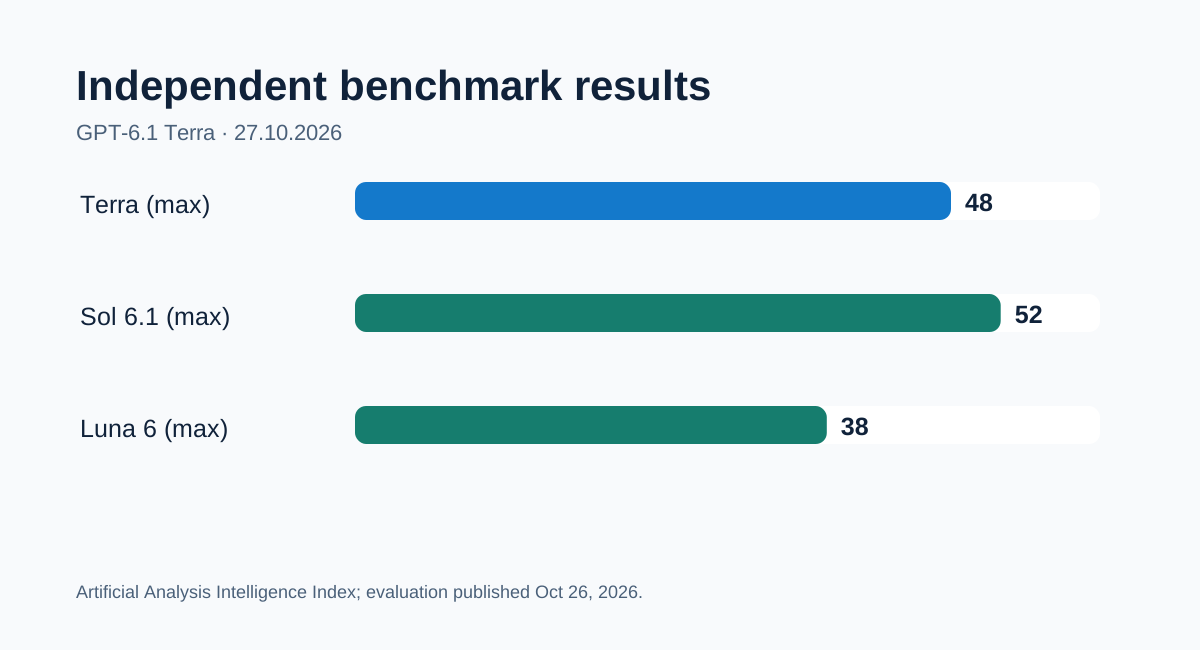
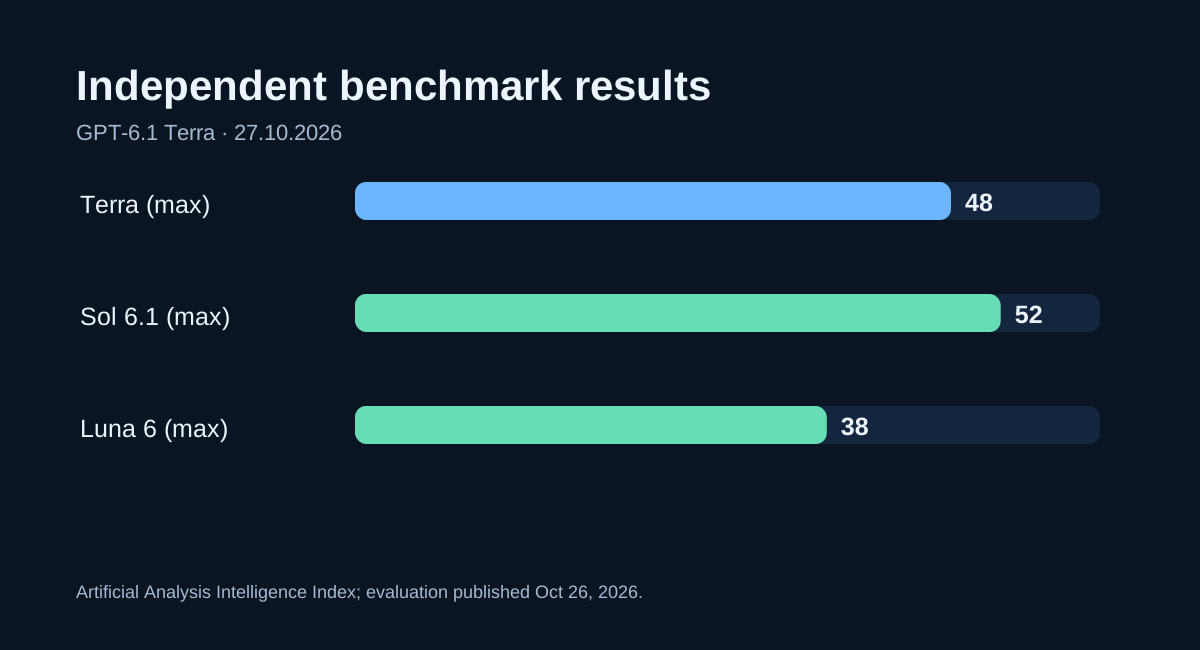
OpenAI reports that Terra at maximum reasoning effort solved 50.3% of its Terminal-Bench 4.0 tasks, against 21.5% for GPT-5.6 Terra. That is a vendor-published comparison, not a claim of an in-house test by this site. In its separate published evaluation, Artificial Analysis scored Terra (Max) around 48 on the Intelligence Index, approximately four points behind GPT-6.1 Sol. Terra also scored 48 on the Coding Agent Index v2.0, versus 54 for Sol. The scores summarize different task families; they do not predict exact success on your codebase. OpenAI launch · Artificial Analysis release analysis
OpenAI’s internal factual-error test found a drop in errors from 53.6% with GPT-5.6 Terra to 16.7% with GPT-6.1 Terra at low reasoning effort. Artificial Analysis independently reports an AA-Omniscience guessing rate of roughly 38%, versus 88% for the older model, on a different benchmark. Neither figure should be advertised as a universal real-world hallucination rate, and the two datasets cannot be conflated. OpenAI release · Artificial Analysis
US versus EU processing: avoid the provider trap
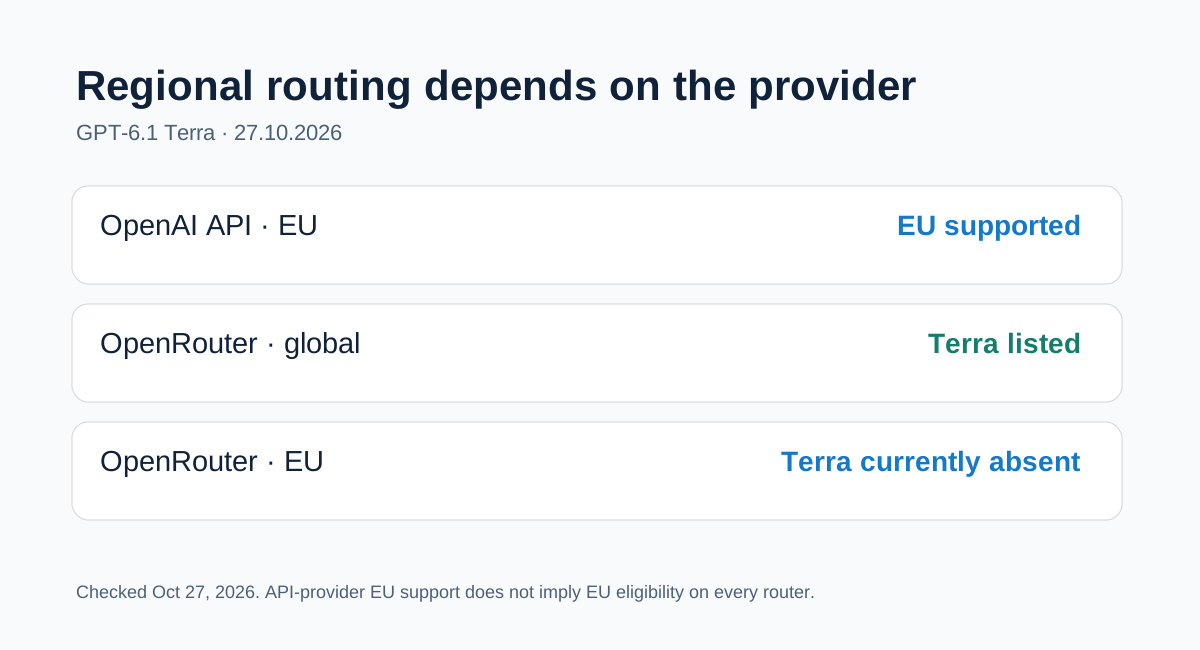
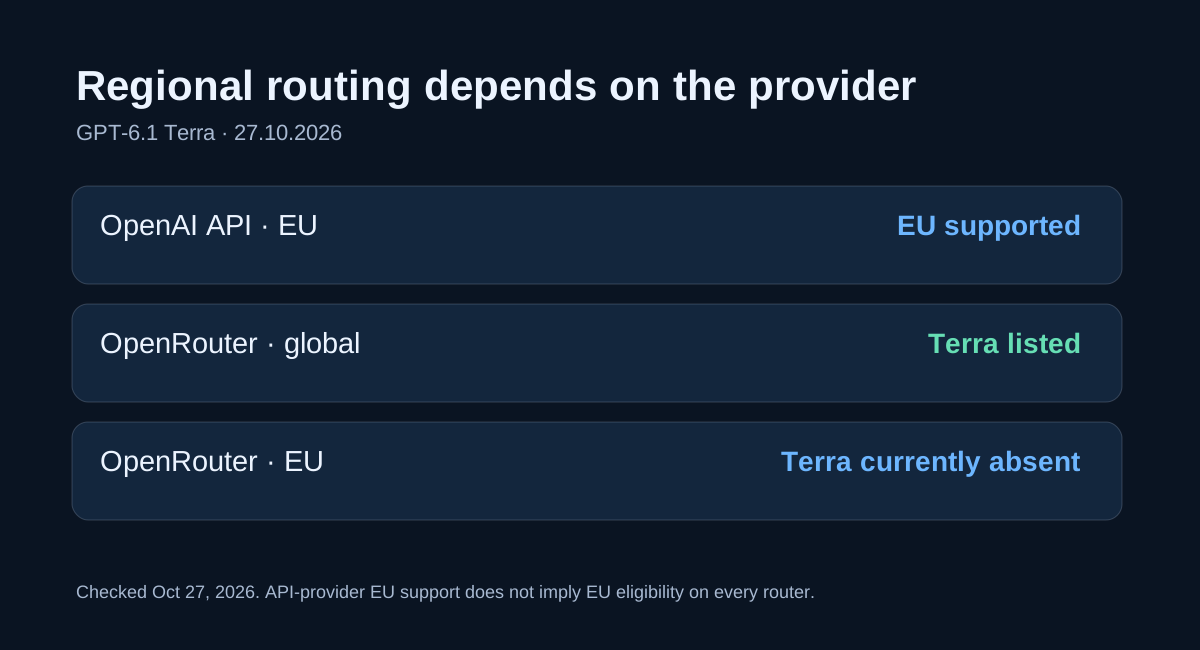
The model’s availability and its processor’s geographical guarantees are separate questions. OpenAI’s direct platform documentation currently lists GPT-6.1 Terra as eligible for EU data residency and processing through supported Standard, Flex and Batch modes. Eligibility depends on the correct organization configuration, endpoint and supported feature. OpenAI data controls
OpenRouter’s listings for the four options currently say they are not available through its EU in-region service. OpenRouter’s EU product page also states that its Batch API uses US-based storage and queue infrastructure, and therefore rejects batch submissions to the EU regional endpoint. In other words, direct OpenAI EU support does not imply Terra availability through OpenRouter’s EU-only route. OpenRouter model page · EU in-region service description
For regulated, confidential or personal records, verify the specific processing route, applicable agreements, subprocessors and retention conditions before transmitting data. A geographic routing claim should not be treated as a comprehensive legal compliance certification.
Which option should you choose?
Start with Terra Standard for interactive assistants, browser automation and everyday coding. Consider Terra Pro for especially difficult, individually important tasks after testing whether the extra token use is offset by fewer failures. Choose Batch when each request is independent and the business can tolerate delayed results. If EU-only processing is mandatory, validate the concrete provider path before deployment rather than trusting the model name.
For hard software-engineering work, run a fixed evaluation against GPT-6.1 Sol as well. OpenAI positions Sol and Astra above Terra for the most challenging coding problems, and independent evaluations show a capability-cost tradeoff rather than one model replacing all others. OpenAI model selection
Related reading: GPT-6 Astra: API prices and running it from a Mac · All English AI-on-Mac articles.
Methodology and disclosure. This review cross-checks the Oct 26 product release, model specifications, all four OpenRouter listings, pricing documentation, system-safety material and third-party benchmarks, with an October 27 review date. It does not claim hands-on model testing. Calculations are editorial examples. Prices, infrastructure support and rollout status may change.
Frequently Asked Questions
What is the difference between Terra, Terra Pro and Batch?
Terra and Terra Pro change the reasoning mode. Batch is an asynchronous processing path with lower token rates but no interactive response time.
Can GPT-6.1 Terra run locally on a Mac?
This article covers the OpenAI and OpenRouter API configurations. Local execution on a typical Mac is not among the provider offerings discussed here.
Is GPT-6.1 Terra available through OpenRouter EU in-region routing?
As checked for this article, OpenRouter did not list the Terra options as available through its EU in-region route. Direct OpenAI processing and OpenRouter routing must be assessed separately.
Transparency
Sources and review basis
These primary and reference sources form the basis of the technical assessment. Vendor claims and external benchmarks are identified as such in the article.
- openai.com index / introducing-gpt-6-1-terra
- developers.openai.com models / gpt-6.1-terra
- developers.openai.com guides / reasoning
- developers.openai.com guides / batch
- developers.openai.com guides / your-data
- openrouter.ai openai / gpt-6.1-terra
- openrouter.ai openai / gpt-6.1-terra-pro
- openrouter.ai announcements / batch-api
- openrouter.ai business / eu
- artificialanalysis.ai articles / gpt-6-1-terra-pushes-the-cost-efficiency-frontier